
October 2026 Investment Outlook

Investment Themes
Macro drivers and major asset classes at a glance.

Macroeconomic Drivers
Strong economic growth should fuel healthy risk appetite going into 2027.

Corporate Credit
Corporate fundamentals and risk premiums point to healthy credit markets.

Government Debt & Policy
A renewed rate-hiking cycle should unmoor sticky inflation.

Currencies
Higher emerging market debt yields reflect durable global growth and potential opportunity.

Global Equities
US growth equities appear attractively valued, with the AI investment cycle potentially providing a tailwind through 2027.

Potential Risks
Impatient central banks, oil-related disruptions or an AI regulatory crackdown could undermine our outlook.
G4 central banks are back in interest rate hiking mode, but we do not believe tighter monetary policy will derail upward economic momentum across the largest economies.1
Our high-conviction view is that the expansion phase of the credit cycle remains intact. The variables that have helped propel the intrepid global economy through five shocks during the past five years remain constructive.
Continued strength in the face of challenge has to be respected. Supply chain disruptions, surging inflation, energy and food shortages across Europe after Russia’s invasion of Ukraine, US protectionism and the most recent oil price shock have not been able to keep the global economy down. At some point, a final straw breaks the camel’s back, but we do not believe that time is near.
Macroeconomic Drivers
Can economic growth continue to support risk appetite going into 2027?
We foresee investor risk appetite remaining healthy. The economic growth engine is on track and AI capital expenditures (capex) are booming.
- With regard to the US consumer and savings rates, our projections suggest real consumption growth should register around 2.5% in 2027, which is quite strong.
- Labor markets are in a good place throughout most of the world, which is boosting global consumption.
- Sticky inflation remains a lingering concern, but we believe central banks will continue to address that risk by raising policy rates.
- We do not believe the deteriorating fiscal position of the US is the sole reason for rising Treasury yields.
- Longer-term interest rates have been rising globally, not just in the US. The cause is likely sticky inflation and strong underlying growth dynamics.
- Much of the upward shift in global rates is likely behind us. We should see a decent rally across fixed income markets if inflation does drift down toward central bank targets.
- In the meantime, corporate profitability has been outstanding across developed and emerging markets. Those trends are likely to continue in 2027, although realized growth rates should ease a bit.
The AI capex boom is in full swing and boosting economic activity.
We see upside risk to the already eye-popping AI hyperscalers’ capex estimates.
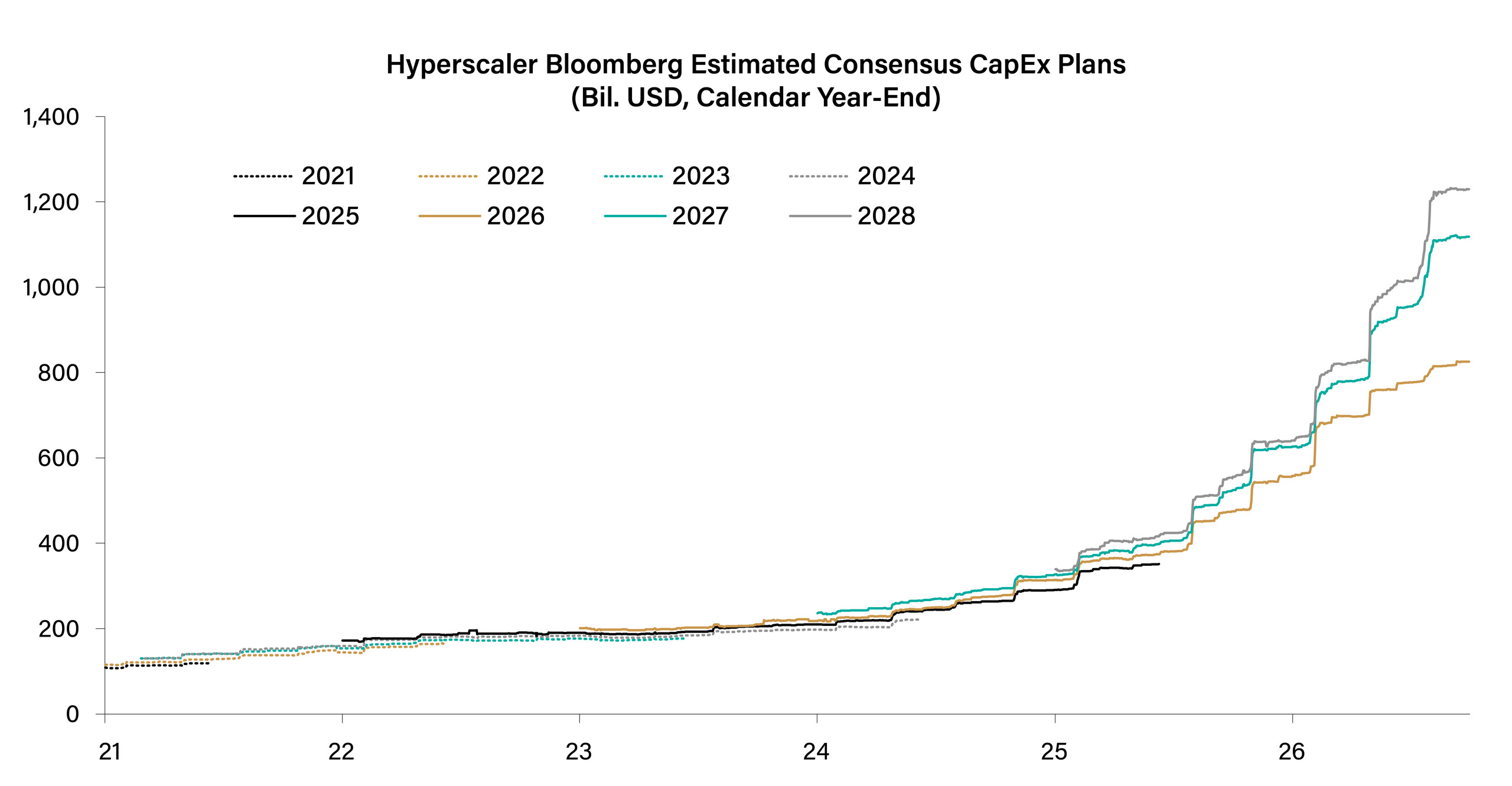
*Bloomberg FA Function Estimates through time.
**Last datapoint for historical years is the actual reported CapEx figure, not an estimate.
***Stocks included: NVDA, AAPL, GOOGL, ORCL, MSFT, AMZN, META.
Source: Bloomberg, as of September 15, 2026.
Corporate Credit
What’s driving corporate health and credit risk premiums?
Improving bottom-up fundamentals are supporting corporate health and healthy risk premiums.
- Credit spreads across investment grade and high yield indices are tight. However, rather than measure the outright level in isolation or relative to its own history, we prefer to focus on the “why” with respect to spreads—such as healthy balance sheets and robust corporate profit growth.
- Bottom-up fundamentals within the corporate space continue to improve, which is providing valuation support.
- Operating profit margins are near record highs, and the potential of AI productivity gains remains.
- The financial sector, a heavyweight within credit indices, remains in excellent shape.
- Hyperscaler and other AI-related debt issuance has been sizable and we think it is likely to increase in 2027. Credit markets have easily absorbed new deals, and we believe investors will continue seeking exposure to the AI theme.
- Perhaps most compelling in our view are the income opportunities in the credit markets. Rising government bond yields also lifted those of credit markets.
- High yield credit markets in the US and Europe offered yields near 8.0% and 7.0% respectively as of September 20, 2026. The potential yield returns are close to the long-run average return of large-cap equities.
Our loss estimates due to default in high yield, or credit rating downgrades within investment grade, are well below expansion late-cycle averages.
Bottom-up fundamentals are strong. Extending the quality spectrum to include high yield credit seems a move for potentially increasing total returns.
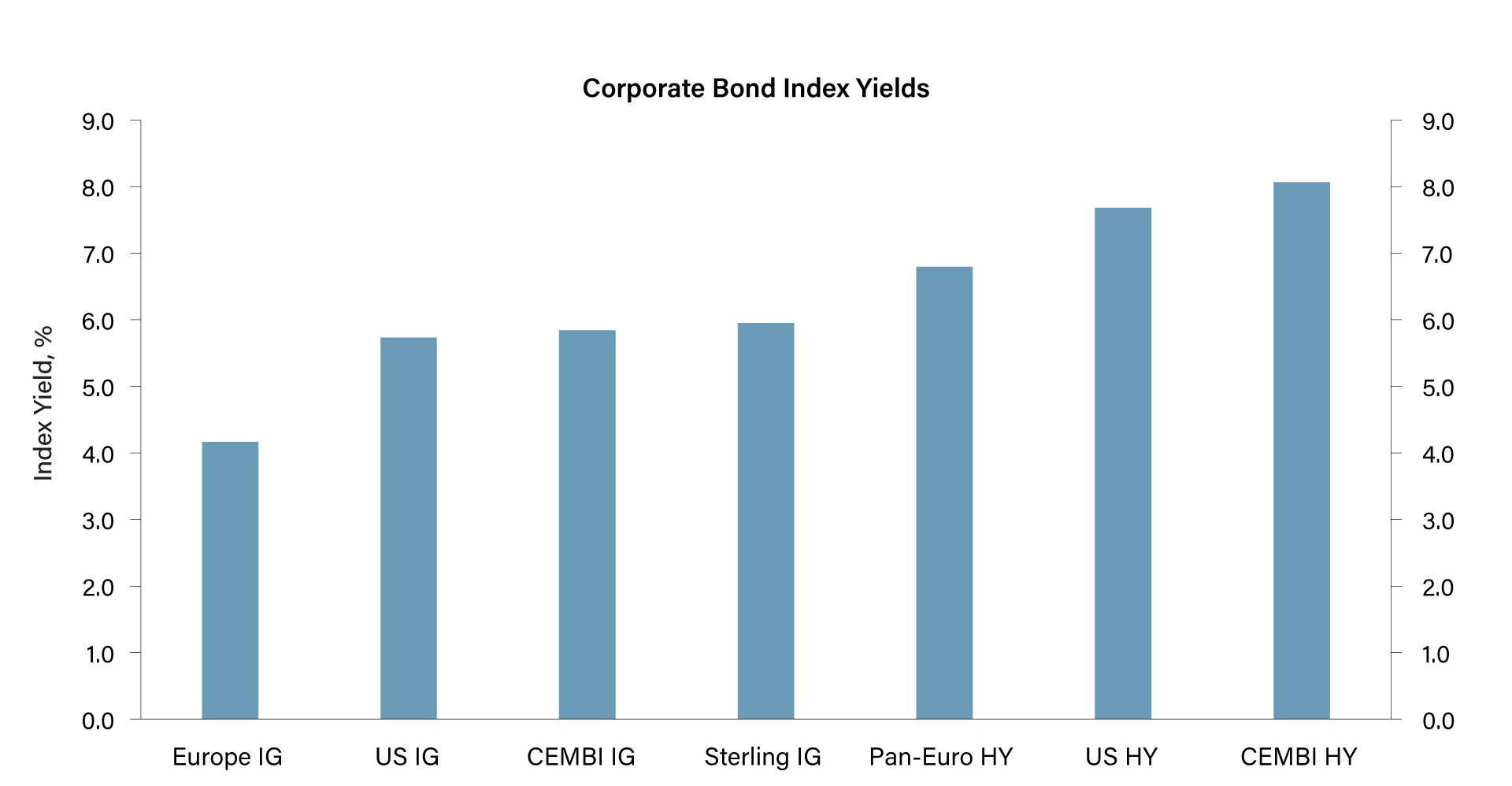
Source: Bloomberg as of September 21, 2026.
The chart presented above is shown for illustrative purposes only.
Government Debt & Policy
How will inflation evolve from here?
Core inflation is likely to stay above the central bank target of 2.0% for a while longer. We think the renewed hiking cycle will gradually bring inflation to the target.
- Government debt burdens are large but still manageable, at least in the near term. Over the next six to 12 months, we believe cyclical factors, like inflation and economic activity, will dictate bond yield ranges.
- The economic tailwinds of AI capex spending and strong consumption trends are likely to continue. Those powerful forces should prevent yields from declining meaningfully in the near term.
- We do not expect a significant bond rally to develop. Instead, we foresee a slow drift lower in yields across the world as inflation cools.
- It is important to keep this higher-interest-rate environment in context. Yields have climbed high enough that we do not see prospects for a significant jump from here. Investors have the opportunity to harvest yield and reinvest coupons at decent rates.
- Yields are higher because growth is in a good place and recession fears have subsided. This is an attractive environment for the highest-rated credits like Treasurys as well as lower-rated levered loans and high yield.
- A slow drift lower in yields could provide price appreciation, while investors clip higher coupons than we have seen in several years.
We still believe high-quality government bonds will perform as a hedge in the next downturn. However, in our
view, such an event is far out on the horizon.
High-grade government bonds should remain within a pretty tight range for the next two quarters.
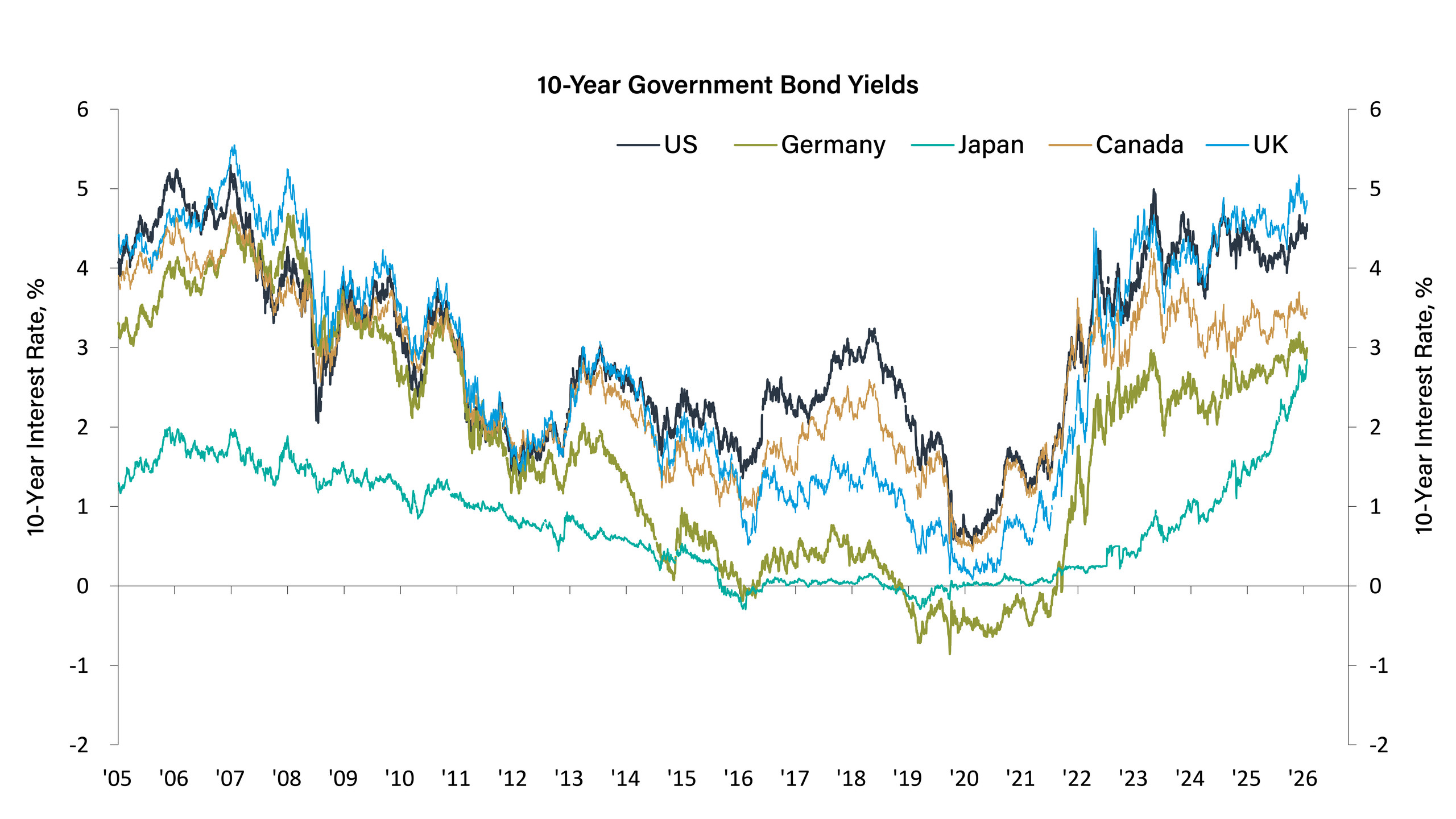
Source: Bloomberg as of September 22, 2026.
The chart presented above is shown for illustrative purposes only.
Past performance is no guarantee of future results.
Currencies
Where are the opportunities in local-currency debt?
Solid global growth has driven up yields of emerging market government bonds, presenting opportunities in markets where yields are relatively higher than those of developed markets.
- The US dollar has been trading in a tight range for almost two years and we suspect that could continue.
- With central banks raising policy rates within similar time frames, short-term interest rate differentials are not offering much of a trading opportunity near term.
- Within the non-US-dollar arena, we have identified selected opportunities where local unhedged bonds have represented excellent value.
- Countries that we think offer attractive local-currency fixed income exposure include Brazil, Colombia and Mexico. We believe investors can realize total return by owning the currency relative to the US dollar and from price appreciation as 10-year yields in those countries slide lower.
- Hungary, South Africa, New Zealand and Australia look attractive through that same lens of currency and bond price appreciation.
- We advocate a selective approach to non-US-dollar assets. We do not believe the US dollar is headed significantly lower from here.
- When the Federal Reserve pivots back to cutting rates we may see the US dollar slide meaningfully. However, that change in stance is likely a late-2027 event.
The Loomis Sayles Broad FX Index tracks an equally weighted basket of 23 currencies. No single currency dominates performance.
The broad FX index may continue to trade range-bound, but we still prefer high-yielding bonds where currencies may appreciate.
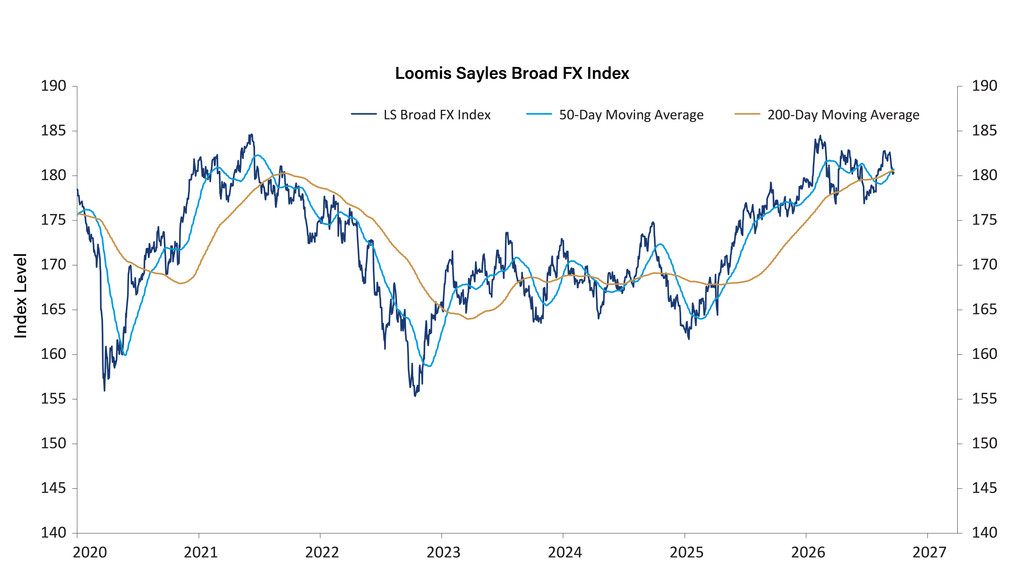
Source: Loomis Sayles, Bloomberg, as of September 21, 2026.
Global Equities
Can global equities continue their run?
Strong bottom-up fundamentals should propel the global equity rally through year-end and into 2027. Most indices are on pace to deliver double-digit earnings growth this year.
- The bull market has been global in nature, with many markets having delivered double-digit year-to-date returns.
- Interestingly, earnings growth is outpacing index performance. Technically, equity market valuations have compressed even as index levels moved higher.
- Looking ahead, we anticipate slowing earnings growth, albeit from truly exceptional levels delivered in 2026. Growth rates may peak, but earnings have not.
- As a result, we prefer exposure to US and non-US equities. We find large caps in the best position to outperform, because small caps are often more sensitive to rate-hiking cycles.
- US growth equity valuations are near the most compelling levels we have seen in years. We think the growth factor is ripe to rally in 2027 as the AI capex theme is in early innings.
- Strong earnings growth, record profit margins and reasonable valuations should propel most global indices higher.
Earnings growth is broadening across sectors with assistance from AI capex.
Consensus earnings growth estimates could plateau, but even if they do, we are still likely to realize robust earnings.
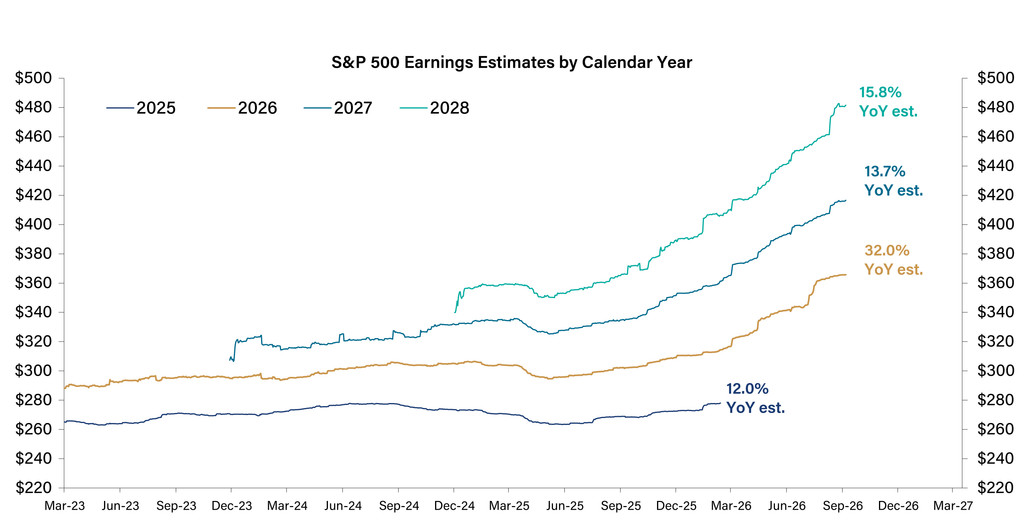
Source: Bloomberg bottom-up consensus estimates, as of September 15, 2026.
Potential Risks
What are the risks that could undermine our outlook?
Long-term investors should be heartened by our current investment outlook. The economic backdrop shows solid fundamentals and very strong corporate health.
- However, there are risks, which we monitor closely. Global central banks are back in tightening mode. While we foresee modestly higher policy rates in 2027, we do not expect a full hiking cycle.
- If central banks become very impatient and take an even harder line against inflation, risk appetite could suffer. Volatility across yield curves would likely upset fixed income and equity markets.
- Disruptions to oil-related traffic through the Strait of Hormuz could spark another oil shock and disrupt markets.
- AI-related investment is massive and having positive knock-on effects across the economy. Government regulation or a slowdown by the hyperscalers would slow economic and earnings growth.
- Domestic and non-US earnings growth expectations for 2027 imply growth rates greater than 13%. That is no longer a low bar to clear. Missing expectations on the earnings front would be disruptive to positive market trends.
- Lastly, we have little evidence to suggest an economic growth scare is probable near term. However, we are always on alert for systemically important events that could alter our outlook.
Asset Class Outlook
What’s our view on major asset classes?
Credit and equity valuations are not inexpensive. However, we believe a robust bottom-up fundamental backdrop can still drive positive returns.
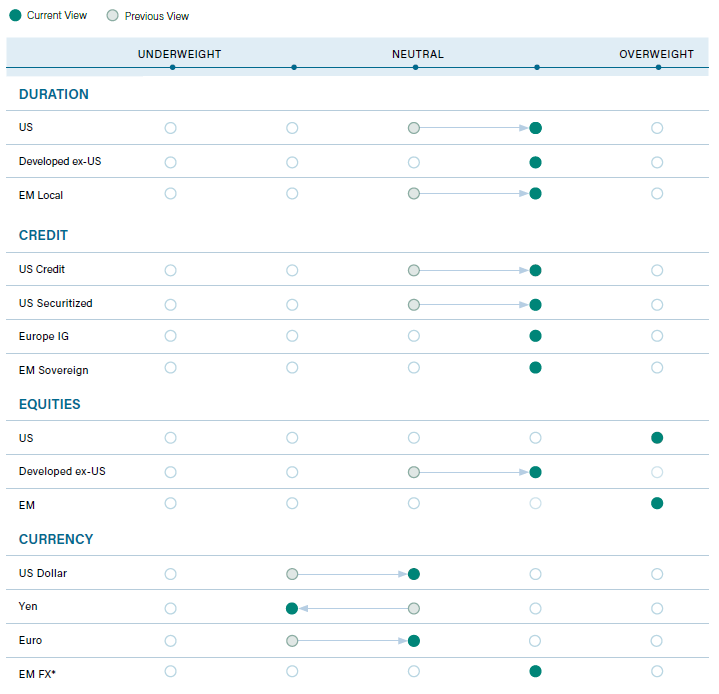
*EM FX = Emerging Markets Foreign Exchange
Loomis Sayles Global Asset Allocation Team
Endnote
1 G4 central banks: US Federal Reserve, the European Central Bank, the Bank of England and the Bank of Japan.
Important Disclosure
This marketing communication is provided for informational purposes only and should not be construed as investment advice. Investment decisions should consider the individual circumstances of the particular investor. Any opinions or forecasts contained herein reflect the subjective judgments and assumptions of the authors only, and do not necessarily reflect the views of Loomis, Sayles & Company, L.P. Investment recommendations may be inconsistent with these opinions. There is no assurance that developments will transpire as forecasted and actual results will be different. Information, including that obtained from outside sources, is believed to be correct, but we cannot guarantee its accuracy. This information is subject to change at any time without notice.
Nothing contained herein constitutes investment, legal, tax or other advice nor is it to be relied on in making an investment or other decision.
Commodity, interest and derivative trading involves substantial risk of loss.
Diversification does not ensure a profit or guarantee against a loss.
Market conditions are extremely fluid and change frequently.
Any investment that has the possibility for profits also has the possibility of losses, including loss of principal.
There is no guarantee that any investment objective will be realized, or that the strategy will be able to generate positive or excess return.
9143006.1.1
Author
