
Authors


What’s Next for the Credit Cycle?

Key Takeaways
- We believe the US expansion remains intact, supported by strong corporate earnings, fiscal support, AI-related investment and durable manufacturing.
- Credit fundamentals appear rock solid. Corporate earnings and margins have been very elevated, and our internal indicators point towards low credit defaults/losses. Even if we see some slight deterioration moving forward, we would be starting from a point of strength.
- Inflation is the variable to watch. Disinflation has stalled, slowing the path to easier monetary policy.
- Looking out over the next six months, we anticipate a resilient expansion with steady growth, a Federal Reserve on hold, and positive risk appetite.
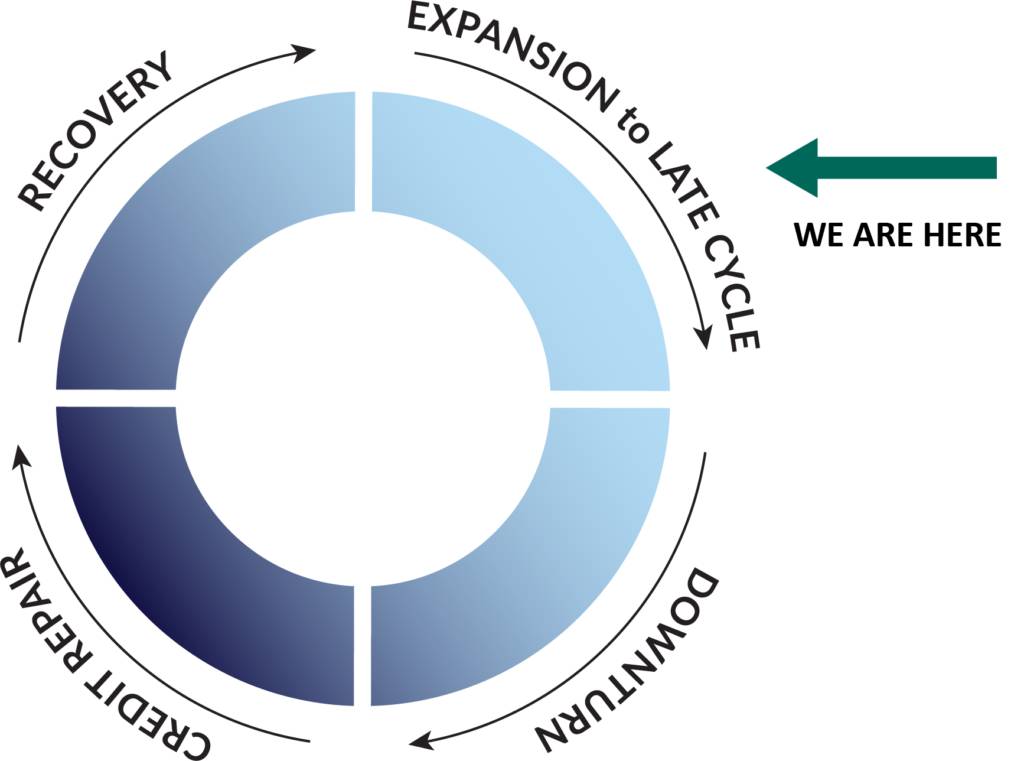
Graphic Source: Loomis Sayles. Views as of June 25, 2026. The graphic presented is shown for illustrative purposes only. Some or all of the information on this chart may be dated, and, therefore, should not be the basis to purchase or sell any securities.
Expansion on Solid Footing
Despite the energy shock and geopolitics, the US economy appears to be far from a downturn. We have a solid growth outlook for 2026, supported by booming profits, wealth effects, fiscal policy and the capital expenditure wave. The artificial intelligence (AI) buildout is far-reaching, lifting many sectors of the economy. Manufacturing activity has been robust, order books are full and inventory is low.i Corporate health looks strong, with impressive earnings and healthy margins.ii The Loomis Sayles Credit Health Index (CHIN) and Credit Analyst Diffusion Indices (CANDIs) continue to signal robust credit fundamentals, though sentiment appears to be more cautious.iii After some softening in 2025, we’re seeing better labor market data, including payroll gains, job openings and low unemployment claims.iv
Inflation is the sticking point. The disinflation we looked for at the start of the year has not materialized, and it’s not only because of higher energy prices. The core Personal Consumption Expenditures (PCE) Index, a measure of inflation that excludes food and energy prices, was 3.3% year over year in April, well above the Federal Reserve’s 2% target.v We think inflation can trend lower once the energy shock subsides, but the journey toward the Fed’s target will likely be long and slow. We expect the Fed to stay on a prolonged hold as the new Fed Chair, Kevin Warsh, steps into his role. We’ll be watching the Fed’s reaction function to inflationary and economic pressures under his leadership.
While we always account for the risk that something breaks (e.g., an unexpected decline in the labor market), we think the odds of such an event are low. In our view, the expansion is on solid footing and the supportive risk backdrop should persist.
A Closer Look
We believe that credit cycle analysis requires art and science. We track key economic indicators that tend to behave differently in each phase of the cycle and put them into context using our credit cycle framework and collective experience. Currently, these indicators primarily fall within expansion/late cycle. We believe the credit cycle remains in this phase of the cycle based largely on the strength of bottom-up fundamentals. At this stage of the cycle, investors tend to focus on capital preservation and moving up in quality.
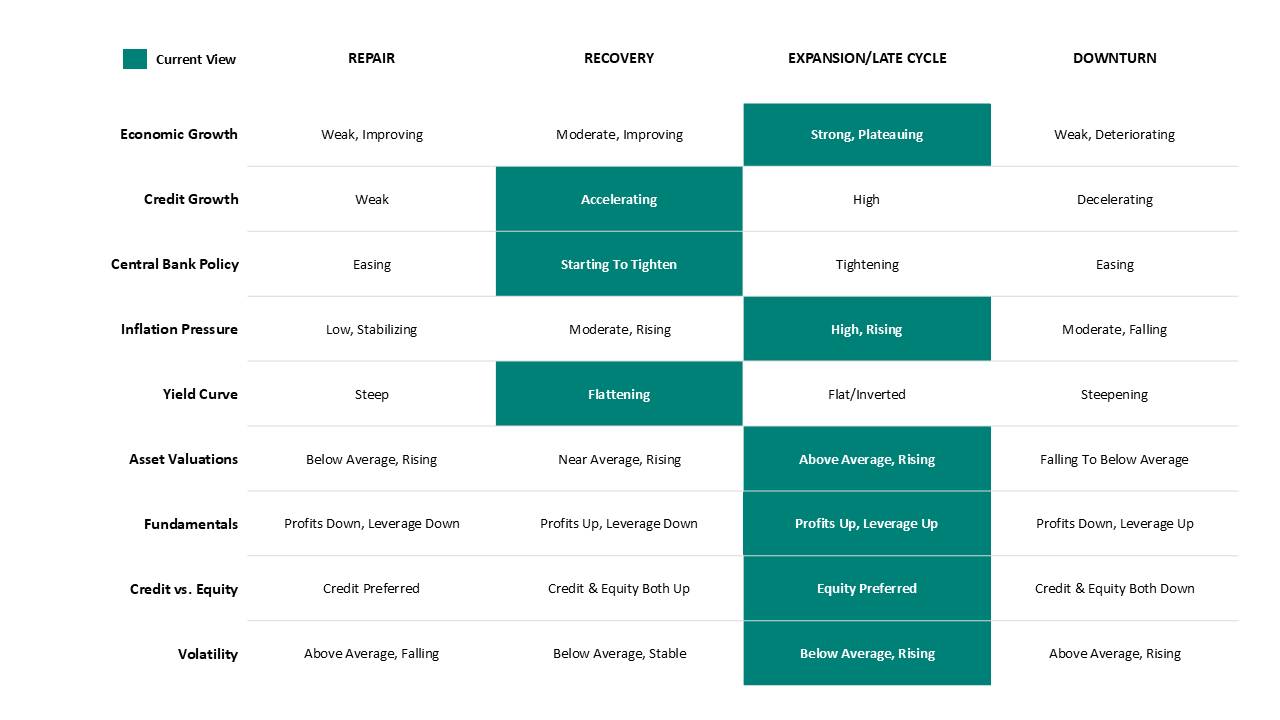
Table Source: Loomis Sayles. Views as of June 25, 2026. Cells highlighted green represent attributes we’re currently observing. The table presented is shown for illustrative purposes only. Some or all of the information on this chart may be dated, and therefore, should not be the basis to purchase or sell any securities.
What’s Next?
Because macroeconomic factors don’t always behave as expected, we prepare scenarios for the path of the US credit cycle over the next six months. Here are three potential scenarios and indicators to watch:
Base Case
Expansion/Resilient
- In this scenario, strong corporate health, resilient consumer spending and fiscal policy support solid growth despite higher energy prices.
- We expect a stable to slightly softer labor market, but strong corporate profits help limit large-scale layoffs.
- Disinflation is interrupted by higher energy prices, but eventually and gradually resumes. Incremental productivity gains may also help the inflation story at some point, but it’s too early to see a major disinflationary push.
- The Fed remains on hold due to higher inflation, but may move back to an easier stance if we get signs of cooling inflation in 2027.
- Risk appetite stays positive.
Alternative Scenario
Late Cycle/Economic Boom
- This scenario recognizes further upside for the US economy, fueled by a boom in capital expenditures and strong aggregate consumer spending (propped up by positive wealth effects and a healthy labor market).
- Inflation fears are persistent due to strong economic activity, profits, low unemployment and low labor supply.
- The Fed hikes rates to help prevent further inflation issues.
- Risk assets perform well due to the strong macroeconomic backdrop, though rising yields could spark market volatility.
Alternative Scenario
Downturn
- This scenario accounts for downside risks (e.g., a sharp and persistent rise in energy prices that causes demand destruction, or a pop in AI-related optimism).
- A sustained correction in the equity market diminishes the wealth effect, hitting the higher-income consumers that have been supporting aggregate spending. Consumption rolls over.
- Companies start to shed labor to protect margins, causing a non-linear move in a fragile labor market.
- The Fed cuts interest rates, yields rally and risk assets sell off.
Macro Themes in a Flash
Our views on key topics that can influence the credit cycle.

Middle East War/Oil
Our view: We entered the conflict with a broadly supportive economic backdrop. We would need to see persistently high oil prices to increase our odds of a downturn materially.
The details: We believe that even with a durable deal between the US and Iran, oil prices are likely to range between $75-$90 per barrel because of low oil inventories, a slow restart to production and rapid rebuilding of inventories across the world. In our view, odds of a true spike in oil prices toward $150 look lower for now.

The US Consumer
Our view: The consumer still appears fairly resilient in aggregate.
The details: Consumers, in aggregate, have been spending at healthy levels, supported by structural shifts such as elevated net worth and low debt as a percent of income.vi Elevated tax refunds this year should help support near-term consumption. We’ll be watching the wealth effect closely—it has been a large factor propping up spending over the past few years.

Global Growth
Our view: Global economies are typically more exposed to large energy shocks compared to the US. We would expect the global economy to slow marginally given the rise in energy costs, but we are not expecting a recessionary environment.
The details: We believe a widespread recession is a tail risk for now. Stronger manufacturing PMIvii data suggests some positive cyclical momentum for the global economy. China is exiting deflation and has been well-positioned to deal with higher energy prices. Europe appears to be in the early stages of a recovery. External risks remain relevant on a global scale, especially with elevated geopolitical tension, but there is more resilience globally compared to the energy shock that followed the beginning of the Russia/Ukraine war.viii

US Monetary Policy
Our view: We think the Fed is likely to hold rates steady for a prolonged period.
The details: With the disinflation trend interrupted, we expect the Fed to be on hold for the rest of 2026. We’ll be watching the Fed’s reaction function to inflationary and economic pressures under the leadership of new Fed Chair Kevin Warsh. The Fed will need to gain confidence in the disinflation trajectory before easing further.

US Corporate Profits
Our view: Corporate earnings growth has been very strong, handily beating expectations. We expect equity earnings-per-share (EPS) growth to remain solid through 2026, though consensus forecasts already appear bullish.
The details: Yes, tech has been the leader, but we have seen better breadth so far in 2026. Markets could see positive growth across sectors this year. Even if earnings fall short of lofty consensus expectations, we expect the earnings backdrop to remain supportive.

US Credit Risk Premium/Risk Appetite
Our view: Credit spreads remain tight, but corporate fundamentals have been strong. We expect that investors can continue to collect extra carry with corporate credit.
The details: Credit fundamentals still look robust and strong demand has helped keep spreads contained despite heavy issuance. We would view further corporate credit spread widening as an opportunity.

Inflation
Our view: We think US inflation can trend lower once the energy shock subsides, but the journey toward the Fed’s 2% target will likely be very gradual.
The details: The disinflation we looked for at the start of the year has not materialized. Higher energy is a factor, but we were seeing signs of stickiness even before the conflict broke out. We believe the path back toward the Fed’s target will be slow, and unlikely to pick up steam before 2027.

Artificial Intelligence (AI)
Our view: AI spending can help support the economy. We think it is likely to drive further productivity gains, though the process will be somewhat gradual and uneven. AI is still in its early innings.
The details: We expect AI to add to productivity gains in the global economy, though the magnitude and timing are uncertain. Labor market disruptions have been mostly concentrated and we don’t anticipate significant near-term displacement. Immense amounts of AI capital expenditures have been largely funded by cash flows so far, but we are seeing increased debt issuance. Most hyperscalers are healthy, profitable companies, in our view.ix We see positive spillovers from the buildout dripping through to other areas of the economy.
The US Dollar
Our view: The US dollar may slide a bit lower as war-related volatility subsides, global growth stays healthy and risk appetite remains strong.
The details: The US dollar tends to trade with a firm tone when international developments pose risk to overall financial market stability. De-escalation in the Middle East is likely to support risk appetite and the growth backdrop, acting as a potential tailwind for non-US-dollar opportunities.
China
Our view: China could see real GDPx growth of approximately 4.5%-5.0% in 2026.
The details: We believe China is well positioned to manage the impact of elevated oil prices. Higher inflation in China could serve as a catalyst for broader economic improvement, and we expect non-US demand to support an elevated trade surplus in China. The People’s Bank of China is likely to hold rates steady for the time being.
Endnotes
i Based on the ISM PMI Composite Index and manufacturing data, through May 2026.
ii Bloomberg data, June 2026.
iii Based on May 2026 readings of the Loomis Sayles CHIN and CANDIs.
iv Bureau of Labor Statistics data, through May 2026.
v Bureau of Economic Analysis, April 2026 reading.
vi Bank of America and Federal Reserve Board data, through May 2026.
vii PMI = Purchasing Managers Index.
viii PMI data from S&P Global, as of May 2026. China deflation data from China’s National Bureau of Statistics, as of May 2026.
ix Productivity and labor market data from the Bureau of Labor Statistics, through Q4 2025 and February 2026, respectively. Capital expenditures as indicated by individual company Q4 2025 balance sheets. Bloomberg consensus expectations as of March 24, 2026. AI spending funded via cash flows from the Federal Reserve Board, as of Q4 2025. Debt issuance data from Bloomberg, as of March 24, 2026.
x GDP = Gross Domestic Product.
Disclosure
All insights and views are as of June 25, 2026, unless otherwise noted.
This marketing communication is provided for informational purposes only and should not be construed as investment advice. Any opinions or forecasts contained herein, reflect the subjective judgments and assumptions of the authors only, and do not necessarily reflect the views of Loomis, Sayles & Company, L.P. Investment recommendations may be inconsistent with these opinions. There is no assurance that developments will transpire as forecasted and actual results will be different. Data and analysis does not represent the actual, or expected future performance of any investment product. Information, including that obtained from outside sources, is believed to be correct, but Loomis Sayles cannot guarantee its accuracy. This information is subject to change at any time without notice.
Indices are unmanaged and do not incur fees. It is not possible to invest directly in an index.
Commodity, interest and derivative trading involve substantial risk of loss.
Any investment that has the possibility for profits also has the possibility of losses, including the loss of principal.
Markets are extremely fluid and change frequently.
Past market experience is no guarantee of future results.
8210502.1.5
Meet the Authors
