
Author

Three Questions on GSEs’ $200 Billion Agency MBS Purchase Program
Earlier this month, the Trump administration announced a policy initiative directing government-sponsored enterprises (GSEs) to increase their purchases of agency mortgage-backed securities (MBS). We spoke with the Mortgage and Structured Finance Team about what was announced, how markets have responded and what it could mean for investors and consumers.
1. What exactly was announced, and how did they arrive at the $200 billion figure?
On January 8, 2026, President Trump announced via Truth Social that government-sponsored enterprises, Fannie Mae and Freddie Mac, will purchase $200 billion of Agency MBS. The goal is pretty straightforward, which is to help improve homeowner affordability by lowering mortgage rates.
The $200 billion number itself is tied directly to how the GSEs are currently constrained. Under the Preferred Stock Purchase Agreement between the US Treasury and the Federal Housing Finance Agency (FHFA), which dates back to the conservatorship in 2008, the GSEs’ retained portfolios are capped at $450 billion. As of November 2025, those portfolios were around $247 billion, so that leaves roughly $200 billion of remaining capacity.
Another interesting point is that $200 billion is also roughly the amount of agency MBS runoff we expect from the Federal Reserve’s (Fed’s) balance sheet. So, from a market perspective, GSE buying ends up looking like a replacement for the Fed’s balance sheet runoff of agency MBS.
As for whether the program could grow, it’s possible. The US Treasury and FHFA can raise the $450 billion cap without going to Congress. The GSEs likely have enough liquidity to fund the initial $200 billion through cash, Treasurys and repo, but if buying were to go beyond that, you’d likely see increased agency debenture issuance. That’s something we’ll be watching closely.
Stepping back, net agency MBS supply in 2026, including Fed runoff, is expected to be around $400 billion. So, if policymakers decide they want to push mortgage rates lower, in theory the GSEs could absorb more than the $200 billion that’s been announced.
2. How did markets react, and does this change how you’re thinking about the Agency MBS basis?
The market reaction was immediate. Agency MBS spreads tightened right away, and conventionals clearly outperformed Ginnies. By that, we mean MBS backed by Fannie Mae and Freddie Mac outperformed those backed by Ginnie Mae,i which makes sense since investors expect GSE buying to be focused in conventional pools.
On January 9, the day after the announcement, the Bloomberg US MBS Index option-adjusted spreads, which measure compensation after accounting for prepayment risk, tightened by about seven basis points. Z-spreads, a simpler measure that looks at spread over the yield curve, tightened by six basis points to roughly 37 basis points. Returns over comparable Treasurys were up about 44 basis points, reflecting strong price performance over that short window.
Within the conventional coupon stack, current coupons (4.5% – 5.0%, where trading and liquidity tend to be deepest), led performance. The GSEs are most likely to target purchases of these coupons in order to have the greatest impact on lowering mortgage rates for borrowers. Lower coupons saw more modest gains. Higher coupons lagged, largely because they are more sensitive to prepayment risk when rates move lower.
If you zoom out a bit, this announcement came on top of a trend that has already been in place. Agency MBS spreads have been tightening steadily over the past six months. The move has been primarily driven by lower implied volatility, relatively low mortgage supply compared with post-COVID history, and expectations that GSE support would continue.
Agency MBS spreads look tight versus Treasurys, but we believe they remain more attractive versus swaps.
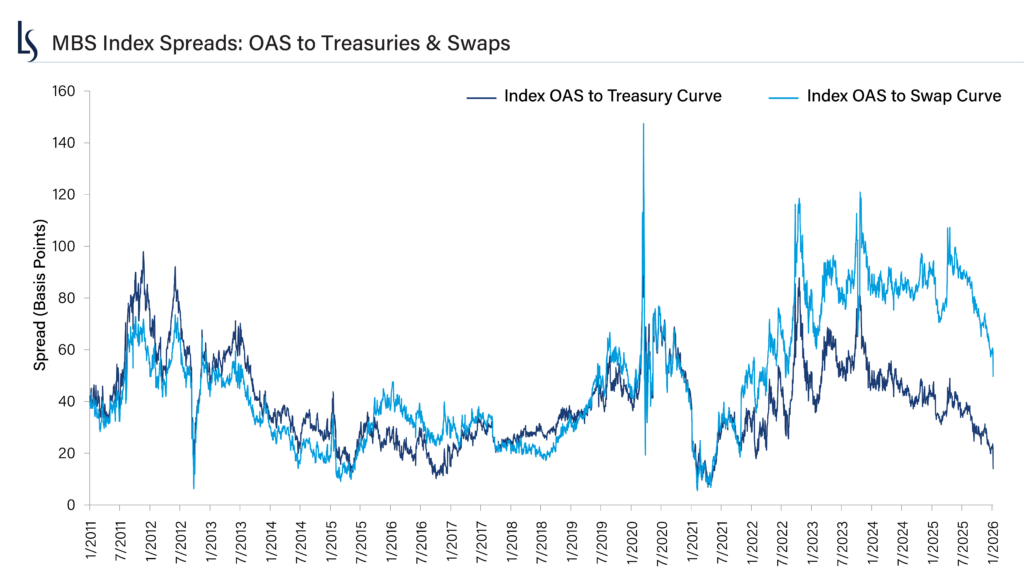
Source: Bloomberg, as of January 9, 2026.
Indices are unmanaged and do not incur fees. It is not possible to invest directly in an index.
The chart above is shown for illustrative purposes only.
Past performance is no guarantee of future results.
At this point, we think the $200 billion announcement is largely priced into agency MBS spreads across the coupon stack. From here, performance is likely to be driven more by where interest rate and macro volatility go.
Liquidity is another piece of the puzzle. Bid-ask costs are still elevated, especially in lower coupons. That’s something we think investors really need to factor in when thinking about making portfolio adjustments. We’re also paying close attention to positioning. Money managers have been running a sizable overweight to agency MBS relative to the Bloomberg US Aggregate Bond Index, and it will be important to see if that changes.
3. Will this program actually trigger a refinance wave and make housing more affordable?
The program is only expected to lower primary mortgage rates by around 25 basis points. That would bring rates into the 5.75% to 6.00% range, assuming Treasury yields don’t move much.
Even at those levels, though, the refinance impact is likely to be fairly limited. Only about 15-20% of the mortgage universe becomes refinanceable. Most borrowers are still several hundred basis points out-of-the-money.
There are also some second-order effects to keep an eye on. One risk is that some originators may not pass through the full benefit of lower rates right away and instead use the opportunity to rebuild margins. If that happens, the primary-secondary spread could widen.
Another risk is on the housing side. Lower mortgage rates without an increase in housing supply could simply boost demand and push home prices higher. If that happens, it ultimately works against the affordability goals the program is trying to achieve.
Endnote
i Fannie Mae (shorthand for the Federal National Mortgage Association) and Freddie Mac (shorthand for the Federal Home Loan Mortgage Corporation) are GSEs that purchase mortgages from lenders to stabilize the US housing market. Ginnie Mae (Government National Mortgage Association) isa wholly owned government corporation within the Department of Housing and Urban Development. which makes sense since investors expect GSE buying to be focused in conventional pools.
8719409.1.1
Market conditions are extremely fluid and change frequently.
This blog post is provided for informational purposes only and should not be construed as investment advice. Any opinions or forecasts contained herein reflect the subjective judgments and assumptions of the authors only and do not necessarily reflect the views of Loomis, Sayles & Company, L.P. Information, including that obtained from outside sources, is believed to be correct, but Loomis Sayles cannot guarantee its accuracy. This material cannot be copied, reproduced or redistributed without authorization. This information is subject to change at any time without notice
Meet the Author
