
The Role of Portfolio Impact (PI) in the Disciplined Alpha Strategy

Key Takeaways
- The Disciplined Alpha process produces portfolios based on bottom-up security selection, with modest sector exposures and minimal yield curve exposures.
- Our risk management process includes a Portfolio Impact (PI) calculation to help explain issue-specific risk and portfolio-level sector risk.
- The PI framework is transparent, a distinguishing feature that enables risk-aware insight throughout the portfolio construction process.
- The Disciplined Alpha PI approach is designed to produce bond portfolios with the potential to realize excess return from bottom-up security selection with low relative risk and high information ratios.
The Loomis Sayles Disciplined Alpha (DA) Team seeks to consistently deliver excess returns relative to the Bloomberg US Aggregate Bond Index (Index) and similar indices.
The strategy’s decision-making structure and investment process helps foster security selection and relative value decisions.
This requires a precise understanding of risk exposures. For this, we use Portfolio Impact (PI), a transparent and relatively straightforward risk measure, to help understand portfolio-level sector risk and issue-specific (idiosyncratic) risk.
Reviewing Risk Factors
The DA team focuses on an investment universe of “core” fixed income securities. These issues have risks comparable to constituents of the Index. The team’s primary objective is to generate positive excess return through bottom-up security selection, while minimizing the (benchmark-relative) risks inherent in this process. To this end, the team uses a risk factor model that incorporates the following elements:
YIELD CURVE
For an investment grade (IG) bond portfolio, yield curve movements are the dominant source of risk. Modeling these risk exposures is relatively straightforward for most securities in the Index—less so for mortgage pools, for which modeling complexity increases due to the prepayment option.
SECTOR
The next leading sources of risk in the IG market are sector factors, usually characterized as spread movements.i The excess returns of bond market sectors represented in the Index are only moderately correlated.ii Therefore, we find it useful to characterize each actively managed sector in a core portfolio by its own excess return and corresponding risk factor. We decompose the exposures of a core portfolio into distinct agency, credit, mortgage-backed securities (MBS), asset-backed securities (ABS) and commercial mortgage-backed securities (CMBS) spread factors. The fundamental drivers of excess returns in these sectors include liquidity, credit quality, prepayment and other cash flow timing uncertainties.
IDIOSYNCRATIC
After accounting for the systematic sources of risk above, each position also contributes its own idiosyncratic risk to the portfolio. For the Index as a whole, the idiosyncratic risk is zero (by definition). For the DA process, by design, idiosyncratic risk contributes the majority of risk relative to the benchmark.
Bond Characteristics Underpinning PI
The three components just described characterize the primary drivers of returns relevant for IG securities. After accounting for yield curve movements, the remaining (excess) return of bonds and other IG securities is broken down as sector return and idiosyncratic return. The excess returns display a persistent pattern:
1. Bond risk is approximately proportional to duration. Longer-maturity, higher-duration bonds are riskier than bonds with shorter durations. Within a sector, security excess returns are highly correlated, with magnitude approximately proportional to their respective durations.
2. Bond risk is approximately proportional to option-adjusted spread (OAS). Bonds with wider spreads are riskier than those with tighter spreads. When a sector’s overall average spread changes, the spreads of bonds in the sector tend to change in rough proportion to their level.
3. These observations apply similarly to both sector and idiosyncratic returns.
Calculating PI
We seek to build on these observations to construct PI, a measure of exposure to sector and idiosyncratic excess returns.
- We compute a bond’s sector exposure β, interpreted as its spread sensitivity to the sector spread, as (approximately) the ratio of its OAS to the sector average OAS.
- A position’s contribution to the sector risk exposure is the product of its portfolio weight (w), its sector exposure β, and its duration (D): wβD. The sum of these contributions for bonds of each sector is that sector’s absolute PI, measuring the portfolio’s excess return sensitivity to that of the corresponding benchmark sector.
- The difference between the portfolio and benchmark sums—the sector-relative PI—measures the portfolio’s over- or underexposure to the sector’s performance.
- For most sectors, we normalize the bond β so that, quantitatively, we can interpret relative PI as the return of the portfolio relative to the benchmark if, all else equal, the benchmark sector spread tightens by 100 basis points (bps).iii For example, a sector-relative PI of 20 means a relative return of 2 bps if the sector OAS tightens by 10 bps.
Frequently Asked Questions about PI
Q: What is the meaning of the overall portfolio PI (the sum of the sector PIs)?
A: There is no special meaning to the sum of sector PIs. Each sector PI indicates whether the portfolio is over- or underexposed to the excess return of that sector. There is no equivalent interpretation of the sum of PIs across active sectors.
Q: What is the meaning of Treasury PI?
A: Treasury PI is not a measure of risk in the Treasury sector. Treasurys have two main functions in the DA process: (1) managing yield curve risk (“risk completion”) and (2) facilitating trading, primarily in the credit markets, where bond trades are typically done as a swap, using a comparable-duration active Treasury.
The portfolio’s relative Treasury PI indicates the duration weight of Treasurys in the portfolio required for the risk completion relative to the benchmark. Typically, the Treasury PI is negative in the DA core strategy, indicating that the portfolio has less duration in Treasurys than the benchmark does.
Q: How do we know the PI model works? It’s an analytical model, so it could be wrong as an empirical matter.
A: There is no guarantee that an analytical risk model like PI will work in practice. While the creation of the PI model was informed by experience and available data, we continue to check on a regular basis that the model is performing as designed.
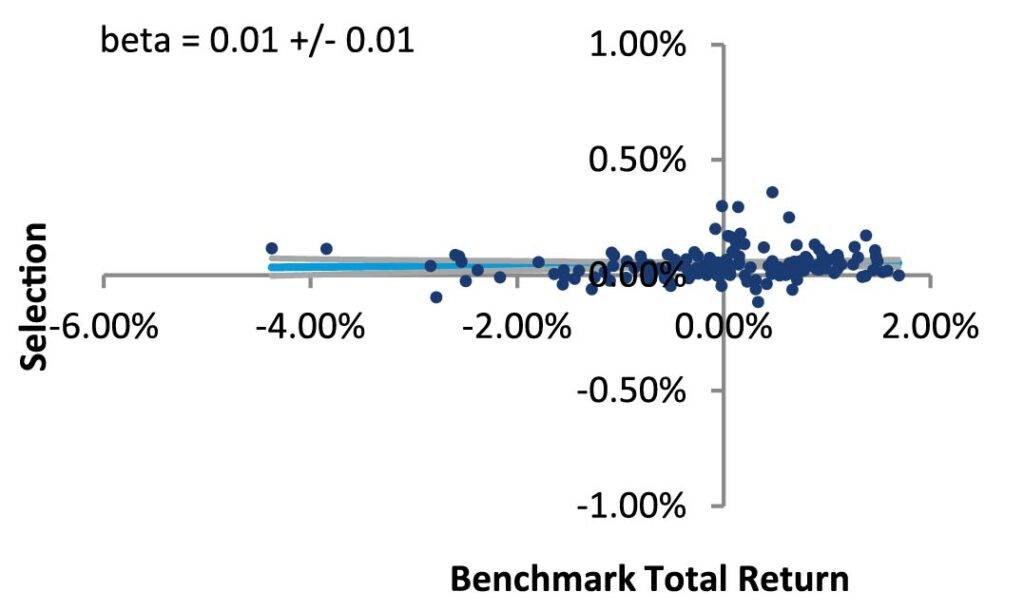
The test is to compare the realized selection returns with benchmark yield curve and excess returns. (The sum of benchmark yield curve and excess returns is the total return.)Since selection returns are what’s left over after subtracting from total returns the components of return explained by yield curve exposure and sector PI, they depend on accurate calculations of those exposures. If the calculations were systematically biased in some fashion, we would likely see significant residual exposure in the selection returns, to yield curve movements or benchmark excess returns (or both).
The two figures on the next page show the empirically measured exposure (realized beta) of monthly core selection returns to benchmark yield curve and excess returns. The scales are chosen to be equal on both axes. The “beta” shown on each figure is the regression coefficient of selection returns on the indicated component of benchmark return. The closeness of these values to zero is a strong indicator that the model calculations of both key rate durations and PI have been accurate enough to minimize unintended exposures in the portfolio.
CORE DISCIPLINED ALPHA COMPOSITE BENCHMARK: BLOOMBERG US AGGREGATE INDEX
Asset-Weighted Returns as of 30 June 2025
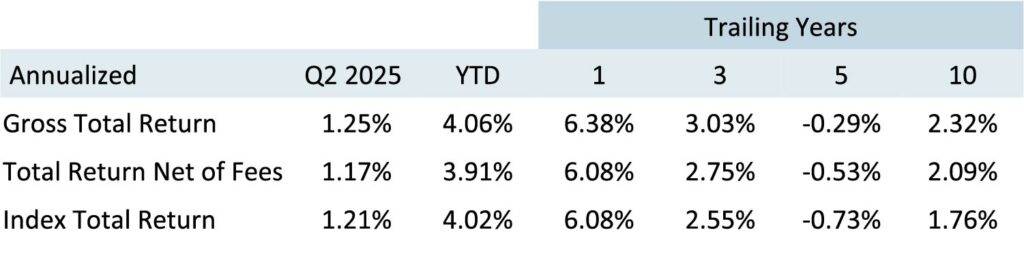
Gross returns are net of trading costs. Net returns are gross returns less effective management fees. Returns for multi-year periods are annualized.
Past Performance is no guarantee of future results.
MONTHLY SELECTION VS. BENCHMARK TOTAL RETURN
Core Disciplined Alpha Representative Account (Gross)
1 November 2010 – 30 June 2025
MONTHLY SELECTION VS. BENCHMARK EXCESS RETURN
Core Disciplined Alpha Representative Account (Gross)
1 November 2010 – 30 June 2025

The blue line shows a linear regression fit between the selection return and benchmark total return (chart left) and benchmark excess return (chart right). The size of the linear dependence (beta) and its statistical uncertainty are given in the figure. Blue dots indicate monthly selection return of the representative account.
Source: Loomis Sayles and Bloomberg. Representative account inception: 1 November 2010. Gross returns are net of trading costs but do not include management fees.
Characteristics are shown for a representative account. Due to system limitations, it may be difficult to analyze this data on a composite basis. This representative account was selected because it closely reflects the Loomis Sayles Core Disciplined Alpha investment strategy. Due to guideline restrictions and other factors, there may be some dispersion between the returns of this account and other accounts managed in the Core Disciplined Alpha investment style. The GIPS Composite Report displays performance, including dispersion, for the Loomis Sayles Core Disciplined Alpha Composite.
Indices are unmanaged and do not incur fees. It is not possible to invest directly in an index.
Please see important disclosures at the end, an integral part of this paper.
Past performance is no guarantee of future results.
Idiosyncratic Risk & Using PI to Determine Position Weights
We manage the DA portfolios to have yield curve exposures very close to those of the benchmark and sector exposures not far from those of the benchmark. At the same time, the portfolios contain significantly fewer holdings than the benchmark.iv As a result, the portfolios have meaningful over- and underweights in individual bonds or issuers. This intentional positioning exposes the portfolios to idiosyncratic risk. The goal of the security selection process is to have positive idiosyncratic returns. The tight control on systematic risk exposure helps to reduce the likelihood that large interest rate and sector spread movements will dominate smaller idiosyncratic returns.
The DA process seeks to maximize the portfolio’s information ratio by sizing positions so that their idiosyncratic risk is proportional to their risk-adjusted expected outperformance.v To make this work, we need a measure of the idiosyncratic risk of individual positions. As just mentioned, a bond’s idiosyncratic risk is approximately proportional to its contribution to systematic risk. That is, higher-beta positions contribute proportionately more to both systematic factor risk and idiosyncratic risk. Therefore, we can use the same PI calculation, allocating larger positive (or negative) PI to securities for which we expect larger out- (or under-) performance per unit of risk.
The resulting portfolio is designed to have a near-optimal information ratio, depending on security selection skill. At times, the DA team may seek to improve performance by raising or lowering the sector-relative PI target. This can occur when the DA team seeks to take advantage of available risk premia for bearing sector risk or when market expectations shift. The team may also alter the sector-relative PI target when seeking advantage from a larger risk budget for security selection. In practice, we tend to keep the risks associated with sector returns only slightly larger than those associated with individual high-conviction trades. The graph below shows cumulative excess return for the Core Disciplined Alpha representative account relative to the Index. It details the contributions from security selection, sector exposure (“Allocation”) and yield curve exposure (“Rates”). This history shows that both risk and return were predominantly due to security selection, with some additional contributions from sector allocation.
SECURITY SELECTION DRIVES ALPHA
Loomis Sayles Core Disciplined Alpha Rep Account
1 November 2010 -30 June 2025
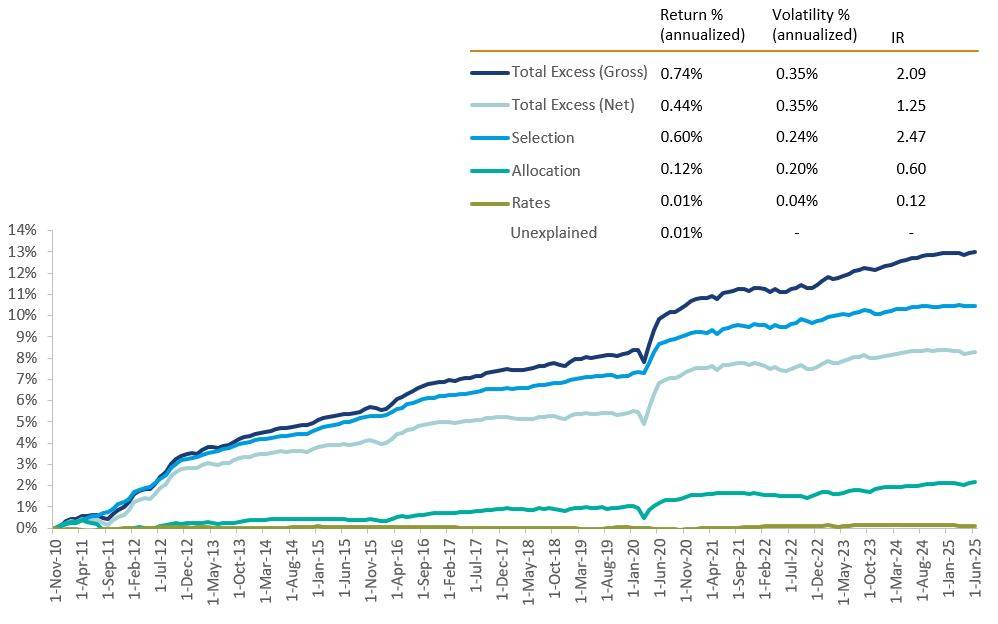
Representative account inception: 1 November 2010. Excess return is relative to the Bloomberg US Aggregate Index. Gross returns are net of trading costs but do not include management fees. Net returns are gross returns less effective management fees. Characteristics are shown for a representative account. Due to system limitations, it may be difficult to analyze this data on a composite basis. This representative account was selected because it closely reflects the Loomis Sayles Core Disciplined Alpha investment strategy. Due to guideline restrictions and other factors, there may be some dispersion between the returns of this account and other accounts managed in the Core Disciplined Alpha investment style. The GIPS Composite Report at the end of this paper displays performance, including dispersion, for the Loomis Sayles Core Disciplined Alpha Composite.
Past performance is no guarantee of future results.
PI Illustrated
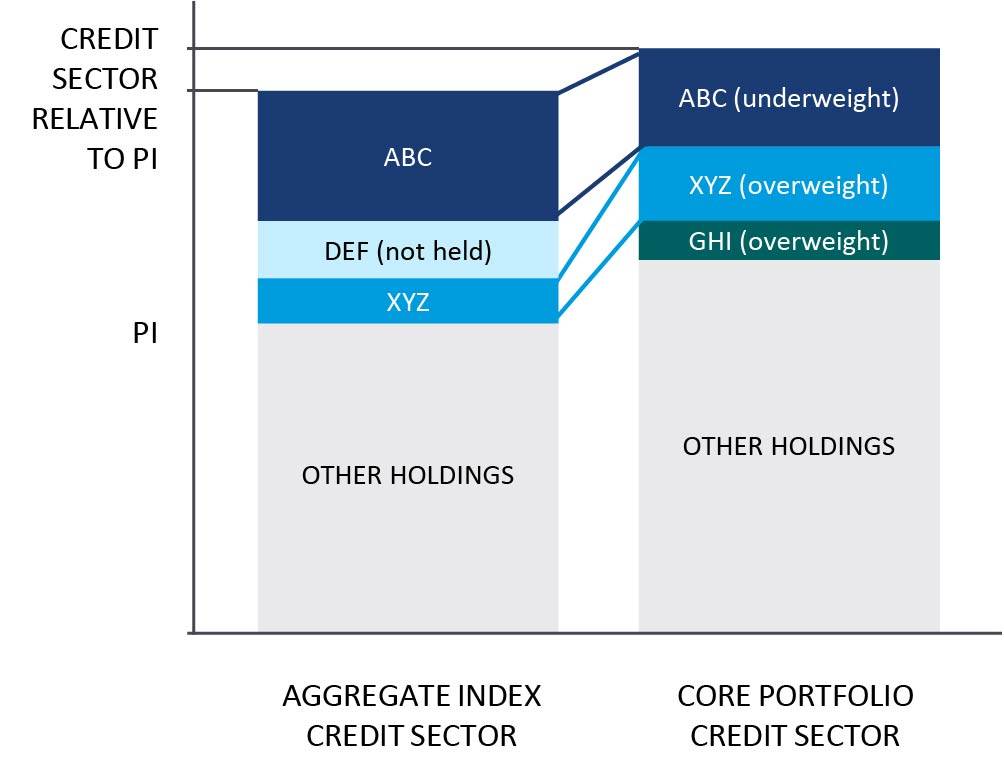
The exhibit below compares the risk structure of a portfolio sector to the same sector in the benchmark.
- For a given spread change, we can interpret sector-relative PIs in terms of expected portfolio gain or loss.
- The individual-position PIs are a relative measure of each position’s idiosyncratic risk.
EXAMPLE OF SECTOR AND ISSUER PI FOR AN ACTIVE SECTOR, SUCH AS US CREDIT
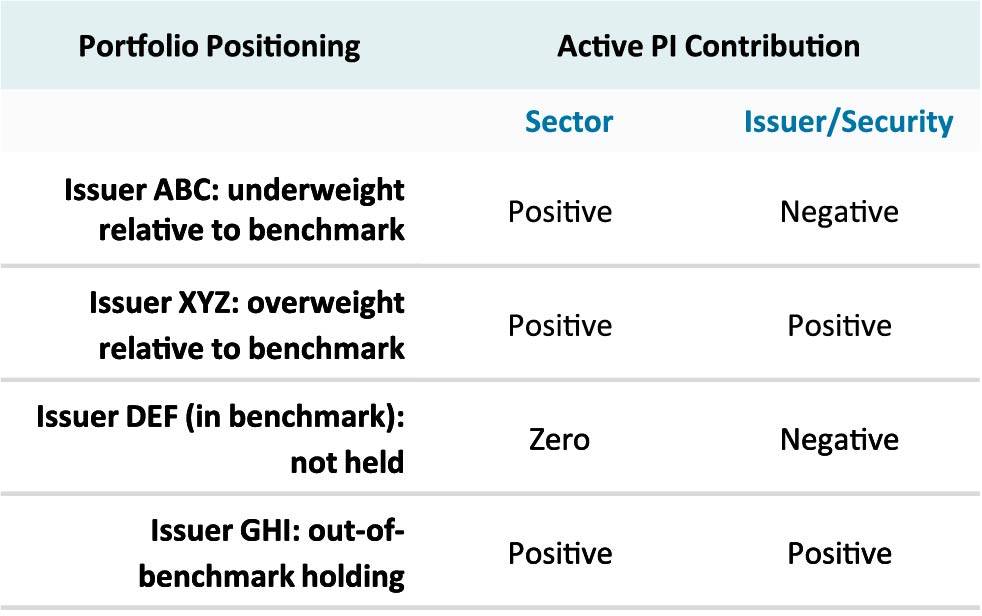
ILLUSTRATION OF SECTOR RISK STRUCTURE RELATIVE TO SAME SECTOR IN BENCHMARK
Source: Loomis Sayles.
The information above are examples for illustrative purposes only. The proposed characteristics and allocations shown do not represent an actual portfolio managed by Loomis Sayles or any specific investment recommendation. There is no assurance Loomis Sayles would be able to construct a portfolio with these characteristics or allocations. Actual portfolios in this strategy will have different characteristics and allocations.
Transparency Distinguishes PI
The PI risk modeling approach is not unique. Factor risk models have been available to bond investors for decades. In fact, various Loomis Sayles investment teams have implemented specialized versions.
However, the PI risk framework is distinctive for its transparency, which enables the use of risk-aware language and insight throughout the portfolio construction process. We fully integrate risk management into portfolio dynamics, rather than treating it as an add-on, after-the-fact activity. When a portfolio manager and trader speak about a transaction, it is in the language of PI, e.g., “add three PI of the 10-year XYZ and one PI of the three-year XYZ bonds and sell the portfolio’s four PI in BCD”. The shared language of PI has helped the DA team deliver alpha with consistently low tracking error.
Endnotes
i To give an idea of the numbers, for the period from 1 November 2010 – 30 June 2025, the average annualized return volatility due to interest rates of the Bloomberg US Aggregate Bond Index was 4.43% (equivalent to a yield volatility of ~74 bps). This is low compared to prior history. For the decade of 1990 – 1999, the annualized yield volatility of the Bloomberg US Treasury index was 101 bps, and was still higher during the preceding decade, which included the Volcker rate shock. Over the same recent period, the annualized volatility of the residual (“excess”, accounting for sector spread and carry) return of the Aggregate was 143 bps, equivalent to a spread volatility of 25 bps.
ii 1 November 2010 to 30 June 2025, the correlations of the monthly excess returns of the credit, MBS, ABS and CMBS sectors ranged from 0.22 (MBS-ABS) to 0.77 (CMBS-credit).
iii The exception is the residential mortgage sector. The details are purely a matter of convention, chosen in this case to be more intuitive to a mortgage specialist.
iv As of 30 June 2025, the Index consisted of 13,841 individual positions, comprised of 1,182 issuers. By comparison, the Core strategy held 659 line items comprised of 209 issuers.
v The information ratio (IR) is the ratio of excess return to tracking error. It measures the effective combination of the manager’s ability to predict outperformance of securities of factors, to implement those insights by trading, and to manage the risk relative to the benchmark entailed by the resulting positions. It has the useful feature that it measures manager skill somewhat independently of the risk constraints imposed by client guidelines, in that the manager can choose to take more or less risk based on the same information and portfolio structuring strategy and show the same IR, even though the resulting portfolios will have different relative returns. The risk allocation approach described here is motivated in part by the Markowitz mean-variance efficiency theory.
Disclosure
Oren Cheyette was one of the original authors of this paper. He retired from his role as quantitative strategist on the Loomis Sayles Disciplined Alpha Fixed Income Team in May 2024.
PI is a proprietary risk-adjusted duration measure. Durations are calculated by the disciplined alpha team using their own internal methodologies and may result in different calculations than are used by other investment teams at Loomis Sayles and by third parties.
This marketing communication is provided for informational purposes only and should not be construed as investment advice. Opinions or forecasts contained herein reflect the subjective judgments and assumptions of the authors only and do not necessarily reflect the views of Loomis, Sayles & Company, L.P. Investment recommendations may be inconsistent with these opinions. There is no assurance that developments will transpire as forecasted and actual results will be different. Data and analysis does not represent the actual or expected future performance of any investment product. Information, including that obtained from outside sources, is believed to be correct, but Loomis Sayles cannot guarantee its accuracy. This information is subject to change at any time without notice.
Diversification does not ensure a profit or guarantee against a loss.
Any investment that has the possibility for profits also has the possibility of losses, including the loss of principal.
There is no guarantee that the investment objective will be realized or that the strategy will generate positive or excess return.
Market conditions are extremely fluid and change frequently.
Past performance is no guarantee of future results.
LS Loomis | Sayles is a trademark of Loomis, Sayles & Company, L.P. registered in the US Patent and Trademark Office.
GIPS Report
As of 31 December 2024
Firm
Loomis, Sayles & Company, L.P. (“Loomis Sayles”) is an independently operated investment advisory firm registered under the Investment Advisers Act of 1940. Registration does not imply a certain level of skill or training.
Loomis Sayles claims compliance with the Global Investment Performance Standards (GIPS®) and has prepared and presented this report in compliance with the GIPS standards. Loomis Sayles has been independently verified for the periods 1 January 1999 through 31 December 2023. The verification reports are available upon request.
A firm that claims compliance with the GIPS standards must establish policies and procedures for complying with all the applicable requirements of the GIPS standards. Verification provides assurance on whether the firm’s policies and procedures related to composite and pooled fund maintenance, as well as the calculation, presentation, and distribution of performance, have been designed in compliance with the GIPS standards and have been implemented on a firm-wide basis. Verification does not provide assurance on the accuracy of any specific performance report.
GIPS® is a registered trademark of CFA Institute. CFA Institute does not endorse or promote this organization, nor does it warrant the accuracy or quality of the content contained herein.
The firm’s list of composite and limited distribution pooled fund descriptions and list of broad distribution pooled funds are available upon request.
Selection Criteria for the Core Disciplined Alpha Composite (“Composite”)
The Composite includes all discretionary accounts with market values of at least $40 million managed by Loomis Sayles that seek to add value for clients primarily through security selection, intending to gain an edge through analysis and market information and minimizing duration, curve, and large sector mismatches with the following additional considerations. The investment universe is primarily investment grade bonds, with a bias for liquidity. Accounts may allow up to 5% in securities below investment grade. Portfolio duration is tightly constrained and normally managed within 10% of the benchmark. Prior to 1 May 2018 the Composite minimum account size requirement was $30 million. The Composite inception date is 1 September 2010. The Composite was created in September 2010.
Loomis Sayles adopted a significant cash flow policy since Composite inception where portfolios are removed from the Composite when net monthly cash flow exceeds 30% of the portfolio’s beginning market value.
Benchmark
The benchmark for the Composite is the Bloomberg US Aggregate Index (“Index”). The Index represents securities that are SEC-registered, taxable, and dollar denominated. The Index covers the US investment grade fixed rate bond market, with index components for government and corporate securities, mortgage pass-through securities, and asset-backed securities. These major sectors are subdivided into more specific indices that are calculated and reported on a regular basis. The investment portfolio underlying the Index is different from the investment portfolios of the accounts included in the Composite. The Index is used for comparative purposes only, is not intended to parallel the risk or investment style of the accounts in the Composite and does not reflect the impact of fees and trading costs. The source of all data regarding the Index is Bloomberg.
Calculation Methodology
Gross of fee account returns are time-weighted rates of return, net of commissions and transaction costs. Net of fee account returns are the gross returns less the effective management fee for the measurement period. Beginning 1 January 2023 the effective fee for an account is derived by applying the highest applicable fee based on the current model fee schedule for the composite to calculate an annual fee amount. Beginning 1 April 2015 through 31 December 2022, the effective fee for an account was derived by using beginning of measurement period assets and model fee schedule for the Composite to calculate an annual fee amount. Prior to 1 April 2015, the effective fee for an account was derived by using beginning of measurement period assets and the model fee schedule for each account to calculate an annual fee amount. The fee amount is divided by the assets for an annual effective fee. The monthly effective fee is based on 1/12 of the annual effective fee.
All performance results are expressed in US dollars. Performance results include the reinvestment of dividends and other earnings on holdings in the Composite and Index. Policies for valuing investments, calculating performance, and preparing GIPS reports are available upon request. Loomis Sayles’s advisory fees are presented below and may also be found in Part 2A of Form ADV.
Annual Rates Applied to Assets Under Management
0.29% on the first $50 million; 0.25% on the next $50 million; 0.20% on the next $100 million; 0.18% on value over $200 million; Minimum account size: $50 million; Minimum annual fee: $145,000. The maximum management fee and total expense ratio for the Core Disciplined Alpha New Hampshire Trust are 0.30%.
GIPS Composite Report
CORE DISCIPLINED ALPHA COMPOSITE
As of 31 December 2024
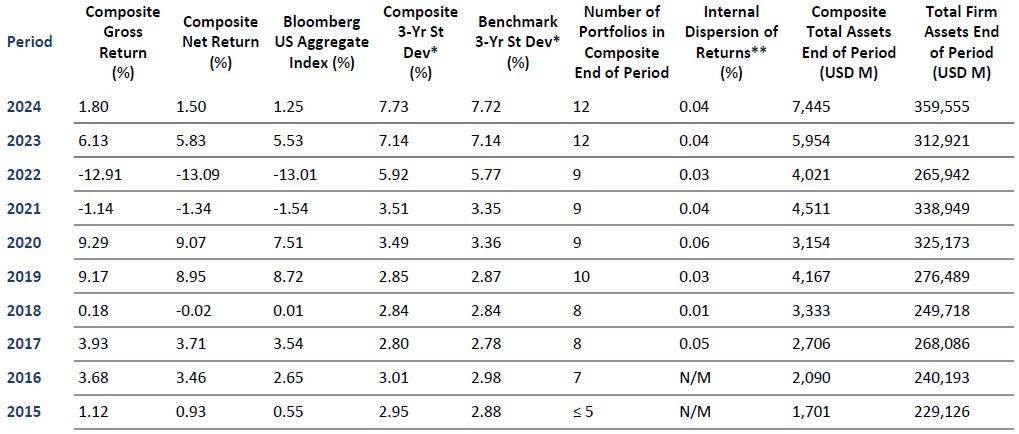
* The three-year annualized standard deviation measures the variability of the gross composite returns and the benchmark returns over the preceding 36 month period.
** The internal dispersion of returns presented reflects the annual equal weighted standard deviation and is calculated as the average dispersion from the mean gross return of all accounts included in the Composite for the entire year.
N/M – Measures of internal dispersion with five or fewer accounts for the entire period are not considered meaningful.
8322763.1.1
Meet the Authors