
The Loomis Sayles Full Discretion Team: Adapting Through the Evolution of Credit

Credit markets never stand still.
Twenty years ago, the SEC opened new pathways for issuers and investors in the high yield market by modifying Rule 144A to increase the liquidity of privately sold securities. Soon after, bank loans and collateralized loan obligations (CLOs) further transformed how credit exposure was sourced and traded. The rise of private credit represents the latest phase of this ongoing evolution.
For the Loomis Sayles Full Discretion (FD) Team, it is not uncharted territory but a natural extension of a longstanding investment philosophy: opportunistic allocation across the full spectrum of credit markets.
Some investors contend that, when investing outside of public markets, private credit-focused managers have an edge over managers with broader platforms, stemming from private specialists’ origination pipelines and first look at new opportunities. This perspective overlooks a critical point. What ultimately matters most to investors is the thoroughness of the underwriting process, and whether they are being adequately compensated for the risks they assume.
In this crucial area, the FD Team’s heritage in public markets provides a distinctive advantage: decades of experience pricing risk and assessing intrinsic value through a consistent, cycle-based framework.
Research depth and integration
We believe alpha generation depends on strong research capabilities. The FD Team draws on more than 85 analysts across Loomis Sayles’ Credit Research, Private Credit and Mortgage & Structured Finance Teams, combining deep sector knowledge with structuring expertise. For each private deal considered, a cross-platform deal team is formed, blending private credit specialists with public market analysts who may have covered the company for decades.
All opportunities are funneled through a centralized trading desk, ensuring consistency in process, pricing and liquidity management. Firmwide resources further strengthen this integration, and one example is the Credit Health Index (CHIN). The CHIN is a proprietary macroeconomic research tool that provides a forward-looking view of US corporate health through a combination of macro, financial market and policy variables, and is a key input into our top-down risk premium framework. The FD Team then synthesizes these inputs to construct portfolios that meet our clients’ risk and return objectives.
A risk premium lens across cycles
The FD approach centers on a simple question: Are investors being paid enough for the risks they are taking?
To answer it, the team relies on a risk premium framework that evaluates current spreads against estimated losses from defaults and downgrades. The difference between those two inputs, what we call the risk premium, represents the true compensation for bearing credit risk.
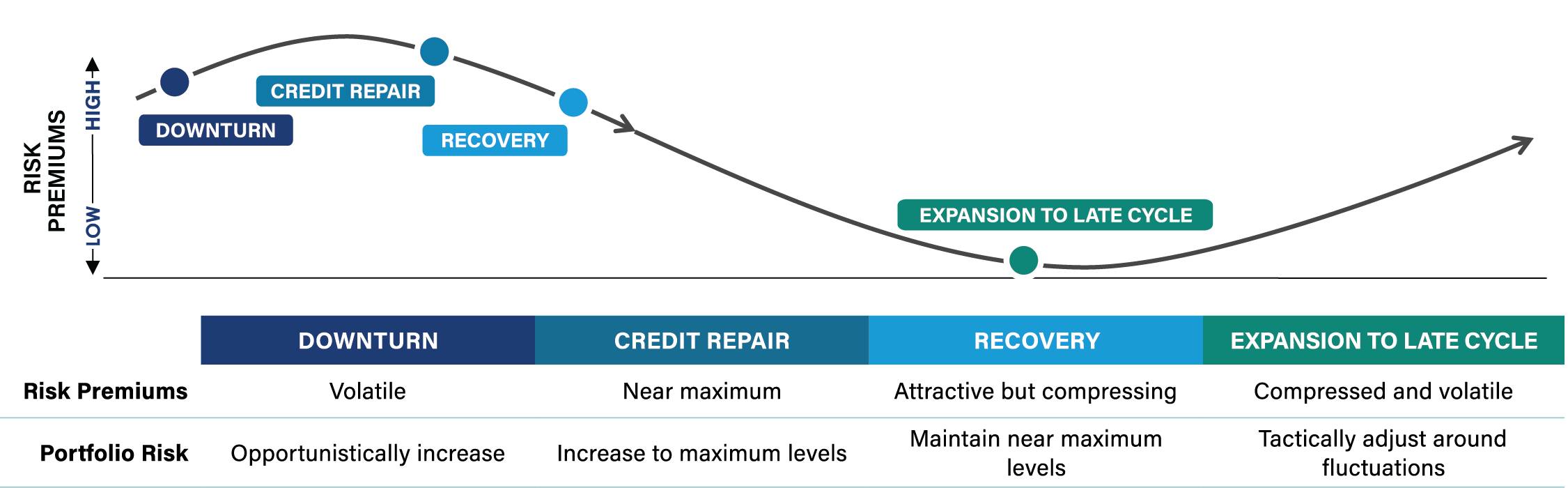
The FD framework is inherently cycle-based. Credit conditions evolve through downturns, credit repair, recovery and expansion to late cycle, each with distinct implications for risk and return. By understanding where markets sit in the credit cycle—and comparing current risk premiums to long-term history—the team adjusts portfolio risk with discipline, mitigating the pitfalls of chasing yield when spreads appear wide and losses loom, or retreating too early during temporary dislocations.
Equally important, the framework is broadly applicable. Whether evaluating investment grade corporates, high yield bonds, leveraged loans, securitized assets or private placements, the same lens applies. This anchors investment decisions in a repeatable process that seeks to balance risk and reward across the full credit spectrum.
ESTIMATED RISK PREMIUMS HELP DRIVE OUR ALLOCATION OF PORTFOLIO RISK THROUGH THE CREDIT CYCLE
An equity-like approach to credit
While the risk premium framework and the credit cycle help us assess how much risk to take, our equity-like approach addresses how we take that risk. Every investment is assessed through the lens of intrinsic value: the long-term worth of the issuer, the sustainability of its cash flows, the protection offered by the equity cushion and the structural safeguards embedded in its capital structure.
This orientation allows the team to pursue the best opportunities for the risk. For example, discounted bonds in stressed situations can offer compelling value if analysis shows that the enterprise is worth more than the market implies. Conversely, securities with attractive yields may be rejected if they fail to offer the appropriate compensation for the level of credit risk inferred by our view of the intrinsic value of the assets.
Patience is a defining feature of this process. The team is prepared to hold investments for years while a thesis plays out. Building on the belief that fundamental research drives the ability to identify and harvest risk premiums, the team then applies six security selection pillars that have proven to be key drivers of performance and effective across cycles:
- Fallen angels — capitalizing on forced selling when bonds exit investment grade indices.
- Cheap for rating — identifying bonds that trade cheap on a spread basis relative to their fundamental risk.
- Upgrade candidates — capturing early signs of improving credit stories before the market prices them in.
- Stressed/distressed — selectively investing in securities trading at or below recovery value.
- Minimize capital losses — seeking to avoid or underweighting exposure to value traps through rigorous research and trading insight.
- New issue premium — sourcing yield from issuance concessions that often dissipate once bonds season.
Holdings are expected to align with at least one of these pillars, ensuring portfolios are opportunistic but rigorously grounded in repeatable sources of potential alpha.
Why mixing public and private works
The debate around public versus private managers typically emphasizes origination. Large private platforms emphasize their ability to originate and distribute deals. However, this can introduce “conflicted capital,” as origination pipelines create pressure to place every transaction into portfolios that are also managed by the originating firm.
The FD Team approaches the private market from a different angle. Managing more than $85 billion1 provides the scale to access significant and complex opportunities, but the absence of an origination mandate preserves the independence to be highly selective, engaging only in transactions that meet our clients’ various return, structural and risk-adjusted requirements.
The team’s public market multisector investing process provides an additional edge. By starting with what public markets offer in terms of risk premium and then layering on the additional compensation required for private securities, the team can assess the relative value offered for taking on for illiquidity, complexity and structural risks.
Carrying the discipline forward
The rise of private credit represents not a revolution, but the next chapter in the long evolution of global credit markets. At each stage, the Loomis Sayles Full Discretion Team has adapted, guided by a cycle-based risk premium framework, an equity-like approach to valuation and deeply integrated research. This discipline has defined the Full Discretion style for decades, across multiple credit cycles, and provides a foundation for navigating both public and private markets with consistency and rigor as the opportunity set continues to expand.
Endnote
1 As of December 31, 2025.
Important Disclosures
This marketing communication is provided for informational purposes only and should not be construed as investment advice. Any opinions or forecasts contained herein, reflect the subjective judgments and assumptions of the authors only, and do not necessarily reflect the views of Loomis, Sayles & Company, L.P. Investment recommendations may be inconsistent with these opinions. There is no assurance that developments will transpire as forecasted and actual results will be different. Data and analysis does not represent the actual, or expected future performance of any investment product. Information, including that obtained from outside sources, is believed to be correct, but Loomis Sayles cannot guarantee its accuracy. This information is subject to change at any time without notice.
Any investment that has the possibility for profits also has the possibility of losses, including the loss of principal.
There is no guarantee that the investment objective will be realized or that the strategy will generate positive or excess return.
8683980.1.2
Meet the Authors