
Authors


The Federal Student Loan Repayment Reckoning: The Consumer ABS Risk Driver Investors May Be Overlooking
After a nearly five-year pause, around 19 million federal student loan borrowers are now on the hook to make payments on $600 billion in outstanding debt, with another roughly 8 million borrowers (about $400 billion) expected to begin repayment by early 2026. The restart comes just as US consumers are grappling with persistent inflation, higher interest rates and a softening labor market. While borrowers with strong credit profiles should be able to manage the transition, some segments of the market may face real strain.
We believe this presents a risk factor that structured credit investors should not ignore. It’s a potential catalyst for rising delinquencies, downward credit migration and reduced consumer credit availability. An increasingly challenging backdrop for the consumer has set the stage for lender underwriting prowess, sponsorship and deal structure to drive meaningful separation in performance across consumer ABS investment opportunities.
Let’s take a quick look at how we got here:
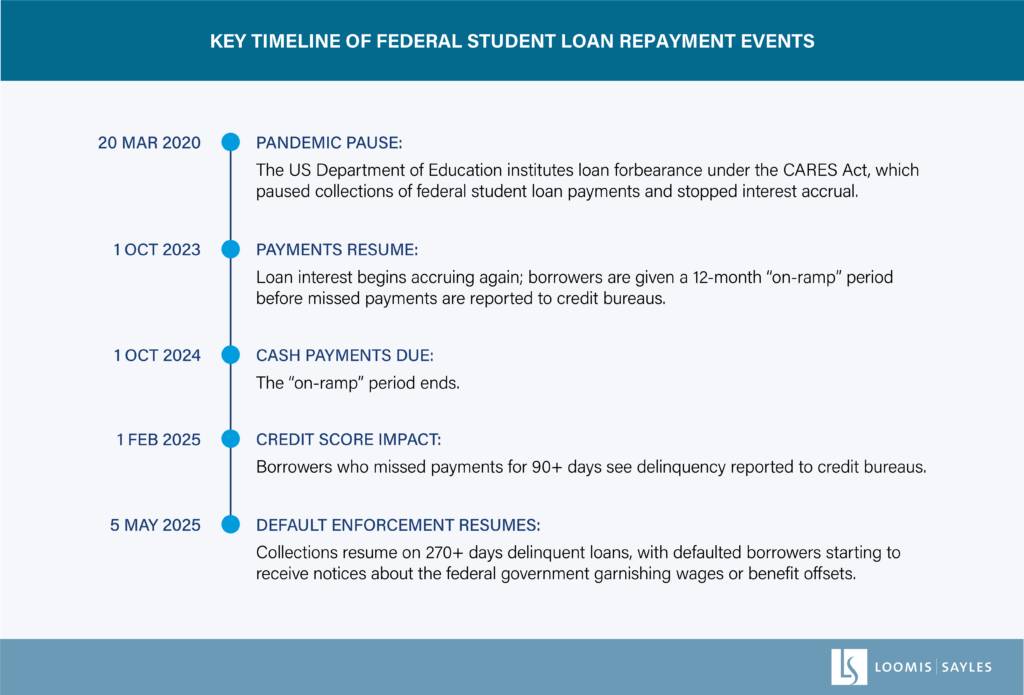
Student loan restart introduces credit pressure at a tricky time
This restart is happening amid layoffs at the Department of Education, which have reduced support for borrowers needing repayment assistance. According to the Department of Education’s National Student Loan Data System (NSLDS), the percentage of federal student loan borrowers in repayment who are 30+ days delinquent in 2025 now exceeds pre-COVID levels. In addition, many more borrowers still in forbearance will soon transition to active repayment as first payments under the Saving on a Valuable Education (SAVE) Plan are expected to be due in December 2025. For some segments, especially near-prime consumers who saw temporary credit score improvements during the pandemic, the pressure is building.
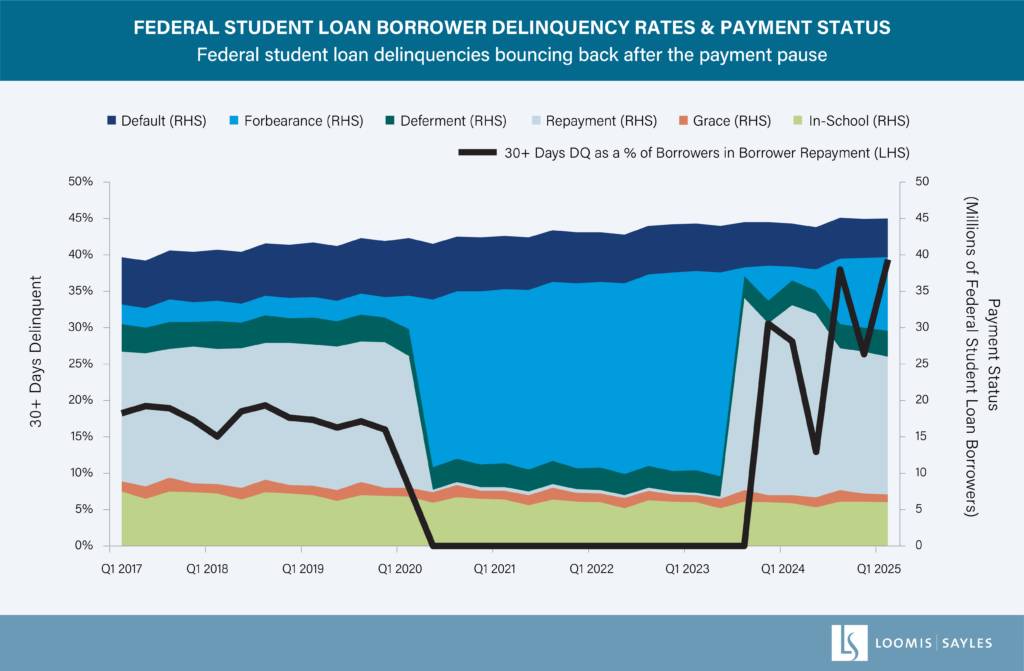
Chart Source: https://studentaid.gov/data-center/student/portfolio, as of 31 March 2025. The chart presented above is shown for illustrative purposes only. Some or all of the information on this chart may be dated, and, therefore, should not be the basis to purchase or sell any securities. The information is not intended to represent any actual portfolio. Information obtained from outside sources is believed to be correct, but Loomis Sayles cannot guarantee its accuracy. This material cannot be copied, reproduced or redistributed without authorization.
Identifying consumer ABS borrowers most at risk
Federal student loans are held across subprime (<620 credit score), near-prime (620-719) and prime (≥720) borrowers, but the impact of resuming repayment will vary by type.
- Subprime borrowers already have limited access to credit. The restart may not meaningfully change their behavior unless collections like wage garnishment re-prioritize these payments.
- Near-prime borrowers are emerging as the most sensitive group. The New York Federal Reserve estimates they hold around 32% of student loan balances.[i] In a Liberty Street Economics report, 2 million near-prime borrowers became 90+ days delinquent in Q1 2025, roughly 36% of all such debt holders.[ii] These borrowers saw credit scores drop an average of 140 points, driving many into subprime territory and cutting off access to new debt.
- Prime borrowers with high credit scores are likely to manage the restart better than others due to their stronger financial stability and higher employment security.
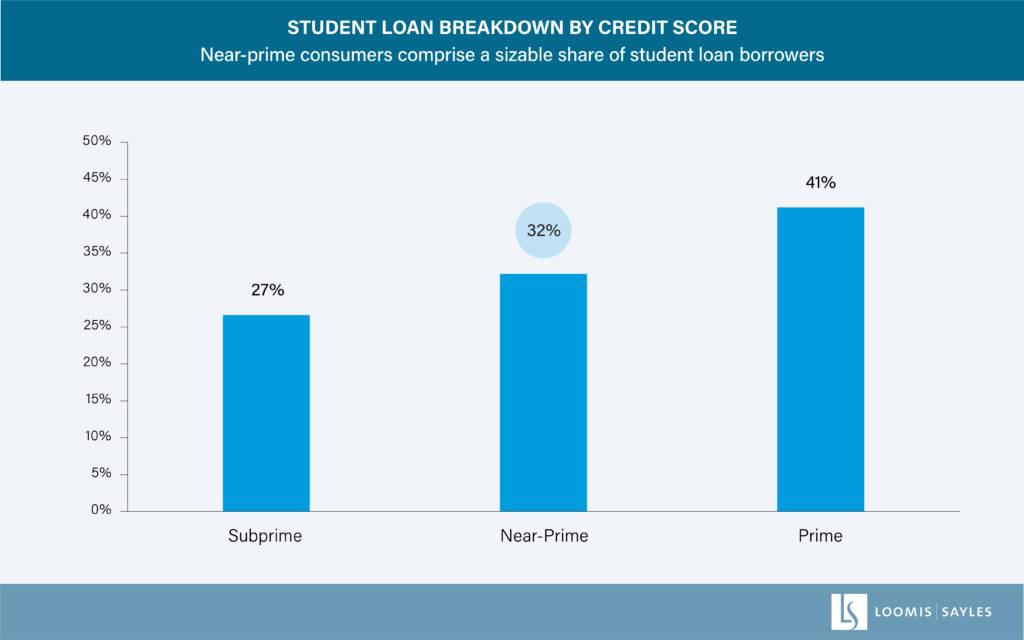
Chart Source: Federal Reserve Bank of New York, 2025 Student Loan Update, March. https://newyorkfed.org/medialibrary/Interactives/householdcredit/data/xls/Student-loan-update-2025-Mangrum. The chart presented above is shown for illustrative purposes only.
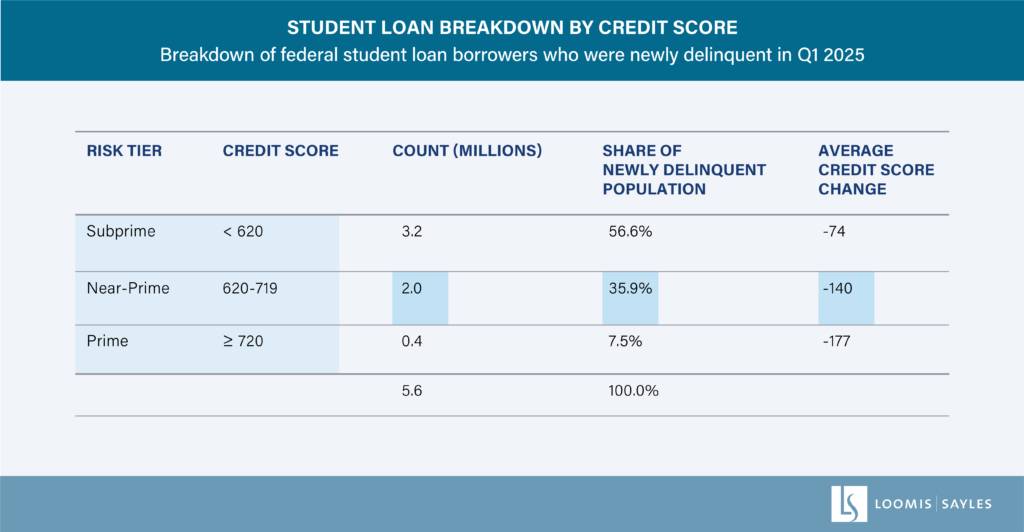
Table Source: Andrew F. Haughwout, Donghoon Lee, Daniel Mangrum, Joelle Scally, and Wilbert van der Klaauw, “Student Loan Delinquencies Are Back, and Credit Scores Take a Tumble ,” Federal Reserve Bank of New York Liberty Street Economics, 13 May 2025, https://libertystreeteconomics.newyorkfed.org/2025/05/student-loan-delinquencies-are-back-and-credit-scores-take-a-tumble. The chart presented above is shown for illustrative purposes only.
What we’ve heard from consumer lenders
In May 2025, we reached out to several consumer finance companies who issue in the ABS market to understand how they are preparing for the restart of federal student loans. Here are a few key takeaways:
- Treatment of student loans in underwriting varies: Some lenders disregard forborne student loans when calculating debt-to-income (DTI); others assume fixed payment percentages of principal balance or rely on credit bureau data.
- Exposure to student loan borrowers is uneven: Depending on the lender, exposure to borrowers with student loans ranged from less than 10% to 37%, with a median of 23% (see chart below). This aligns with our estimate, based on US census figures, that approximately 21% of US adults with a credit score carry student loan debt.
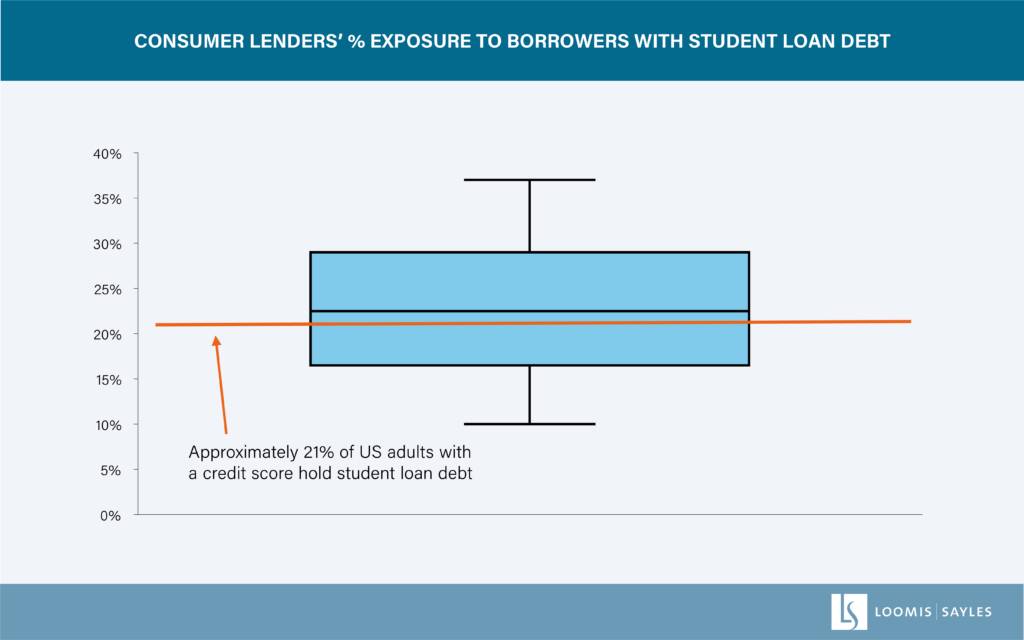
Chart Source: Loomis Sayles Lender Survey, conducted in Q2 2025. Responses from 20 auto and personal consumer loan lenders. The chart presented above is shown for illustrative purposes only.
- Auto lenders benefit from payment priority and collateral: Historically, borrowers prioritize auto payments over student loans to preserve mobility and employment (especially when they have equity or replacing their vehicle would be challenging).
- Unsecured term loans in the crosshairs: While student loans historically tend to fall behind other consumer term debts in payment priority, heightened federal collections activity may reprioritize federal student loans ahead of unsecured term loans.
Preparing for a layered risk environment
The return of student loan payments adds a new variable to an already complex macro backdrop. For investors in consumer ABS, the risks lie in the compounding effects of high interest rates, a softer labor market and lingering inflation. For vulnerable borrowers, this mix of pressures could tip the balance.
As borrower fundamentals weaken at the margins, the subtle differences between deals—particularly in terms of sponsor quality, underwriting approach and credit enhancement—may be of increasing importance.
Endnotes
[i] https://www.newyorkfed.org/microeconomics/topics/student-debt
SAIFjt262sdv
Market conditions are extremely fluid and change frequently.
This blog post is provided for informational purposes only and should not be construed as investment advice. Any opinions or forecasts contained herein reflect the subjective judgments and assumptions of the authors only and do not necessarily reflect the views of Loomis, Sayles & Company, L.P. Information, including that obtained from outside sources, is believed to be correct, but Loomis Sayles cannot guarantee its accuracy. This material cannot be copied, reproduced or redistributed without authorization. This information is subject to change at any time without notice.
Meet the Authors