
Pension Plan Hedge Ratios: Time for a Boost?
Recent moves in the Treasury market have created an opportunity that many defined benefit (DB) plan sponsors have not seen in years. Long-end Treasury yields have risen to levels not experienced since the mid-2000s, with 30-year Treasury yields recently exceeding 5.25%, materially improving the economics of liability hedging.i
Importantly, we don’t view increasing Treasury exposure as an attempt to forecast interest rates. Instead, we see it as a recognition that the compensation for assuming long-duration risk has improved materially. Pension investing is fundamentally about matching assets to liabilities. When markets offer the chance to lock in high-quality, long-term yields while simultaneously improving hedge ratios, we believe plan sponsors would be wise to pay attention.
Potential to Lock In Attractive Long-Term Yields
For much of the last decade, pension sponsors have faced a difficult tradeoff: accept low Treasury yields in exchange for interest rate protection or take additional credit risk to generate a sufficient return for the plan. Today, that tradeoff looks considerably different. Long-duration Treasurys and Treasury STRIPSii now offer yields that are significantly higher than those available just a few months ago, allowing plans to potentially lock in recent funded status gains at more attractive entry points.
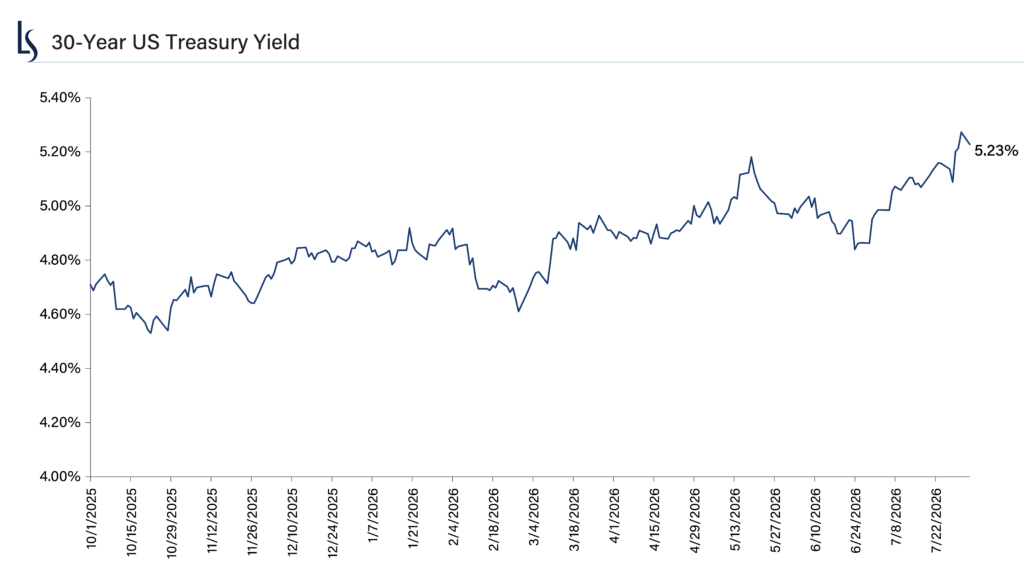
Source: Bloomberg, data from September 30, 2025 through August 3, 2026.
Hedging When It Matters Most
Despite much progress, many DB plans remain underhedged to long-end interest rate risk whereby a decline in long-term rates can increase liabilities more than asset values, creating funded status volatility that sponsors may not wish to bear. We believe increasing allocations to long-duration Treasurys or Treasury STRIPS can help close this gap.
Higher yields also improve the optionality embedded in Treasury allocations. If long-term rates decline in response to economic weakness, recession or a flight to quality, long-duration Treasurys and Treasury STRIPS are likely to appreciate. Those gains can help offset increases in liability values and preserve funded status while also serving as dry powder to reallocate into credit if spreads were to widen. Conversely, if rates remain elevated, sponsors may benefit from the ability to reinvest cash flows at attractive yields.
Implementation Options
For most plan sponsors, we believe long-term Treasury exposure is best achieved by simple and capital-efficient implementation. Sponsors can choose their duration target and whether or not they would like to use Treasury futures.
STRIPS benchmarks provide the most capital-efficient exposure through physical bonds. For sponsors that desire even more duration per unit of capital, a Treasury completion mandate that utilizes derivatives can be used to customize exposures directly to the liability. These potential benchmarks can be implemented as stand-alone mandates or given to a portfolio manager as part of a blended benchmark.
Implementation Choice Depends on Target Duration
IMPLEMENTATION OPTIONS
DURATION
YIELD TO WORST
Bloomberg Long Treasury Index
14.0
5.24%
Bloomberg 20+ Treasury Index
15.6
5.29%
Bloomberg 20+ STRIPS Index
25.4
5.42%
Bloomberg 25+ STRIPS Index
27.6
5.39%
Treasury Completion
Varies but typically can range up to 50 years
Varies
Source: Bloomberg, data as of August 3, 2026.
For well-funded plans, frozen plans and sponsors considering endgame strategies such as annuity purchases or hibernation, today’s higher long-end rates may represent one of the more attractive opportunities in years to strengthen liability alignment and reduce funded status risk. We believe the case for long-dated Treasurys and STRIPS has become considerably more compelling than it was when yields were anchored near historic lows, but the window of opportunity may not remain open indefinitely.
Endnotes
i Data source: Federal Reserve Bank of St. Louis, July 31, 2026.
ii STRIPS stands for “Separate Trading of Registered Interest and Principal Securities.” Treasury STRIPS are US-government-backed securities that are sold at a discount and do not pay interest until they mature, offering fixed returns based on their full face value.
Disclosure
Any investment that has the possibility for profits also has the possibility of losses, including the loss of principal.
Market conditions are extremely fluid and change frequently.
This blog post is provided for informational purposes only and should not be construed as investment advice. Any opinions or forecasts contained herein reflect the subjective judgments and assumptions of the authors only and do not necessarily reflect the views of Loomis, Sayles & Company, L.P. Information, including that obtained from outside sources, is believed to be correct, but Loomis Sayles cannot guarantee its accuracy. This material cannot be copied, reproduced or redistributed without authorization. This information is subject to change at any time without notice
9062814.1.1
Author
