
Municipal Market Update

1st Quarter 2026
Economy & Rates
- The US Treasury interest rates moved higher during the first quarter. With the federal funds target range held at a 3.50%-3.75% range, front end yields were relatively stable, while intermediate and longer-dated Treasury yields rose. This dynamic reflected continued economic resilience, firmer inflation readings, trepidation about the potential inflationary impact of the Iran conflict—particularly upon energy costs—and ongoing concerns about longer-term inflation trends and fiscal deficits.
- The Federal Reserve (Fed) maintained a pause in rate cuts at the March Federal Open Market Committee (FOMC) meeting, reiterating a data-dependent approach to future policy decisions. Chairman Jerome Powell acknowledged some moderation in labor market momentum but emphasized that inflation remains above target, reinforcing the case for patience. The market is forecasting between zero and one additional Fed rate cuts for the remainder of 2026.
- The Treasury yield curve has continued to normalize in 2026. The 2-year/10-year yield spread has remained solidly positive, around +50 basis points (bps), as front-end yields remain constrained by Fed policy while longer-term yields have been pulled upward by the resilient economy and lingering inflation expectations. This configuration is a typical indicator of a market which is pricing in continued economic expansion and persistent inflation.
- The outlook for the US economy, in our view, remains constructive. We expect positive GDP growth of approximately 2%, with a possible bias toward the upside, driven by resilient consumer spending, solid corporate investment (including AI-related capital expenditures), and supportive fiscal programs.
- As of 4/2/2026, Loomis Sayles’ Macro Strategies team currently assigns a 60% probability to a “Expansion Resilient” macro scenario as their base case, which forecasts that growth is likely to persist with a boost from fiscal programs, artificial intelligence productivity gains, strong corporate earnings growth, and a stable but cooling labor market. “Late Cycle Economic Boom” (marked by a more resilient economic growth trend, an upward bias to yields, and the possibility of a modest Fed rate hike later this year) is assigned a 20% likelihood, and “Downturn” (essentially a mild recession scenario marked by a pullback in consumer spending, negative S&P 500 earnings growth, and an increasingly accommodative Fed) is also assigned a 20% likelihood.
Municipal Market Performance
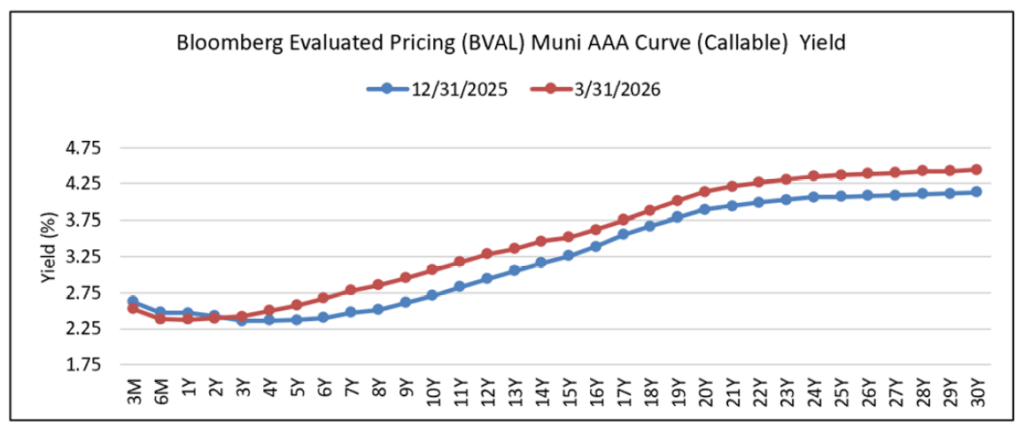
- Like the Treasury curve, municipal (muni) yields generally rose in the first quarter. Yields generally rose 20-30 bps beyond five years of maturity, with more muted increases in the 3-5 yearrange. Rates two years and less actually declined slightly, in sympathy with short-term Treasurys and the Fed pause. Municipal bond credit spreads were slightly tighter in the first quarter. Elevated absolute yields (or “carry”), on the longer end of the curve in particular, createda solid foundation for total return potential.
- The net effect of the yield curve rising, spreads tightening, and elevated level of carry was a modestly negative return for the Bloomberg Municipal Bond Index, which posted a -0.18% return in Q1. The total return in Q1 did vary notably at different points on the curve. Inside of 5 years, yield curve and credit spread movements were more muted, enabling modestly positive total returns to be achieved. In the 5-15 yearrange, the rise of interest rates in Q1 was sufficient to drive somewhat negative returns. In the 20-year range rates also rose but the higher level of carry and spread tightening was sufficient to eke out a positive return for the quarter.
- From a credit quality perspective, lower quality investment grade tax-exempt munis (BBB and A-rated) posted slightly stronger performance in the first quarter, and revenue backed bonds slightly outperformed General Obligation bonds. This aligns well with the spread tightening theme and the general “risk on” consensus outlook for the economy.
- Most sectors of the investment grade tax-exempt muni market posted modestly negative returns for the quarter. Among our focus sectors, higher education fared the worst at -0.45% in Q1, whereas transportation posted a slightly positive return of 0.08%.

Source: Bloomberg
Returns for multi-year periods are annualized. Indices are unmanaged and do not incur fees. It is not possible to invest directly in an index.
Past market performance is no guarantee of future results.
- At the end of the first quarter, the muni curve maintained a generally normal, upward-sloping shape, aside from a bit of a “hook” inside of six months where yields were elevated in correlation with the Fed funds rate. After flattening a bit in Q4 2025, the increase in muni yields beyond the 5-year mark was relatively uniform in Q1 (+20 to +30 basis points across most tenors), representing a more “parallel” upward shift this quarter.
Source: Bloomberg as of 3/31/26
Indices are unmanaged and do not incur fees. It is not possible to invest directly in an index.
Past market performance is no guarantee of future results.
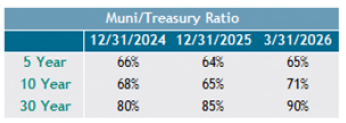
- Muni valuations, as measured by the muni-to-treasury ratio, cheapened (rose) in the first quarter after grinding richer (falling) during the second half of 2025. Across most tenors, the yield increases in Q1 were generally higher for munis than treasurys, thus the cheapening effect. This is at least partly attributable to seasonal reinvestment flows from muni coupons and maturities tapering off during Q1 while new muni supply continued its robust pace. As a result, the 5-year and 10-year muni-to-treasury ratios cheapened somewhat but still appear fairly rich by historical standards. The 30-year ratio is closer to fair value, in our opinion.
Source: Bloomberg
Returns for multi-year periods are annualized. Indices are unmanaged and do not incur fees. It is not possible to invest directly in an index.
Past market performance is no guarantee of future results.
Muni Supply & Demand
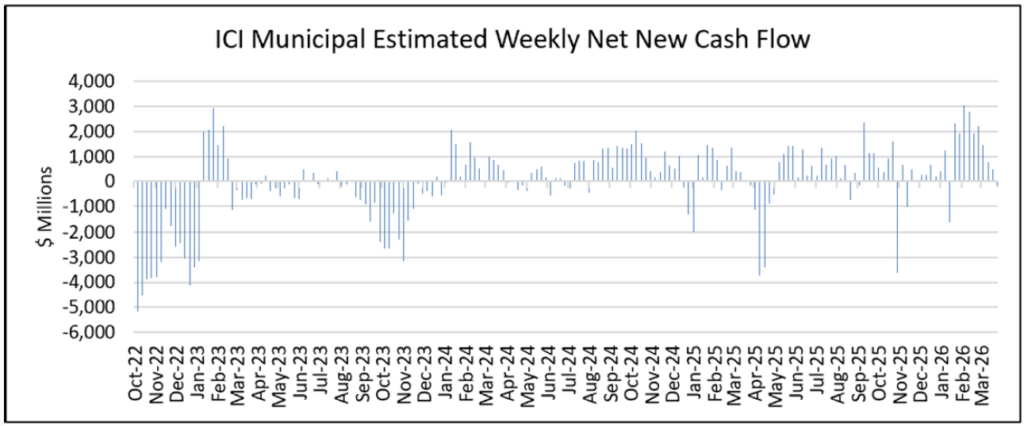
- The flow of investor money into municipals demonstrated a positive trend in Q1, with weekly muni mutual fund flows remaining primarily positive and with separately managed account (SMA) and ETF demand remaining robust as well. Mutual fund net inflows totaled approximately $16-17 billion in the quarter.
Source: Bloomberg, as of 3/31/2026.
Past market performance is no guarantee of future results.
- New muni bond supply expectations remain strong, given increased project costs and less supportive Fiscal Policy. New issuance of muni bonds in Q1 tracked approximately 9-10% ahead of Q1 2025. We expect strong new issuance to continue in 2026, albeit potentially at a slightly lower pace than 2025’s record pace. New issuance continues to be fueled by inflationary effects (which increase municipal project costs) and decreased federal support for state and local entities, which could induce new borrowing needs and spur incremental new issuance. However, a continued rise of interest rates (i.e., borrowing costs) could start to taper supply.
- From a technical perspective, seasonal flows from bond coupons and maturities entered a relatively weaker time of year in March, which should persist through the month of May. While this cycle is a known annual event and just one factor in what moves the muni market, weaker seasonals paired with persistently strong new issuance supply can help to create a buying opportunity in an environment of otherwise-strong demand for munis.
Muni Supply & Demand
The following conditions underpin our moderate outlook for the municipal market:
- Elevated absolute yields and a still relatively steep muni yield curve offer an opportunity for attractive carry and rolldown.
- On a “tax equivalent” basis, munis may provide a compelling alternative to other investment grade credit asset classes, particularly for high tax bracket investors.
- We expect demand from retail investors in mutual funds, ETFs and separately managed accounts to continue absorbing the heavy pace of new issuance and bring balance to the muni market. However, as Q1 ended we have entered a period of seasonally weaker reinvestment flows which could lead to temporarily reduced absorption of new issuance.
- Credit spreads remain modestly attractive across the curve and rating spectrum for most sectors relative to historical averages.
- While credit conditions in several muni sectors are being impacted by Federal policy headwinds, an overall upbeat macroeconomic tone has provided stability to the credit environment.
- Valuations, especially across the shorter tenors, have cheapened lately but still appear relatively rich by historical standards.
- The risks which challenge our constructive view include Fed policy uncertainties which could impact the credit fundamentals of weaker quality muni issuers, the impact of inflation which could affect the extent and timing of future Fed rate cuts, and the potential for an unexpectedly strong economy which pressures long-term rates higher.
The Bloomberg Municipal Bond Index sported a 3.77% yield at quarter-end, which equates to a 6.38% Taxable Equivalent Yield (using an effective tax rate of 40.8%). We believe this represents reasonable value -and a possible entry point -relative to the Bloomberg US Corporate Bond Index and the Bloomberg US Aggregate Index.
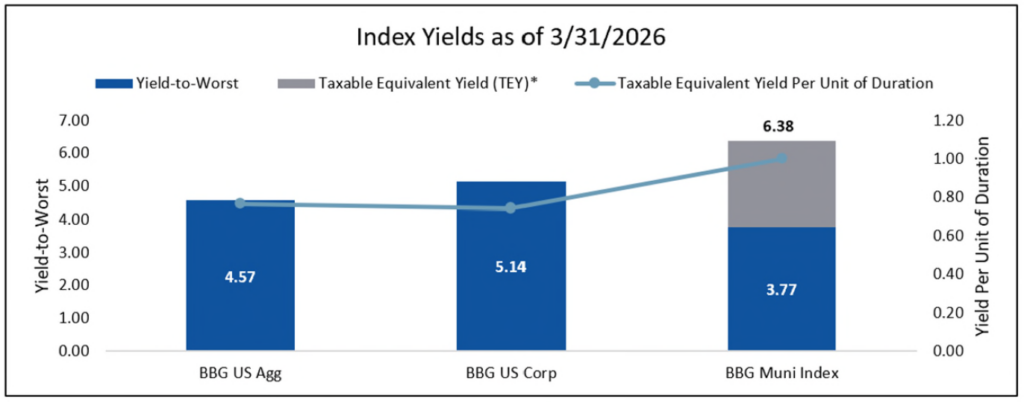
*The taxable equivalent yield is calculated using an effective tax rate of 40.8% which includes the 37.0% top federal marginal income tax rate and the 3.8% Net Investment Income Tax to fund Medicare. Source: Loomis Sayles and Bloomberg as of 3/31/2026. Indices are unmanaged and do not incur fees. It is not possible to invest directly in an index.
This material is not intended to provide tax, legal, insurance, or investment advice. Please seek appropriate professional expertise for your needs. Past market performance is no guarantee of future results.
IMPORTANT DISCLSOURES
Past performance is no guarantee of future results.
Market conditions are extremely fluid and change frequently.
Diversification does not ensure a profit or guarantee against a loss.
Any investment that has the possibility for profits also as the possibility of losses, including the loss of principal.
This material is not intended to provide tax, legal, insurance, or investment advice. Please seek appropriate professional expertise for your needs.
Indices are unmanaged and do not incur fees. It is not possible to invest directly in an index.
This marketing communication is provided for informational purposes only and should not be construed as investment advice. Any opinions or forecasts contained herein, reflect the subjective judgments and assumptions of the authors only, and do not necessarily reflect the viewsof Loomis, Sayles & Company, L.P. Investment recommendations may be inconsistent with these opinions. There is no assurance that developments will transpire as forecasted and actual results will be different. Data and analysis does not represent the actual, orexpected future performance of any investment product. Information, including that obtained from outside sources, is believed to be correct, but we cannot guarantee its accuracy. This information is subject to change at any time without notice.
For Investment professional use only. Not for further distribution.
8860686.1.1
Meet the Author