Author

Inching Toward a Deal: What’s Next in the US-China Trade Negotiations
The United States and China surprised me with their announcement of a small “phase one” trade deal last week. I had thought any kind of deal would be a long shot, so I view this development as good news. Here’s a summary of the deal and what could happen next.
What’s in the deal?
- China will step up purchases of US farm goods. President Trump indicated that the purchases would amount to $40 -$50 billion.
- Some agreement on certain intellectual property issues.
- China made concessions on financial services to give US financial firms more access to China’s market.
- There was an agreement on currency issues. Treasury Secretary Mnuchin indicated he is considering lifting China’s designation as a “currency manipulator” if phase one is completed.
- The US delayed tariffs scheduled to go into effect on October 22. The US may still impose these if a deal is not finalized.
- The US did not change scheduled tariff hikes on December 15. However, the US may suspend them if more progress is made.
- No existing tariffs were rolled back.
 What’s next?
Trump plans to sign the phase one trade deal with President Xi at the Asia-Pacific Economic Cooperation (APEC) summit in Chile next month. This deal is far from certain. There is no text of an agreement at this time; all we have is a verbal agreement on the outline of the possible deal. The negotiators have only about four weeks to finalize an acceptable text. US-China negotiations have collapsed before, and it could happen again.
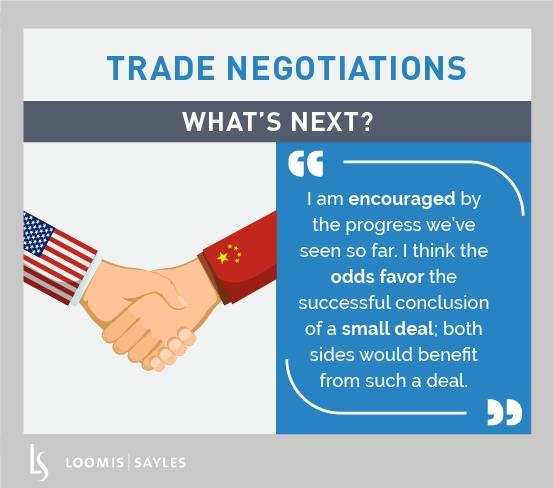
Having said that, I am encouraged by the progress we’ve seen so far. I think the odds favor the successful conclusion of a small deal; both sides would benefit from such a deal.
What I’m watching
If the talks fail, Trump may skip the APEC summit altogether. Watch for signs and rumors of negotiating progress. The negotiations for a deal may continue right until the deadline.
Market implications
Markets surged on the day the deal was announced, but the optimism has dimmed somewhat. As further details emerge about the phase one deal, markets could get more excited.
If the emerging trade deal falls apart, Trump may get angry and impose the October tariffs, which could drive major risk-off pricing in financial markets.
However, if Trump and Xi sign the deal in November, currently scheduled tariffs would likely be suspended, which would reduce uncertainty and boost economic optimism. I view a deal as positive for the US and global economy and financial markets.
Could there be a phase two deal?
Longer term, once a phase one deal is signed, negotiators would likely move on to phase two, which would involve deeper and more complicated issues on trade relations. If a phase two deal turns out to be bigger and better than phase one, markets would get even more excited. Unfortunately, I doubt a phase two trade deal will happen in the next 15 months.

MALR024418
Meet the Author