Extra Credit

Q3 Round Up: Resilient Growth, Sticky Inflation and Potential for a Higher Neutral Interest Rate
Despite Tighter Financial Conditions and Higher Interest Rates, Economic Activity Remains Surprisingly Strong
Investors reassessed the outlook for growth, inflation, monetary policy, and long-term interest rates during the third quarter. Economic growth remained resilient despite higher energy prices and tighter financial conditions, while inflation continued to prove more persistent than many had expected. As a result, market attention shifted from the risks associated with the Middle East conflict toward the prospect of a prolonged period of restrictive monetary policy. Against this backdrop, the 10-year U.S. Treasury yield rose from 4.47% to 5.28% as investors demanded greater compensation for inflation uncertainty and the potential for elevated Treasury supply. Credit markets also experienced some repricing, as investment grade and high yield corporate spreads widened modestly.
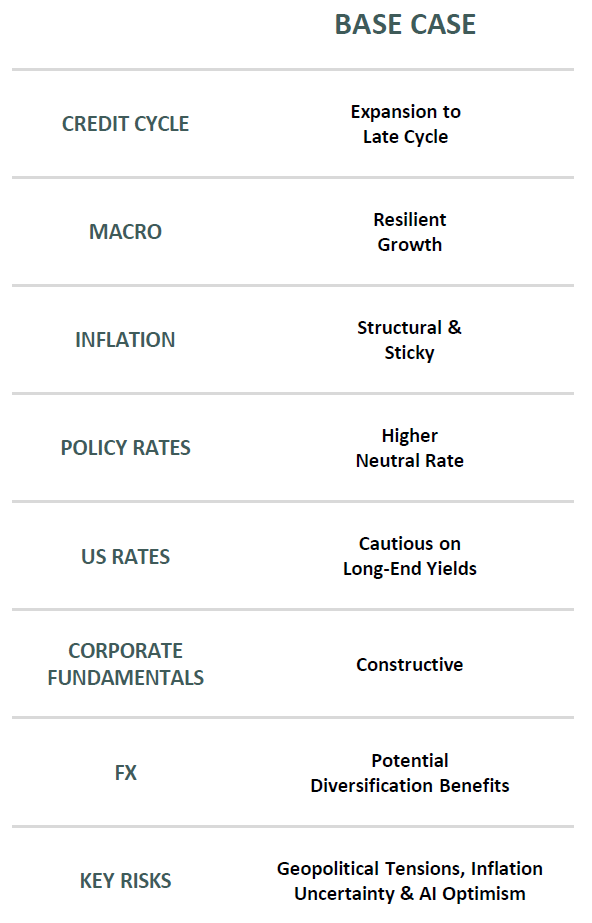
Looking ahead, we continue to believe the U.S. remains firmly within the ‘Expansion to Late Cycle’ phase of the credit cycle. Corporate profitability continues to exceed expectations, labor markets remain healthy, consumer spending remains resilient, and the artificial intelligence (AI) investment cycle continues to drive significant capital spending. Manufacturing activity remains constructive, with healthy order books and lean inventories. We believe the economy is on solid footing and that the primary macroeconomic debate is the appropriate level of interest rates required to maintain price stability.
Structural Factors Keeping Inflation Sticky
Inflation remains a key challenge. The disinflation many investors expected at the beginning of the year has largely stalled, with inflation increasingly supported by structural forces including persistent fiscal deficits, demographic pressures, deglobalization, supply-chain reconfiguration, rising defense spending, and significant investment in AI, energy infrastructure, and industrial capacity.
Earlier in 2026, markets focused on the timing of future rate cuts. Now, the discussion increasingly centers on the magnitude of additional tightening that may ultimately be required. Forward markets are signaling tighter monetary conditions for several months ahead, and the Federal Open Market Committee moved in that direction with a September rate hike accompanied by a more hawkish tone. We believe the Fed will maintain a bias toward price stability until inflation shows clearer evidence of moving sustainably lower. Our base case remains above-target inflation accompanied by trend-like growth, which keeps the Fed hiking toward 4.75% with upside risk if supply-side inflation reaccelerates.
Team Outlook
What’s Driving Higher Interest Rates?
We continue to view the U.S. fiscal deficit as a longer-term concern. Large structural expenditures related to entitlements and defense, combined with elevated debt-servicing costs, suggest to us deficits are likely to remain sizable. While fiscal expansion contributes to inflationary pressures and Treasury supply, we do not believe it is the sole driver of higher yields. Most of the rise in Treasury rates this year has been driven by higher real yields rather than inflation expectations, suggesting markets are repricing growth and equilibrium interest rates more than questioning the Federal Reserve’s credibility. In addition, competition for capital across AI infrastructure, energy investment, and government borrowing is helping to support a structurally higher interest rate environment. In our view, investors are still adapting to a world characterized by structurally higher nominal and real interest rates.
Maintain Flexibility in the Current Environment
Against this backdrop, our cycle-based investment process remains anchored to a long-term horizon and focused on balancing valuation, fundamentals, and risk. Credit spreads remain relatively tight by historical standards, but corporate fundamentals continue to justify a constructive stance. Our Credit Health Index (CHIN) suggests defaults and downgrades should remain below historical averages, supported by strong profitability, healthy margins, and resilient balance sheets. We believe corporate balance sheets remain well positioned to absorb episodic macro volatility related to geopolitics, energy prices and policy uncertainty.
Fed Chair Warsh has attributed higher yields to economic strength, geopolitics, and competition for capital, and we broadly agree. From an investment perspective, today’s interest-rate environment presents some of the most attractive fixed income opportunities investors have seen in years. Current yield levels allow investors to earn compelling income while maintaining high-quality portfolios. Within our portfolios, we remain focused on maintaining flexibility, selectively extending duration, and preserving liquidity. Given our expectation for a relatively benign loss environment, we believe investors should consider leaning into credit risk to capture incremental carry while maintaining broad diversification across fixed income sectors. We believe our edge is in security selection and up-in-quality carry, not broad credit beta. We remain selective across investment grade and high yield credit, bank loans, and securitized assets, where we believe relative value opportunities continue to emerge. We believe diversification across non-U.S.-dollar exposures remains compelling, as investors can seek higher yields and potential for currency appreciation outside the US. Lastly, convergence between public and private credit markets is also creating additional opportunities for multi-sector investors.
Important Disclosure
This marketing communication is provided for informational purposes only and should not be construed as investment advice. It is meant to offer a snapshot of select market developments and is not a complete summary of all market activities. Investment decisions should consider the individual circumstances of the particular investor. Any opinions or forecasts contained herein reflect subjective judgments and assumptions of the author and do not necessarily reflect the views of Loomis, Sayles& Company, L. P. Investment recommendations may be inconsistent with these opinions. There can be no assurance that developments will transpire as forecasted. Data and analysis does not represent the actual or expected future performance of any investment strategy, account or individual positions. Accuracy of data is not guaranteed but represents our best judgment and can be derived from a variety of sources. Opinions are subject to change at any time without notice.
The Credit Health Index (CHIN) is a macro tool created by Loomis Sayles. The CHIN is currently managed by the Loomis Sayles Applied IQ team. It is a proprietary framework that utilizes a combination of macro, financial market and policy variables to project US corporate health.
Commodity, interest and derivative trading involves substantial risk of loss.
Diversification does not ensure a profit or guarantee against a loss.
Market conditions are extremely fluid and change frequently.
Any investment that has the possibility for profits also has the possibility of losses, including loss of principal.
There is no guarantee that any investment objective will be realized, or that the strategy will be able to generate any positive or excess returns.
Past performance is no guarantee of future results.
For Institutional Use Only. Not For Further Distribution. All information is preliminary and subject to change.
9175211.1.1
Meet the Team