
Extra Credit

Q2 Round Up: Resilient Growth, Stubborn Inflation, Risk of Federal Reserve Interest Rate Hikes
Economic Backdrop Remained Resilient Through the Middle East Conflict, Interest Rates Moved Higher
Market volatility remained elevated during the second quarter, though fears of a severe economic downturn eased as the conflict involving the U.S., Israel, and Iran proved less disruptive to global energy markets than initially feared. While higher oil prices and geopolitical uncertainty continued to weigh on sentiment, the broader economic backdrop remained resilient. The initial energy shock lifted inflation expectations and contributed to higher interest rates, with the 10-year Treasury yield rising from approximately 4.32% to 4.47% during the quarter. At the same time, credit markets largely absorbed the volatility and investment grade and high yield corporate spreads tightened as investors looked through near-term geopolitical risks and remained focused on resilient economic growth.
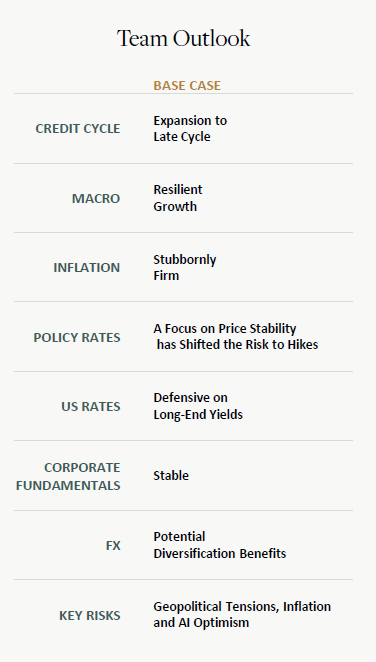
Looking ahead through the remainder of 2026, we believe the U.S. will remain firmly in the ‘Expansion to Late Cycle’ phase of the credit cycle. Our outlook is based on positive wealth effects, supportive fiscal policy, robust corporate profits and a significant capital expenditure cycle tied to artificial intelligence (AI). Manufacturing activity has also remained healthy, order books are strong, and inventories remain relatively lean. Corporate health appears solid, as reflected in healthy earnings, profit margins and corporate balance sheets. After softening in 2025, labor market indicators have improved, with payroll growth, job openings, and unemployment claims also suggesting continued resilience.
Globally, growth entered 2026 on more synchronized footing, supported by monetary easing in 2025, improving manufacturing activity, and increasingly supportive fiscal policy. Despite the energy shock and geopolitical tensions that remain, the global economy appears more resilient than it was during the initial energy shock following Russia’s invasion of Ukraine.
Structural Factors Keeping Inflation Stubbornly Firm
Inflation across the globe remains a key challenge. The disinflationary progress many investors expected at the start of the year has yet to materialize. While higher energy prices have contributed to inflation pressures, underlying inflation measures have remained stubbornly firm. More importantly, we believe inflation is increasingly being supported by structural factors, including persistent fiscal deficits, demographic pressures, supply-chain reconfiguration, rising defense spending, and substantial investment in AI, energy infrastructure, and industrial capacity. In our view, global central bankers no longer have an easing bias; however, we are not concerned about cycles of aggressive interest rate hikes either.
Uncertainty Surrounding Interest Rate Hikes and Evolving Fed Policy
The evolving inflation backdrop has led to an important shift in the market’s policy debate. Within the U.S., earlier in the year, investors focused primarily on the timing of additional Federal Reserve interest rate cuts. The discussion has now shifted toward whether persistent inflation could ultimately require a more restrictive stance. The policy framework itself is also evolving as newly appointed Chair Kevin Warsh has made it clear that reforming aspects of Federal Reserve communication and decision-making are priorities. Most notably, forward guidance appears likely to play a much smaller role, while policymakers reassess the balance sheet, economic projections, and the potential effects of AI-driven productivity gains. While these reforms may ultimately strengthen credibility, the transition introduces some potential uncertainty and interest rate volatility as investors seek to understand the framework that will guide monetary policy decisions in coming years.
Fiscal Deficit is Structural Rather Than Counter-Cyclical
We continue to view the U.S. fiscal deficit as a longer-term concern. Large structural expenditures, particularly related to entitlements and defense, combined with elevated debt-servicing costs, suggest deficits are likely to remain sizable, in our view. Persistent fiscal expansion contributes to inflationary pressures and places upward pressure on Treasury supply and long-term interest rates. We continue to estimate fair value for the 10-year U.S. Treasury at approximately 4.25%-4.75%, though rising term premia and the prospect of structurally higher neutral rates could push yields modestly higher over time.
Maintain Flexibility in the Current Environment
Within this environment, our cycle-based investment process remains anchored to a long-term horizon and focused on balancing valuation, fundamentals and risk. Credit spreads remain relatively tight by historical standards, but corporate fundamentals continue to justify a constructive stance. Our Credit Health Index (CHIN) framework suggests defaults/losses and downgrades should remain below historical averages for this stage of the cycle, supported by strong profitability, healthy margins, and resilient balance sheets. We believe corporate balance sheets remain well positioned to absorb episodic macro volatility related to geopolitics, energy prices and policy uncertainty.
Given our expectation for a relatively benign loss environment, we believe investors should consider selectively leaning into credit risk to capture incremental carry, while maintaining broad diversification across fixed income sectors. Elevated volatility and evolving macro risks reinforce the importance of flexibility in managing both interest-rate and credit exposure. We remain selective across investment grade and high yield credit, bank loans, and securitized assets, where relative value opportunities continue to emerge. Convergence between public and private credit markets is accelerating, creating additional opportunities for multi-sector investors. Finally, we believe diversification across non-U.S. dollar exposures remains compelling, as the current macro backdrop suggests a sustained flight-to-safety bid for the U.S. dollar is unlikely, allowing investors to seek higher yields and potential currency appreciation outside the U.S. While uncertainty surrounding growth, inflation, and central bank policy is likely to persist, we believe strong corporate profitability, healthy consumers, AI-driven investment, and resilient credit fundamentals should continue to support risk assets through the remainder of 2026.
Important Disclosure
This marketing communication is provided for informational purposes only and should not be construed as investment advice. It is meant to offer a snapshot of select market developments and is not a complete summary of all market activities. Investment decisions should consider the individual circumstances of the particular investor. Any opinions or forecasts contained herein reflect subjective judgments and assumptions of the author and do not necessarily reflect the views of Loomis, Sayles & Company, L. P. Investment recommendations may be inconsistent with these opinions. There can be no assurance that developments will transpire as forecasted. Data and analysis does not represent the actual or expected future performance of any investment strategy, account or individual positions. Accuracy of data is not guaranteed but represents our best judgment and can be derived from a variety of sources. Opinions are subject to change at any time without notice.
The Credit Health Index (CHIN) is a macro tool created by Loomis Sayles. The CHIN is currently managed by the Loomis Sayles Applied IQ team. It is a proprietary framework that utilizes a combination of macro, financial market and policy variables to project US corporate health.
Commodity, interest and derivative trading involves substantial risk of loss.
Diversification does not ensure a profit or guarantee against a loss.
Market conditions are extremely fluid and change frequently.
Any investment that has the possibility for profits also has the possibility of losses, including loss of principal.
There is no guarantee that any investment objective will be realized, or that the strategy will be able to generate any positive or excess returns.
Past performance is no guarantee of future results.
For Institutional Use Only. Not For Further Distribution. All information is preliminary and subject to change.
9025609.1.1
Meet the Team