
Author

Energy and the US Economy: A Story in Five Charts
The conflict in the Middle East has driven sharp swings in oil prices and renewed concerns that an energy shock could undermine the US economy. Those fears recall the experience of the 1970s and early 1980s, when geopolitical disruptions translated quickly into higher inflation and weaker growth. However, the structure of the US economy today is fundamentally different today than it was back then.
Here, I share five charts that illustrate how the US has reduced its vulnerability to oil prices. As a result, while geopolitical shocks can still move prices and unsettle markets, their macroeconomic impact on the US is likely to be smaller than in past oil‑shock episodes. That said, extreme or prolonged disruptions would still pose meaningful risks.
1. Oil is not as important to the US economy as it was decades ago.
The chart below gives the ratio of oil consumption to real GDP, which allows us to compare changes over time. As you can see, the ratio has trended down since 1980. The US economy’s oil use is much less intensive than it used to be. In other words, an oil shock would have far less economic impact now than it would have in the 80s.
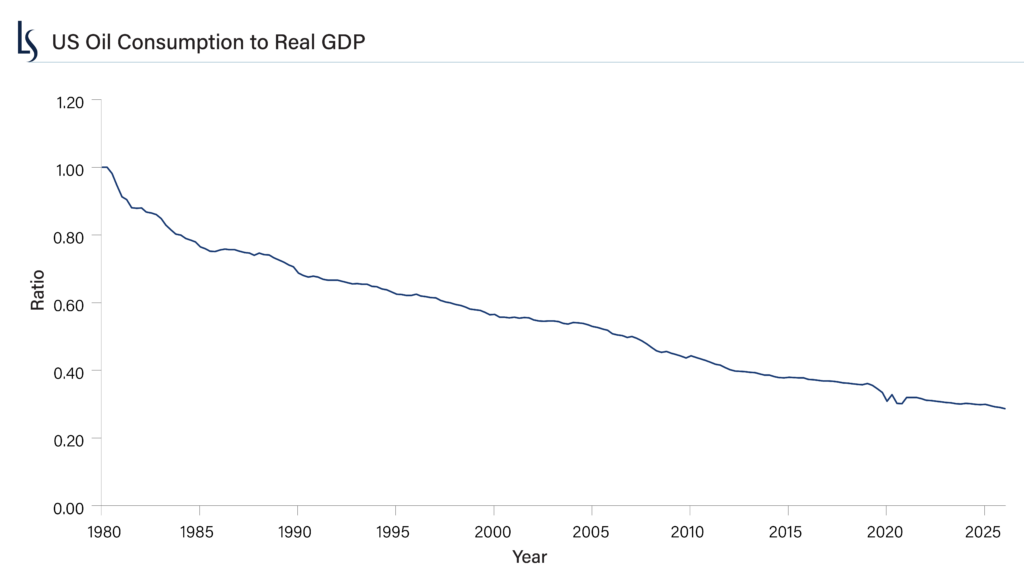
Source: Haver Analytics, Oxford Economics, as of March 11, 2026. Data shows the ratio of oil consumption (measured in millions of ton-oil-equivalent) to real GDP (measured in billions of real dollars). Data are annualized and seasonally adjusted. Data have been indexed with the values in Q1 1980 set equal to 100.0 and the ratio for that datapoint is equal to 1.0. The chart presented above is shown for illustrative purposes only.
2. The energy intensity of the US economy has decreased.
Energy is not just oil, but all forms of energy: coal, natural gas, hydro, nuclear and renewables. The chart below shows US energy consumption (measured as British Thermal Units, or BTUs) per dollar of real GDP. Back in 1949, it took almost 14 BTU to produce one dollar of real GDP. At the end of 2025, it took about 4 BTU. Why the decrease? Services grew as a share of the US economy, and services generally consume less energy than manufacturing. In addition, energy efficiency has improved considerably.
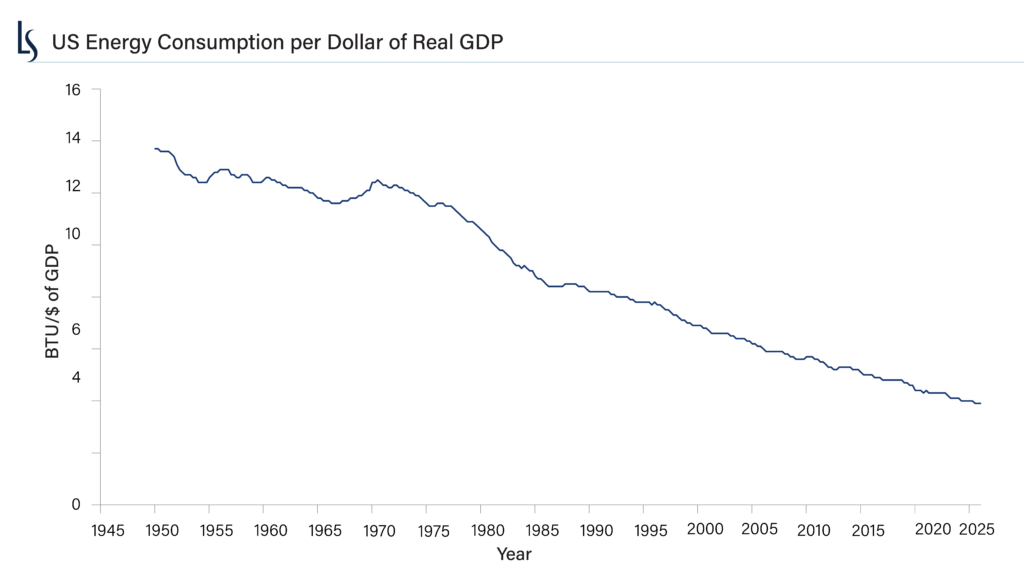
Source: Haver Analytics, S&P Global, as of March 10, 2026. Loomis Sayles forecasts for 2026 and 2007, as of February 2026. The chart presented above is shown for illustrative purposes only.
3. US consumers spend less of their budgets on energy.
The chart below shows total consumer spending on energy goods and services divided by total consumer spending. The ratio reached a record high in the second quarter of 1981 after several large oil price shocks in less than a decade. By the fourth quarter of 2025, that ratio was close to a record low. (The record low was in 2020, during the COVID-19 pandemic.) A very large rise in the price of energy would push that ratio up, but starting from such a low level, the final result is not likely to be very high, in my view.
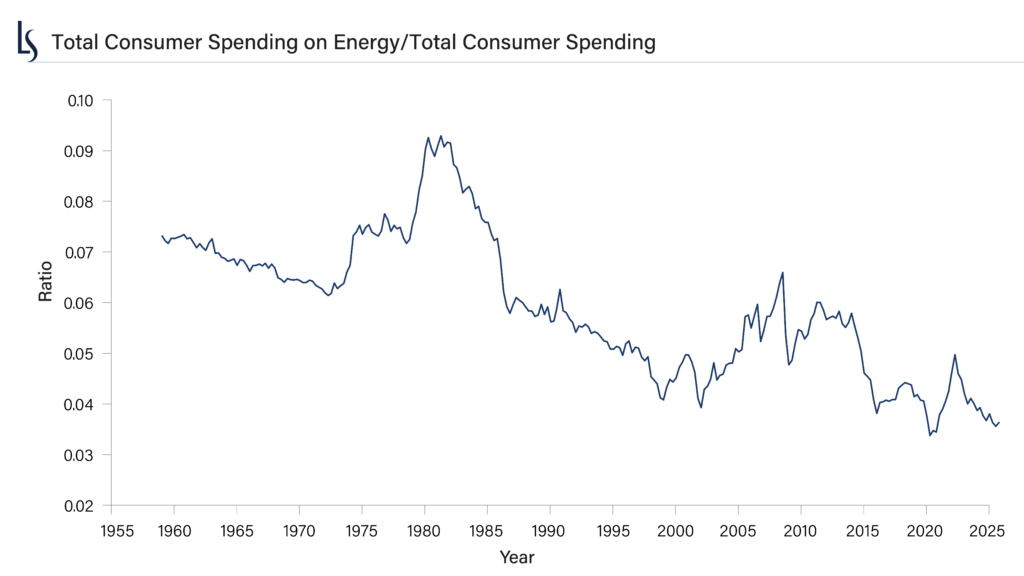
Source: Haver Analytics, as of March 13, 2026. Seasonally adjusted data. The chart presented above is shown for illustrative purposes only.
4. The US has reached record-high domestic crude oil production.
For a long time, US oil production trended down from its 1970 peak, falling sharply after the mid-1980s oil slump and hitting a post-World-War-Two low in 2008. Fracking changed the trajectory of US production after the Global Financial Crisis. The technique took off, improving oil production and helping the economic recovery. The US became the largest producer of crude oil in the world, producing a record high of about 5 billion barrels per year in 2025.
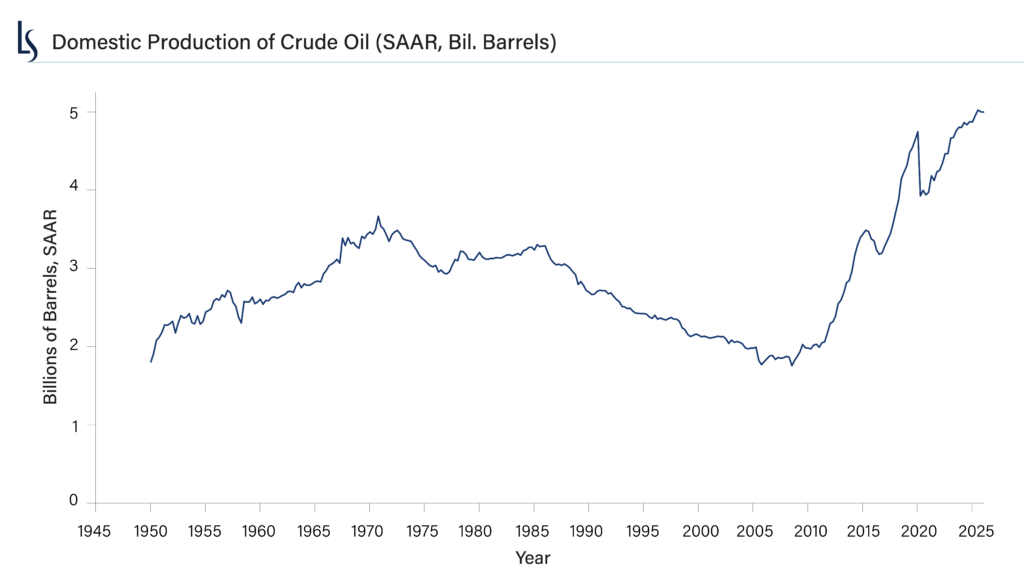
Source: Haver Analytics, S&P Global, as of March 10, 2026. SAAR=Seasonally Adjusted Annual Rate. The chart presented above is shown for illustrative purposes only.
5. The US is a net exporter of crude oil.
This final chart shows the US trade balance in petroleum and products: exports minus imports. Petroleum and products include not only crude oil, but refined petroleum products. For the most part, the US has been running a trade surplus since the COVID-19 pandemic. The surplus was $58 billion in 2025. I don’t think anyone back in 1973 could have imagined an oil trade surplus.
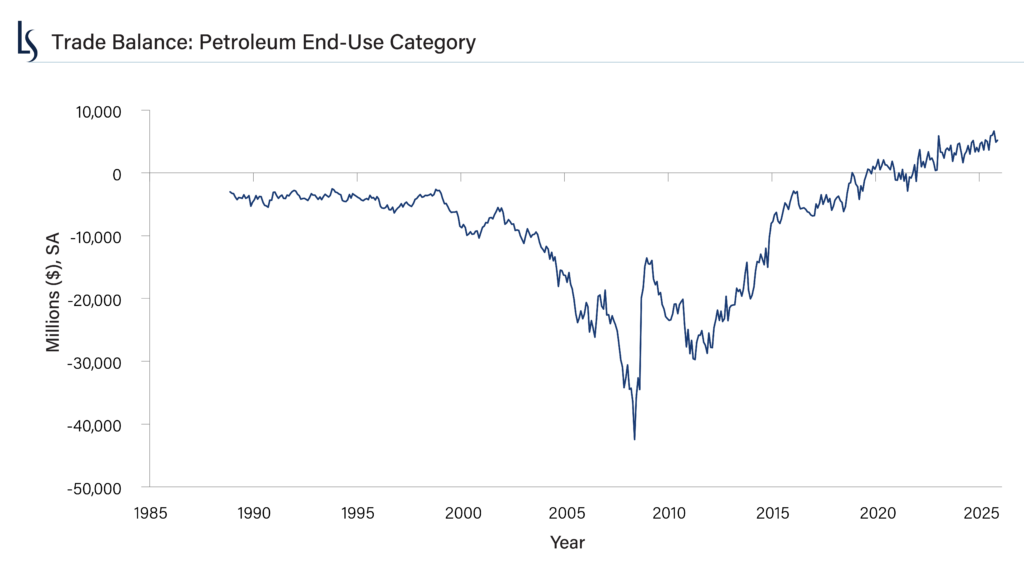
Source: Census Bureau, Haver Analytics, as of March 12, 2026. SA=Seasonally Adjusted. The chart presented above is shown for illustrative purposes only.
The risks go beyond oil prices
As the US became a huge oil producer and a net exporter of petroleum and products, the effect of increases in oil prices on the economy became more ambiguous. Ordinary consumers are hurt by higher energy prices, as are businesses that depend on petroleum products. On the other hand, producers and exporters of petroleum benefit. If oil prices go high enough, I think the downside risks dominate.
I must warn that the war in Iran involves far more risks than just a period of high oil prices. The uncertainty and fears involving war can undermine consumer and business confidence and so compromise spending. Higher levels of risk aversion could undermine financial markets, as we have seen in the stock market. And countries not as fortunate as the US with energy resources could be damaged, with the result of slowing US exports.
Market conditions are extremely fluid and change frequently.
This blog post is provided for informational purposes only and should not be construed as investment advice. Any opinions or forecasts contained herein reflect the subjective judgments and assumptions of the authors only and do not necessarily reflect the views of Loomis, Sayles & Company, L.P. Information, including that obtained from outside sources, is believed to be correct, but Loomis Sayles cannot guarantee its accuracy. This material cannot be copied, reproduced or redistributed without authorization. This information is subject to change at any time without notice.
8823017.1.1
Meet the Author
