
Authors


Choose Your Own (Floating-Rate) Adventure: Considerations for Investing in CLOs and Bank Loans
Recently, demand for collateralized loan obligations (CLOs) has accelerated—not only among institutional investors, but increasingly from retail participants as well. Initially, CLOs attracted institutional investors by transforming high yield loan exposures into scalable, investment-grade-rated securities that offered more favorable capital treatment and shorter settlement periods. Now, CLO-focused ETFs have gained traction with retail buyers, attracting substantial inflows. There are currently over 25 ETFs with more than $35 billion in AUM,[i] a figure expected to rise as new products enter the market. But it’s not just ETFs; appetite for CLOs has expanded considerably across buyer types.
CLOs are one of two scalable asset classes for investors seeking floating-rate exposure to corporate credit; the other instrument is broadly syndicated loans (BSLs). While both invest in the same underlying loan universe, CLOs are vehicles that invest in BSLs and sell tranches of debt and equity, each offering distinct risk-return profiles to investors. This surge in CLO demand has fueled expansion of both the CLO market and the underlying BSL market. The BSL market itself has grown from $800 billion to roughly $1.5 trillion over the past decade, with CLOs growing from 45% of the BSL market to now more than 65%.[ii] In our view, this shift underscores the importance of understanding the drivers behind CLO growth and the tradeoffs between investing in CLOs versus direct exposure to bank loans. Here’s what we think investors should know.
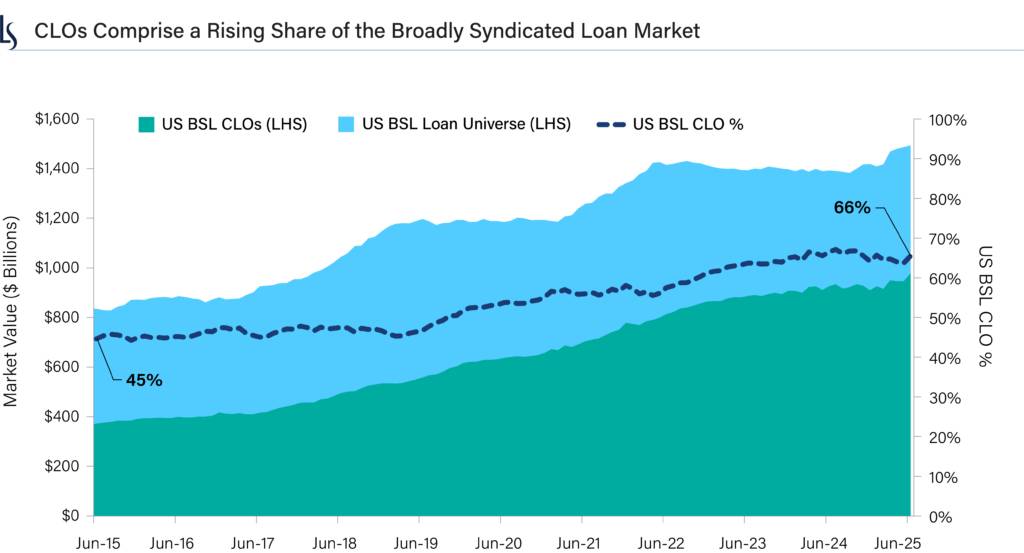
Data Sources: Bank of America Research, Intex, LCD, June 2015 – June 2025.
The chart presented above is shown for illustrative purposes only. Some or all of the information shown may be dated, and, therefore, should not be the basis to purchase or sell any securities. The information is not intended to represent any actual portfolio managed by Loomis Sayles.
Considerations for CLOs
CLOs are backed by actively managed, highly diversified pools of loans, and benefit from structural protections that help insulate CLO tranches from idiosyncratic loan-level risk that direct loan investors face.
- An ability to target specific parts of the capital structure. In our view, one of the key advantages of investing in CLO tranches is the ability to target specific parts of the capital structure. This allows investors to tailor their exposure based upon what they are seeking for desired return and volatility. In addition, for those aware of ratings, we believe CLO tranches offer compelling return profiles relative to similarly rated corporate bonds.
- Historically attractive returns and lower defaults than similarly rated corporate bonds. Despite lingering skepticism around structured products after the global financial crisis, CLOs have demonstrated resilience across multiple market cycles. As seen in the charts below, CLOs have historically delivered attractive returns with minimal default losses compared to similarly rated corporate bonds. We believe that this performance has helped rebuild investor confidence and drive demand.
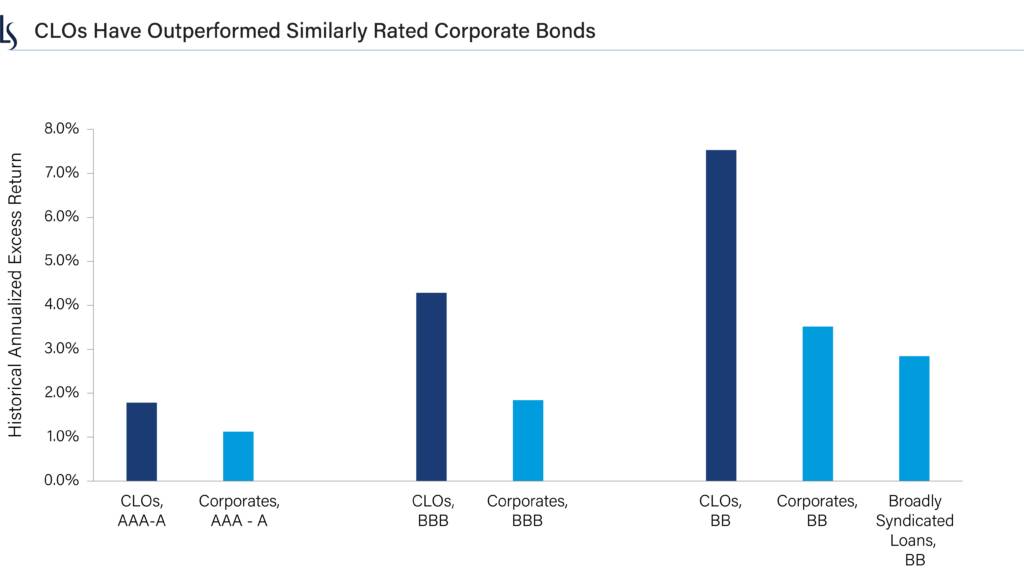
Data Sources: J.P. Morgan DataQuery, Bloomberg, ICE BofA Index, January 2014 – June 2025.[iii] Excess return over 3-month Treasury Bills for CLO/Broadly Syndicated Loan indices. Excess return over duration-matched Treasurys for Corporate AAA-A/BBB/BB Indices. J.P. Morgan data courtesy of J.P. Morgan Chase & Co., Copyright 2025.
The chart presented above is shown for illustrative purposes only.
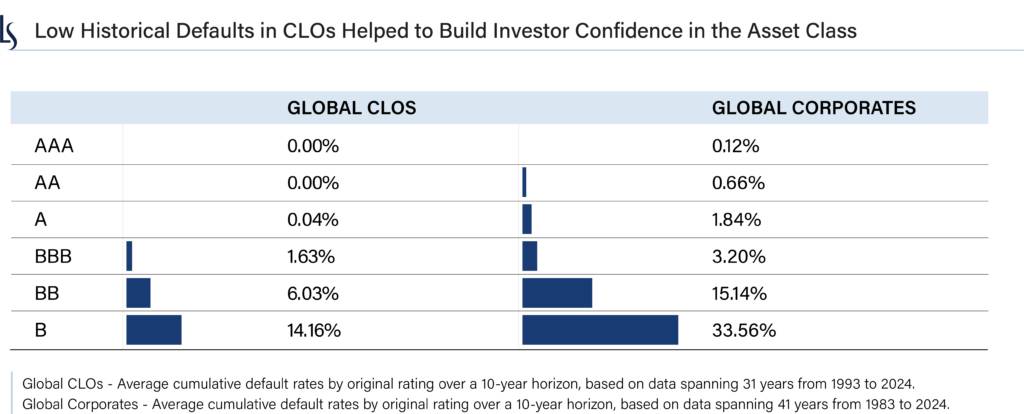
Data Source: Moody’s Ratings, “Structured Finance: Impairment and Loss Rates of Global CLOs: 1993-2024,” published 23 June 2025, and “Annual Default Study: Corporate Default Rate to Fall Below its Long-Term Average in 2025,” published 28 February 2025.
The chart presented above is shown for illustrative purposes only.
- Potential for greater volatility. The enhanced return potential of CLOs comes with greater mark-to-market volatility, particularly in mezzanine tranches, which are lower in the capital structure. Mezzanine tranches are more sensitive to changing market expectations around defaults and the pricing of structural leverage. As investors move down the capital stack, price volatility increases due to the fear of interest payment deferral and principal losses. Historically, CLO lower mezzanine tranches have traded with significantly more volatility than the underlying bank loans, but that price volatility has not resulted in higher defaults.
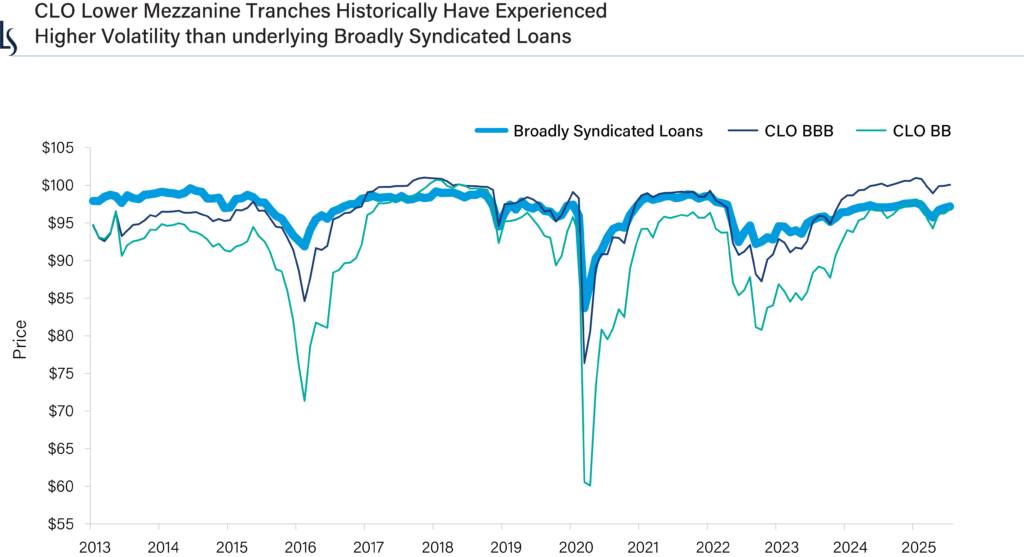
Data Source: J.P. Morgan Data Query, January 2013 – July 2025.[iv] J.P. Morgan data courtesy of J.P. Morgan Chase & Co., Copyright 2025.
The chart presented above is shown for illustrative purposes only. Some or all of the information shown may be dated, and, therefore, should not be the basis to purchase or sell any securities. The information is not intended to represent any actual portfolio managed by Loomis Sayles.
In our view, investing in CLO tranches requires a deep understanding of the underlying collateral, the manager’s strategy, and the deal’s structure. Skilled investors can seek to capitalize on mispricings across the capital stack, between new and seasoned deals, and among different managers.
Considerations for direct bank loan investments
BSLs are senior in the capital structure and secured by the borrower’s assets. They tend to offer a competitive and generally stable yield, and like CLOs, are price-insensitive to interest rate changes due to their floating-rate nature.
- Historically strong volatility-adjusted returns. For investors seeking below-investment-grade floating-rate exposure, BSLs have historically delivered strong volatility-adjusted returns. As illustrated in the chart below, BSLs have historically outperformed when compared to CLO tranches and high yield corporate bonds on a volatility-adjusted basis.
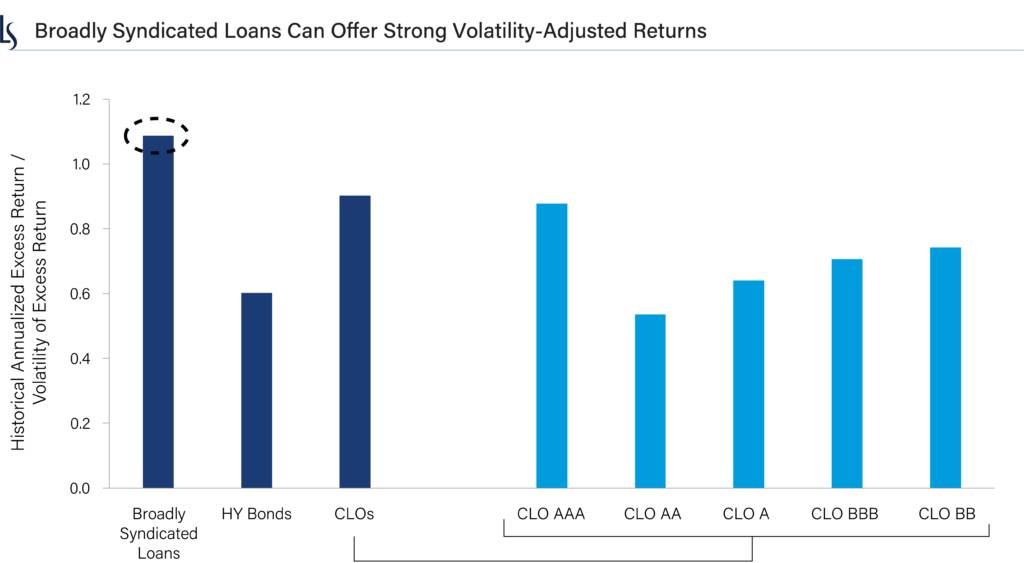
Data Sources: J.P. Morgan DataQuery, Bloomberg, January 2014 – June 2025.[v] Excess return over 3-month Treasury Bills for CLO/Leverage Loan indices. Excess return over duration-matched Treasurys for High Yield Index. JP Morgan data courtesy of J.P. Morgan Chase & Co., Copyright 2025.
The chart presented above is shown for illustrative purposes only.
- Ability to select specific credits and employ tactical strategies. Direct loan investments allow managers to employ active credit selection and industry rotation strategies that help to enhance return potential while seeking to mitigate losses. Market dislocations may present tactical buying opportunities, which loan managers could harness. Dedicated loan portfolios are typically less constrained by structural guidelines, allowing managers to participate in restructurings and capitalize on rating downgrades.
Bank loans are not immune from technical pressures and volatility, but the fundamentals matter most. In our view, they merit a place in many portfolios as a yield producer and a volatility reducer.
The choice depends on an investor’s objectives
As with any investment vehicle, we believe the right choice depends on an investor’s objectives. For those seeking higher return potential and willing to accept greater volatility, we think CLOs offer a robust and scalable solution. For investors prioritizing volatility-adjusted performance, dedicated loan products may be a more suitable option for non-investment grade floating-rate exposure, in our view. However, many investors may choose to invest in both!
Endnotes
[i] Source: Bloomberg, as of 31 August 2025.
[ii] Bank of America Research, Intex, LCD, as of June 2025.
[iii] CLOs, AAA-A represented by the J.P. Morgan US CLOIE AAA, AA and A Indices. Corporates, AAA-A represented by the ICE BofA AAA-A US Corporate Index. CLOs, BBB represented by the J.P. Morgan US CLOIE BBB Index. Corporates, BBB represented by the Bloomberg Baa Corporate Total Return Index Value Unhedged USD. CLOs BB represented by the J.P. Morgan US CLOIE BB Index. Corporates, BB represented by the Bloomberg Ba US High Yield TR Index Value Unhedged USD. Broadly Syndicated Loans, BB represented by the J.P. Morgan Leveraged Loan Index BB Value.
[iv] Broadly syndicated Loans represented by the J.P. Morgan Leveraged Loan Index Value. CLO BBB represented by the J.P. Morgan US CLOIE BBB Index. CLO BB represented by the J.P. Morgan US CLOIE BB Index.
[v] Broadly syndicated loans represented by the J.P. Morgan Leveraged Loan Index Value. High yield bonds represented by the Bloomberg US Corporate High Yield Total Return Index Value Unhedged USD. CLOs represented by the J.P. Morgan US CLOIE Index. CLO AAA represented by the J.P. Morgan US CLOIE AAA Index. CLO AA represented by the J.P. Morgan US CLOIE AA Index. CLO A represented by the J.P. Morgan US CLOIE A Index. CLO BBB represented by the J.P. Morgan US CLOIE BBB Index. CLO BB represented by the J.P. Morgan US CLOIE BB Index.
8374349.1.1
Diversification does not ensure a profit or guarantee against a loss.
Market conditions are extremely fluid and change frequently.
This blog post is provided for informational purposes only and should not be construed as investment advice. Any opinions or forecasts contained herein reflect the subjective judgments and assumptions of the authors only and do not necessarily reflect the views of Loomis, Sayles & Company, L.P. Information, including that obtained from outside sources, is believed to be correct, but Loomis Sayles cannot guarantee its accuracy. This material cannot be copied, reproduced or redistributed without authorization. This information is subject to change at any time without notice.
Meet the Authors