
Back to the Future? US Autos Face a 1970s-Style Shock
US auto sector credit spreads are near all-time tights,i but we see little compensation for building structural and cyclical risks. The current competitive landscape for the US auto sector bears a striking resemblance to the 1970s, when oil shocks drove consumers toward smaller, more efficient vehicles while US automakers were geared toward large gas guzzlers. Japanese manufacturers captured meaningful market share with cheaper, higher-quality alternatives. Today, we see similar forces at work, but the disruption may be even more profound, as US automakers face intensifying Chinese competition, rising capital intensity, tariff-driven cost inflation, and a fragile consumer backdrop.
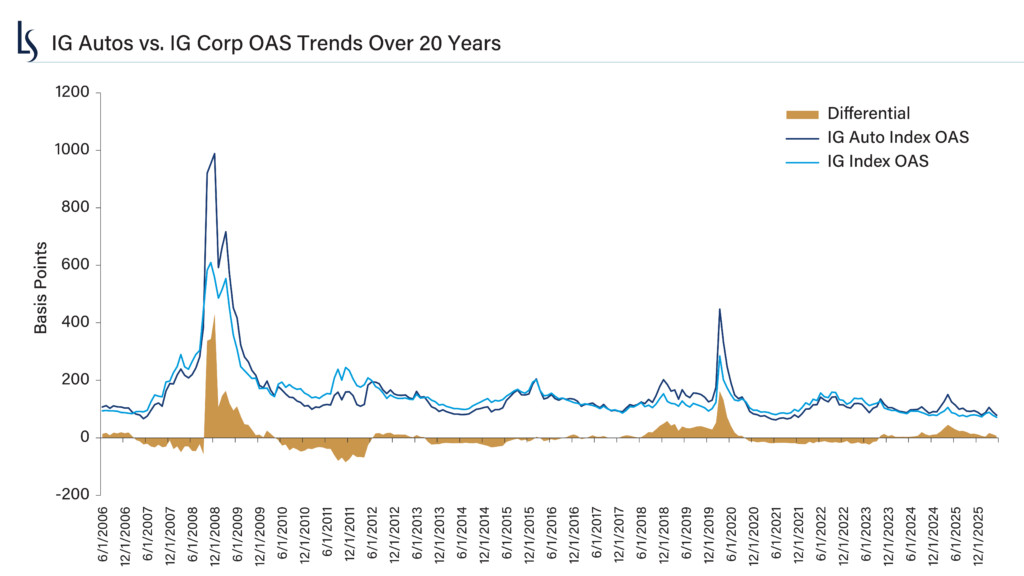
Source: Bloomberg LP, as of May 29, 2026. IG=Investment Grade. OAS=Option-Adjusted Spread. IG Index represents the Bloomberg US Corporate Bond Index. IG Auto Index represents the auto sector portion of the Bloomberg US Corporate Bond Index.
The Competitive Gap is Closing
Chinese carmakers are expanding globally with competitively priced, feature-rich electric vehicles (EVs) as elevated fuel costs drive consumers toward more affordable and fuel-efficient alternatives. Backed by clear technological advantages in batteries and software, and shorter development cycles (as little as 18 months vs. roughly 4 years for Western peers), they are closing the gap with US incumbents far faster than the Japanese did a generation ago. Meanwhile, the legacy manufacturers in the US remain stuck navigating the tension between protecting profitable internal combustion engine franchises and funding the capital-intensive pivot to electrification/software-defined vehicles.
The Cost of Reinvention
The EV transition comes at a steep cost. US automakers have recognized close to ~$50 billion in cumulative impairment charges, asset write-downs and accelerated depreciation tied to EV investments, a permanent destruction of invested capital that materially reduces the asset base underpinning future earnings power.ii Taking impairments early was prudent in our view, but execution risk has grown as US-based incumbents restructure while competitors abroad invest aggressively with no signs of decelerating. As the US industry resets and capital intensity rises, we see a risk that sector-wide return on invested capital structurally compresses, with the incremental dollar invested generating diminishing returns. If returns trend below their weighted average cost of capital for an extended period, we believe issuers face a difficult choice: accept lower profitability and increase leverage to maintain investment, or pull back and cede further ground to better-capitalized competitors. Otherwise, we see the potential for sustained value destruction.
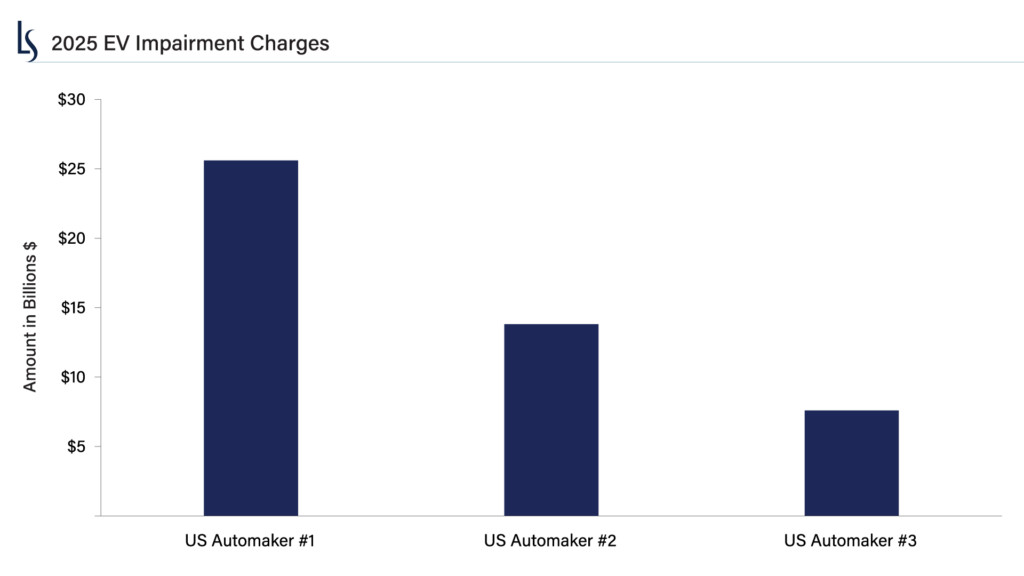
Source: US automaker company filings, Bloomberg, as of March 31, 2026.
Tariff-Driven Pressures
Tariffs are adding fuel to the fire. Tariffs have pushed automakers to divert capital toward localizing production, effectively crowding out the investment needed to close the widening EV development gap with Chinese competitors who already dominate the battery value chain end-to-end. History suggests that protectionist policy has its limits. Protectionist measures in the 1970s and 80s (including voluntary export restraints and coordinated currency interventions) slowed but did not prevent Japanese manufacturers from capturing meaningful market share. Instead, Japanese companies adapted, building transplant factories on US soil and pushing upmarket into the most profitable segments of the internal-combustion product portfolio. Chinese automakers appear to be following the same playbook, steadily expanding their footprint across both developed and emerging markets as trade barriers keep them out of the US market.
A Fragile Consumer Backdrop
On the demand side, the consumer backdrop appears fragile. Elevated transaction prices, lean inventories and all-time high monthly payments have been sustained largely by higher-income buyers purchasing higher-margin vehicles. Auto loan delinquencies are approaching levels seen during the Global Financial Crisis (GFC), loan terms continue to stretch and the labor market appears increasingly vulnerable. The 1990s offered a cautionary parallel: the SUV boom created a false dawn for the big US automakers, masking competitive vulnerabilities that culminated in GFC-era bankruptcies. In our view, a shift toward a less-profitable vehicle mix, coupled with persistent cost inflation and elevated capital expenditures and research & development, would be a perfect storm that is not priced into current valuations.
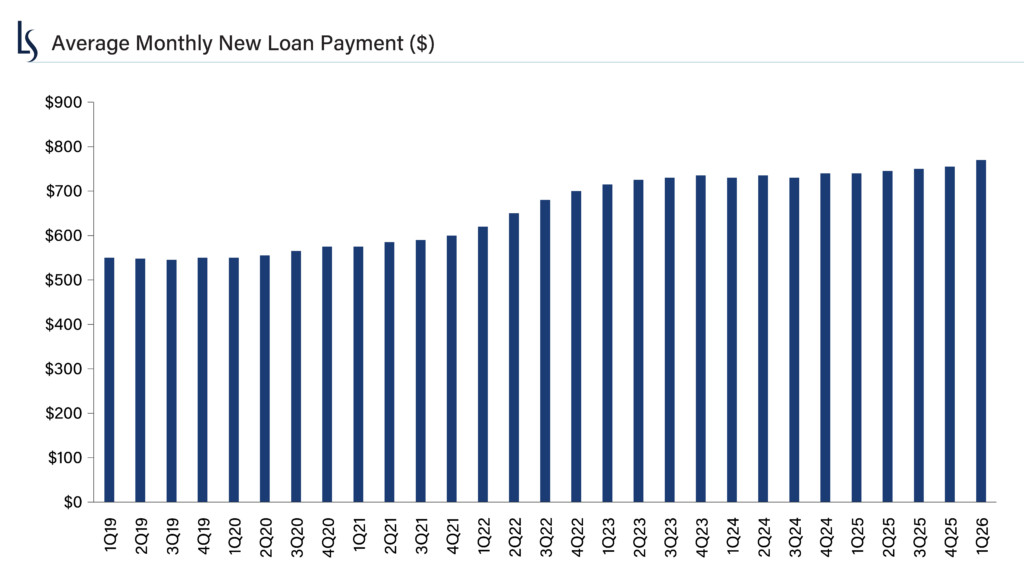
Source: Experian, as of March 31, 2026.
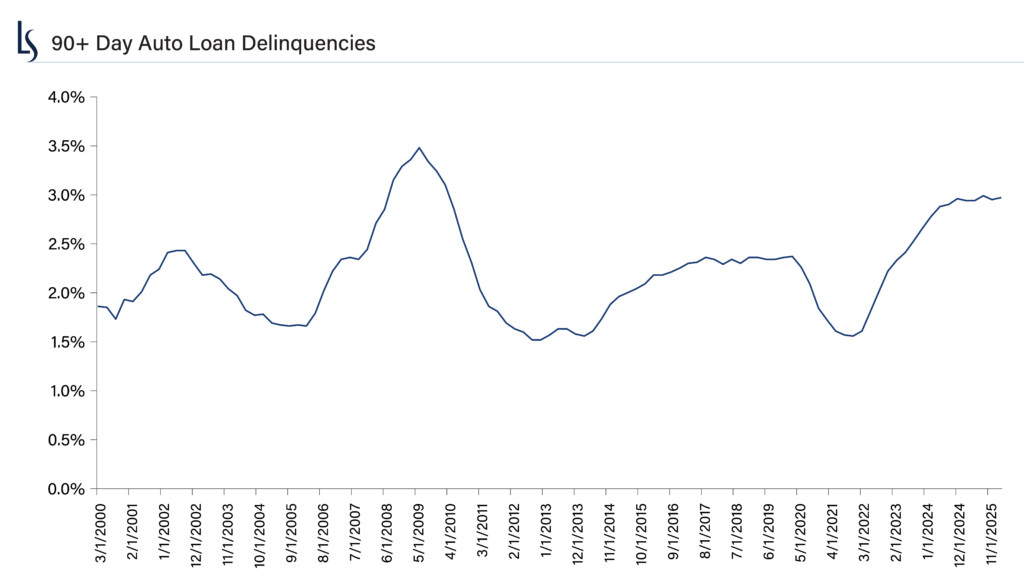
Source: Bloomberg, as of March 31, 2026.
Tight Spreads and a Vulnerable Reality
We believe that valuations in the US auto sector are increasingly at odds with the sector’s risk profile. The auto sector is navigating one of the most complex operating environments in decades, yet credit spreads remain near historic tights.iii We favor issuers with diversified powertrain offerings and balance sheet flexibility, but in our view, the sector remains exposed to a catalyst that could force a repricing of risk. If the 1970s are a guide, such gaps can close abruptly.
Endnotes
i Source: Bloomberg, as of May 29, 2026.
ii Source: Company filings, Bloomberg, as of March 31, 2026.
iii Source: Bloomberg, as of May 29, 2026.
Disclosure
Any investment that has the possibility for profits also has the possibility of losses, including the loss of principal.
Market conditions are extremely fluid and change frequently.
This blog post is provided for informational purposes only and should not be construed as investment advice. Any opinions or forecasts contained herein reflect the subjective judgments and assumptions of the authors only and do not necessarily reflect the views of Loomis, Sayles & Company, L.P. Information, including that obtained from outside sources, is believed to be correct, but Loomis Sayles cannot guarantee its accuracy. This material cannot be copied, reproduced or redistributed without authorization. This information is subject to change at any time without notice. Market conditions are extremely fluid and change frequently.
Indices are unmanaged and do not incur fees. It is not possible to invest directly in an index.
8993015.1.1
Author
