
An LDI Playbook for 2026

Many corporate pension plan sponsors likely view 2025 as a strong year for the continued health of their plans.
Liability discount rates remained above 5% for the entire year and were tightly bound within a 35-basis-point range, the tightest range in the past 15 years.1 This stability in liabilities was paired with strong investment returns across many widely used asset classes in pension portfolios. Most US equity benchmarks returned between 10-20%, while international equity benchmarks delivered returns above 30%. US fixed income credit markets were also strong with returns in the 5-10% range depending on quality, duration and sector.
Key Takeaways
- Fine tune, don’t overhaul. Many plan sponsors are well positioned and should focus on incremental adjustments rather than wholesale changes—especially to avoid surrendering hard-won gains at the finish line.
- Look beyond traditional LDI. With tight credit spreads and elevated equity valuations, diversify into securitized assets, investment grade private credit, and cash flow matching structures to potentially enhance risk-adjusted outcomes.
- Build for resiliency and durability. Strategies designed for stability will better withstand market turbulence and preserve hard-earned gains through potential periods of volatility.
- Evaluate PRTs. The PRT market appears to have a steady path forward despite recent noise, but expect increased scrutiny on transaction execution.
As we kick off 2026, how should plan sponsors be shaping their strategies? Which priorities deserve the greatest focus?
Here is our take on five key considerations.
1 | Focus on Resiliency in Asset Allocation
Many plans are now in a surplus position with optionality on the table. We suggest these plans focus on resiliency
so that hard-earned gains are not lost if markets turn unfavorable.
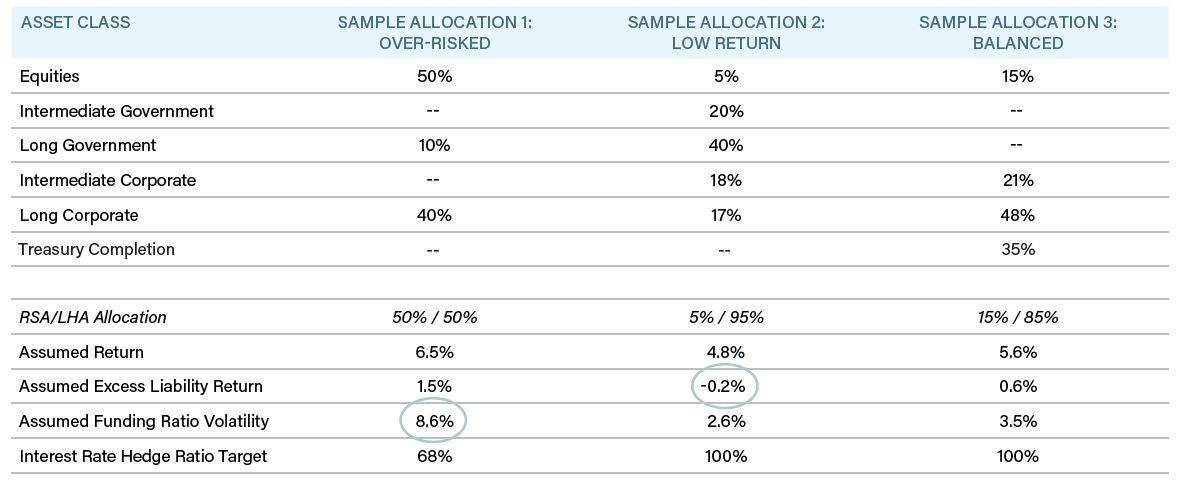
For example, not all 105% funded plans are created equal in terms of their ability to withstand certain market
environments. Consider the three examples below:
- Sample Allocation 1 remains underhedged with a reasonably high funding ratio volatility. Even a one standard
deviation event could see the plan funding ratio drop below 100%. - Sample Allocation 2 has the opposite problem; while the interest rate hedge ratio is 100% and funding ratio
volatility is low, the potential returns are not sufficient to keep up with the liabilities. This plan’s funded status would
likely deteriorate over time. - Sample Allocation 3 provides a reasonable balance between risk and return. Funding ratio volatility is at a
sufficiently low level and assumed returns are 0.5% annualized over the liability return—a suitable target to cover
administrative expenses and liability headwinds over time. The allocation also utilizes a Treasury Completion sleeve
to target a specific hedge ratio and fine-tune key rate duration mismatches.
SAMPLE ASSETS ALLOCATION: 105%
Asset Allocation
Source: Loomis Sayles analysis. See Capital Market Assumptions Methodology.
2 | Secure Your Plan with Securitized
While long corporate spreads have remained tight compared to history, many plan sponsors have considered boosting allocations to securitized assets to help diversify exposure while maintaining competitive yields and elements of duration hedging.
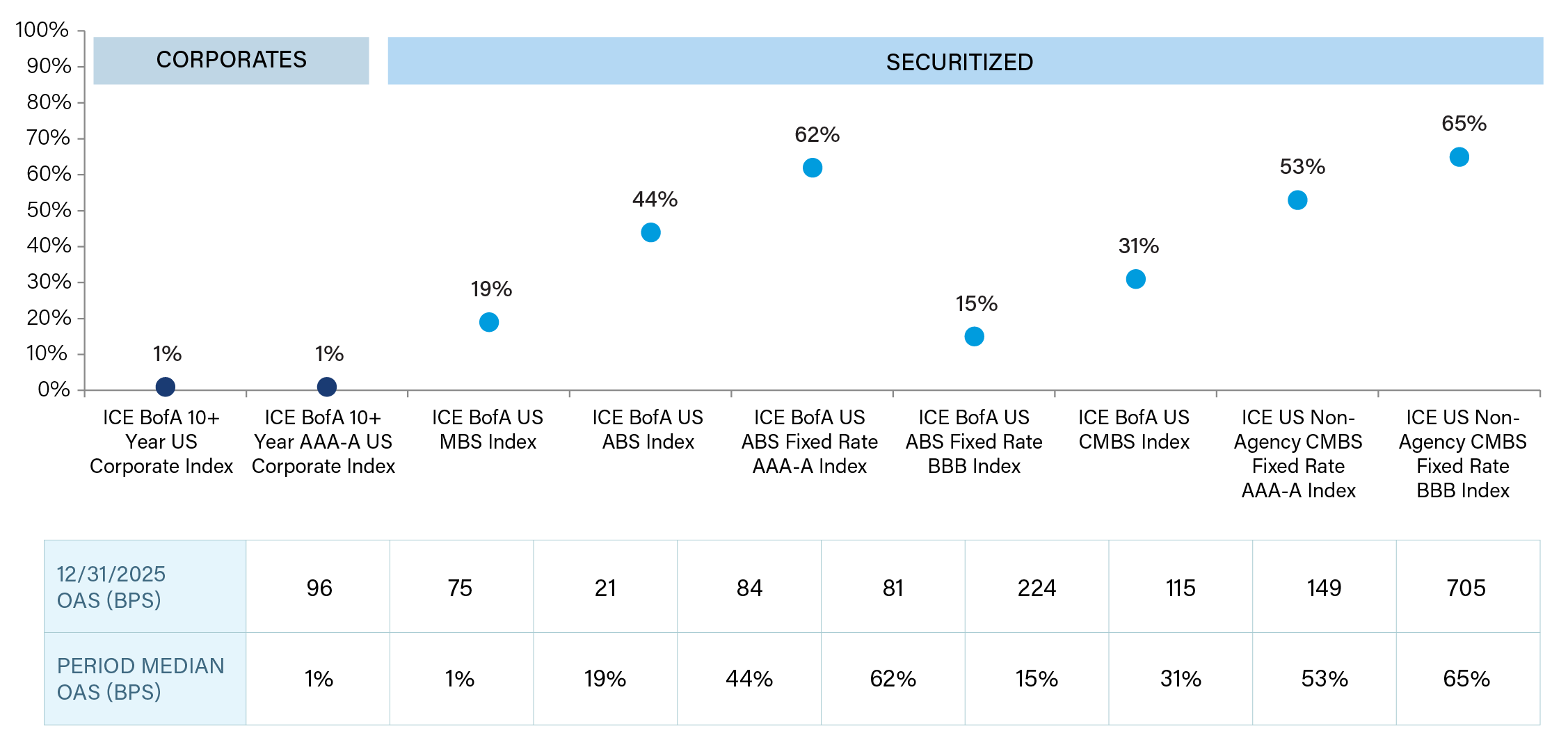
Throughout 2025, corporate bond spreads remained tight compared to historical norms. As of year-end, long-duration corporate spreads were at their richest levels relative to the past 16 years (December 2009– December 2025). In contrast, securitized sectors such as ABS, MBS and CMBS were more fairly valued. Plan sponsors will be quick to point out the lack of depth in the long-duration securitized market outside of certain lower-yielding agency CMBS and agency CMOs.
This is why we advocate for broad securitized exposure across the maturity spectrum paired with an increase in the duration of Treasury allocations (e.g., physical bonds, STRIPS or Treasury futures) to maintain overall interest rate hedge ratios. In particular, we believe securitized credit in the belly of the curve can provide diversification with a spread risk that is reasonably correlated to high-quality long duration liability spreads. Furthermore, as plans have matured and liability durations have gradually decreased, we see less of a need to seek longer-duration securitized assets; broadening the maturity constraint opens up a wider opportunity set with higher potential returns.
SECURITIZED IN PENSION ALLOCATIONS
Spread levels may provide attractive entry points relative to long corporates
Current Index OAS Percentile Rank Relative To Period History
12/31/2009 – 12/31/2025
Source: ICE index data. Percentile Rank and Median OAS are based on data from 12/31/2009 through 12/31/2025.
Views and opinions expressed reflect the current opinions of the Pension Solutions team only, and views are subject to change at any time without notice.
Other industry analysts and investment personnel may have different views and opinions.
Indices are unmanaged and do not incur fees.
Past market performance is no guarantee of future results.
3 | Match Cash Flows
Plan sponsors have spent many years building LDI allocations that primarily serve to hedge the duration of liabilities and control funding ratio volatility. However, as plans reach the end of glide paths, we are beginning to see plans go one step further by having strategies that focus explicitly on delivering cash flows to pay monthly benefit payments.
At a surface level, these cash flow matching strategies may not appear significantly different from traditional LDI strategies, but the implementation approach is nuanced and requires an experienced manager in this space. Below are a few advantages worth considering:
- Avoid forced selling
While ad-hoc redemptions from LDI strategies may work in most environments, forced selling after a market dislocation can be painful. In contrast, as long as the bonds in a cash flow matching strategy do not default (a historically rare event in the investment grade bond sector), there is no selling required—the portfolio can be relied upon to deliver cash flows on a known schedule. This also allows other areas of the portfolio additional time to recover from a downturn. - Seek a yield in line with liability discount rate
Devoting assets to this type of strategy may allow plan sponsors to match or exceed the liability yield, which helps to earn a spread over time. - Low turnover and low transactions costs
In contrast to a total return approach, cash flow matching portfolios are typically managed with minimal trading, which keeps transaction costs contained. - Flexibility
A cash flow matching portfolio can be set up to immunize a longer set of liabilities (e.g., beyond 10 years) or it can be a near-term structure (e.g., 3 years or 5 years). Regardless of the implementation choice, the use of high-quality publicly traded fixed income results in significant flexibility. For shorter-term structures, plan sponsors can tactically choose whether to replenish as the portfolio rolls down or pivot to other more attractive asset classes depending on the market environment.
4 | Consider Investment Grade Private Credit
Private credit continues to be an area of interest for plan sponsors, especially as the public and private fixed income markets show signs of convergence. We believe plan sponsors should consider adding investment grade private credit (e.g., via corporates or asset-based finance) either as a standalone strategy or by allowing existing fixed income managers flexibility to invest in private deals.
Below are a few reasons why investment grade private credit (IGPC) can play an important role in pension portfolios:
- Duration Variation
The IGPC universe consists of a range of fixed-rate obligations across a wide duration spectrum, providing the potential for pensions to match both long- and short-dated liabilities alike. - Issuer Diversification
Diversity in the issuer opportunity set and transaction structures can give pensions access to a broad and differentiated range of underlying risk factors for their investment portfolios beyond what is available in the public markets. - Structural Protection
Covenants may be able to provide both additional lender protections in downside scenarios (higher recoveries
vs. public bonds) and potential yield enhancement via fee income.
While some plan sponsors may have a natural place to house an IGPC allocation (e.g., in a growth fixed income, credit or private debt bucket), other plans may find it challenging to initiate due to their existing structures. In these cases, we suggest incorporating IGPC as an allowable component of a manager’s public corporate or multisector fixed income mandate (e.g., up to 20% in IGPC). This can be a way to gain comfort with the asset class without having to disrupt the existing investment structure.
Ultimately, we believe investment grade private credit can be a natural fit for corporate pensions since it essentially mimics existing public bond allocations with the additional benefits described above.
5 | Evaluate Pension Risk Transfers
After a slowdown in pension risk transfer (PRT) activity during the first half of 2025 and a wave of lawsuits challenging insurer selection practices, many plan sponsors are looking to better understand PRT market dynamics heading into 2026.
There are signs of comfort, including a strong third quarter marked by two jumbo deals over $1 billion, and early indicators that a robust fourth quarter is a reasonable possibility.
While there are likely to be further headlines as these lawsuits play out in the courts, we believe plan sponsors will continue to pursue PRTs if they align with their plan-specific objectives. Despite increased legal scrutiny, insurer appetite remains strong, with competitive forces keeping prices attractive from a plan sponsor standpoint. Plan sponsors will likely increase focus on having a well-documented insurer selection process and continuing to assess their options for timing and pricing of transactions. We have also seen an uptick in plan sponsors executing buy-ins to lock in pricing at higher rates and we expect that to continue.
Overall, despite a significant amount of noise, we see a reasonably steady path forward for the PRT market, albeit with more scrutiny around transaction execution.
Conclusion
Many plan sponsors are in a strong position and are likely to be fine-tuning their pension strategies rather than making wholesale changes. That said, it can be quite painful to lose ground on hard-earned gains right at the finish line.
With tight credit spreads and lofty equity valuations, we believe it is critical to look outside of traditional LDI portfolios and consider securitized assets, investment grade private credit and cash flow matching structures. Plan sponsors with an investment strategy that is set up for resiliency and durability will be better equipped to ride out potential market turmoil and preserve hard-earned gains.
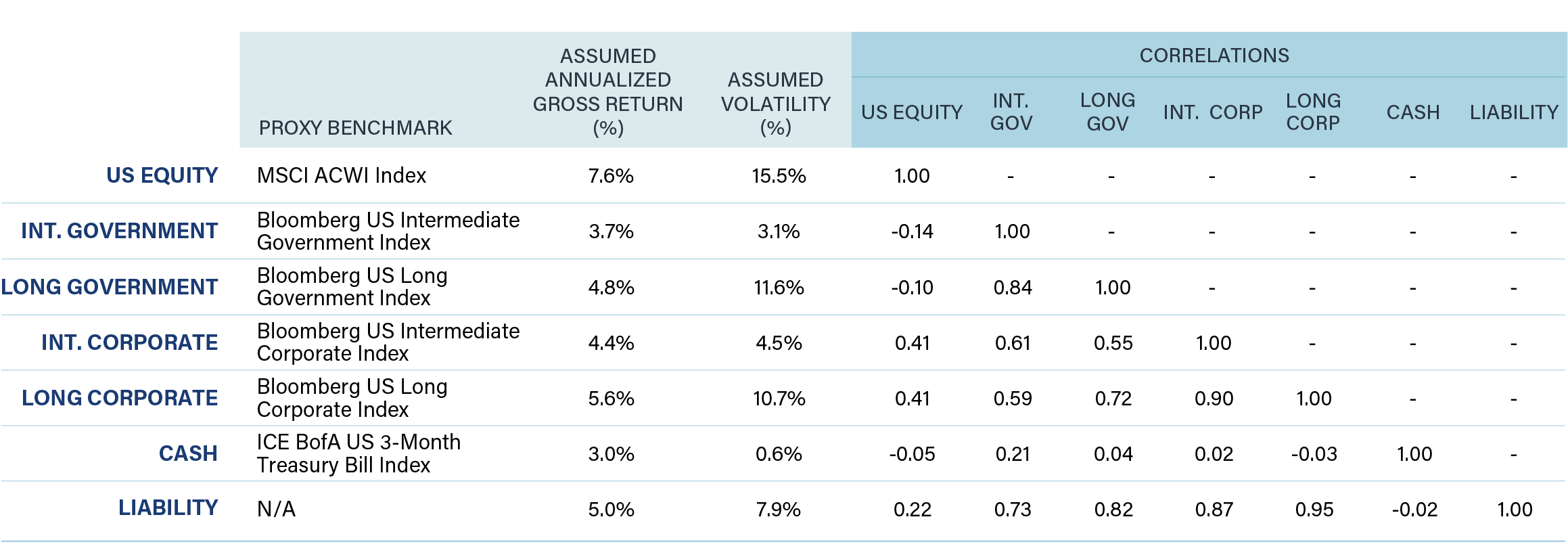
Capital Market Assumptions
Summary by Asset Class
Source: Loomis Sayles analysis. See Capital Market Assumptions Methodology.
Endnotes
1 Based on monthly FTSE Pension Discount Curve – Short data from January 2011 through December 2025. (https://www.soa.org/communities/retirement-practice/ftse-pension-discount-curve)
Important Disclosures
Capital Market Assumptions Methodology Assumed returns for all Return Seeking asset classes use annualized historical index data for the period of December 31, 2000, through December 31, 2025. Assumed returns for all Liability Hedging asset classes uses the current yield to worst of the benchmark as of December 31, 2025. Assumed volatility and correlations are compiled using monthly historical return data for the period December 31, 2000, through December 31, 2025. Liabilities are modeled as an asset class using a duration and credit spread matched blend of fixed income asset classes.
Information is not intended to be representative of any investment product or strategy and does not reflect the fees and expenses associated with managing a portfolio or any other related charges, such as commissions, management fees, transaction costs, taxes and other potential expenses are not considered and would reduce returns. Actual returns may vary significantly. Loomis Sayles makes no representations regarding the reasonableness or completeness of any such assumptions and inputs. Assumptions, inputs and estimates are periodically revised and subject to change without notice. Actual results experienced by clients may vary significantly from the hypothetical illustrations shown.
This marketing communication is provided for informational purposes only and should not be construed as investment advice. Investment decisions should consider the individual circumstances of the particular investor. Any opinions or forecasts contained herein, reflect the subjective judgments and assumptions of the authors only, and do not necessarily reflect the views of Loomis, Sayles & Company, L.P. Investment recommendations may be inconsistent with these opinions. There is no assurance that developments will transpire as forecasted and actual results will be different. Information, including that obtained from outside sources, is believed to be correct, but we cannot guarantee its accuracy. This information is subject to change at any time without notice. This material was prepared for an institutional audience, is it not intended for a retail investor.
Indices are unmanaged and do not incur fees. It is not possible to invest directly in an index.
Past market performance is no guarantee of future results.
Market conditions are extremely fluid and change frequently.
Diversification does not ensure a profit or guarantee against a loss.
Any investment that has the possibility for profits also has the possibility of losses, including the loss of principal.
LS Loomis | Sayles is a trademark of Loomis, Sayles & Company, L.P. registered in the US Patent and Trademark Office.
8700550.1.1
Meet the Author