A Dynamic Approach to Core Fixed Income Investing

Investor demand for core fixed income strategies may wax and wane based on the interest rate environment.
But, we believe investment grade fixed income should always have a place in a diversified portfolio. The critical question is how to implement it.
Key Takeaways
- Core fixed income investing may be necessary for a diversified portfolio, but it’s not necessarily simple.
- Replicating the benchmark does not result in peer-leading returns.
- We believe tactical sector allocation through beta adjustments and strong security selection are necessary ingredients for excess return.
- Our dynamic, active approach has resulted in a strong long-term track record.
A Deceptively Complex Puzzle
Core strategies need to do more than just manage tracking error to a benchmark, typically the Bloomberg US Aggregate Index. Trying to replicate a benchmark can come with some undesired tradeoffs. As of December 31, 2025, the Bloomberg US Aggregate Index posted bottom-quartile returns in the core fixed income manager universe for the 1-, 3-, 5- and 10-year periods.i These returns highlight the shortcomings of an autopilot approach to core fixed income investing. Importantly, many active core strategies can and have generated attractive relative returns for investors over a market cycle (as shown on page 8).
The investment universe for core strategies is vast and comprised of US Treasurys, agencies, agency mortgages, investment grade corporate bonds, CMBS and ABS. The economic and fundamental drivers of these investment grade sectors are markedly different. Therefore, making impactful, well-timed use of these sectors can be a challenge, even for the savviest investor. As illustrated in the table below, each sector offers a distinct contribution to a diversified portfolio. Within the Loomis Sayles Core Fixed Income strategy, we dynamically allocate among these sectors based on top-down views and populate them with our best bottom-up security ideas.
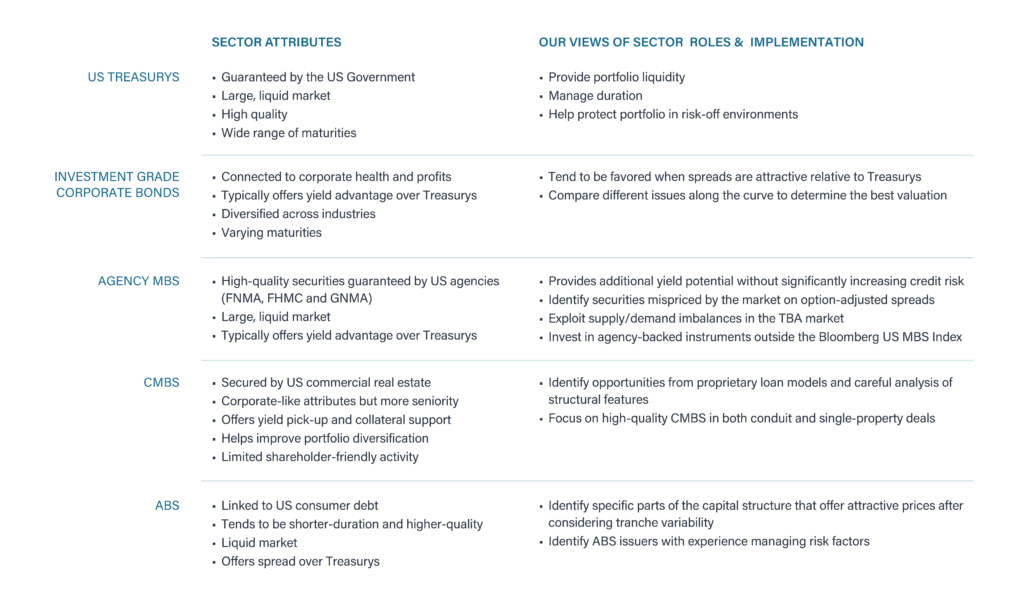
The table reflects the current opinions of the Core Fixed Income Team as of December 31, 2025. Views are subject to change at any time without notice. Other industry analysts and investment personnel may have different views and assumptions.
Macro sector teams, composed of portfolio managers, traders and macro analysts, furnish top-down macroeconomic insights, which are important inputs into our portfolio allocation. Market sector teams leverage the firm’s credit cycle framework, a model that analyzes changing credit conditions over time, to forecast sector returns, comprehensively assess risks and provide relative value recommendations. Using our sector team views as a baseline, we develop sector allocations across the core fixed income universe. To size these allocations, we primarily consider contribution to beta, a measure of risk and return potential.
Why Use Beta?
We believe beta is a more accurate way to measure our relative risk than simply relying on market value. Relative risk in beta terms may be different than market value weights because beta also incorporates duration, spread and historical volatility. In simpler terms, a beta greater than zero implies an overweight, while a beta of less than zero implies an underweight. Higher values also indicate greater relative risk exposure. For example, the two bonds in the table below are from the same industry, have identical portfolio market value weights and are represented in the benchmark. However, contribution to beta, both absolute and relative, differs materially due to distinct duration and spread characteristics.
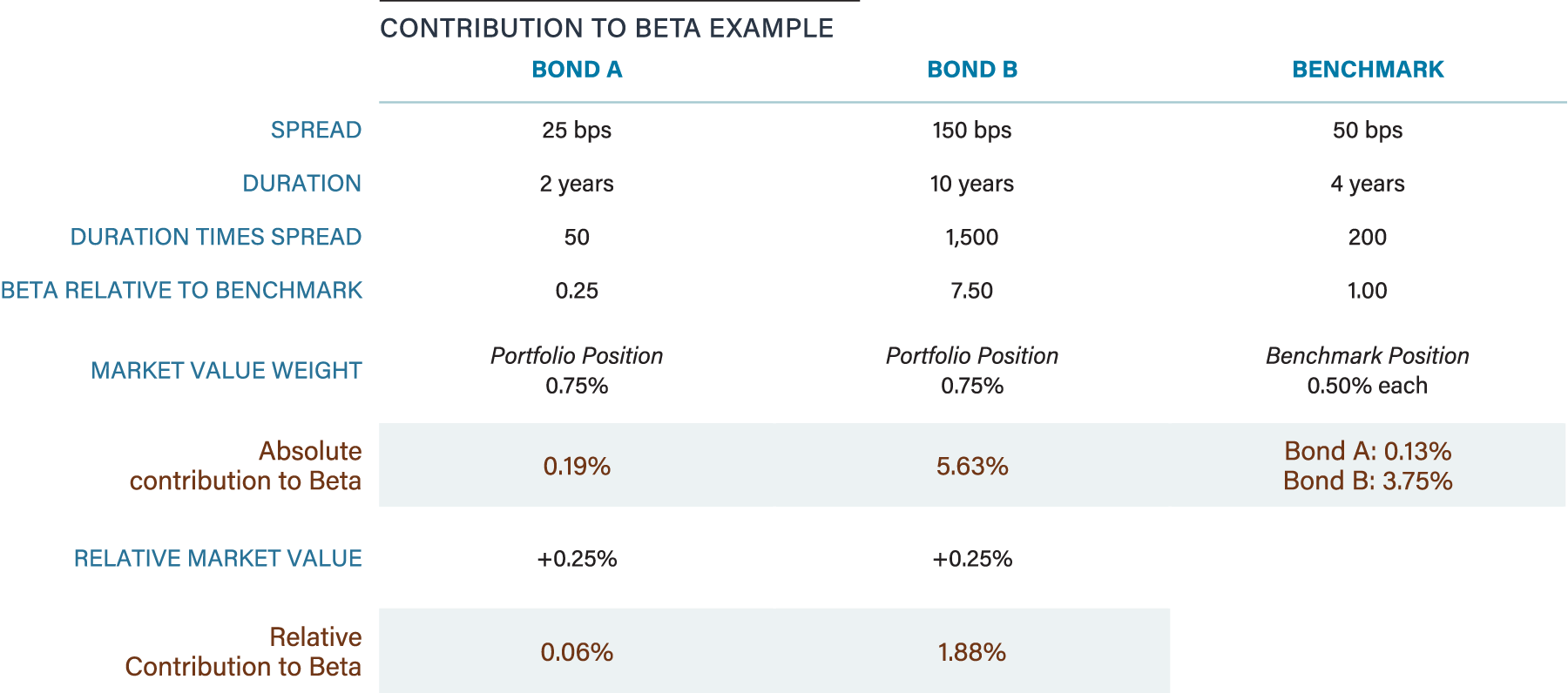
The example presented above is shown for illustrative purposes only. Some or all of the information may be dated, and, therefore, should not be the basis to purchase or sell any securities. The information is not intended to represent any actual portfolio managed by Loomis Sayles.
For us, contribution to beta is more than just a historical reflection of risk or volatility. It is a dynamic investment tool that we use to actively assess prospective relative risk at the security, sector and portfolio level. Our customized contribution-to-beta models guide us in determining appropriate sector weights by considering valuations, spread levels and different market outcomes.
Our Active Approach to Sector Allocation
We have dynamically shifted our beta exposures across sectors over time, as the charts below illustrate. Sector betas are actively managed and change as the relative attractiveness of each market evolves over time.
Our sector allocation process considers fundamental analysis and valuations relative to risk as well as the macroeconomic landscape. We leverage Loomis Sayles’ deep research capabilities and proprietary tools to help us frame our understanding of risk and shape our views on valuations. If valuations appear robust and we believe we can be compensated for taking risk, we typically dial up our portfolio risk.
In many cases, we use corporate bonds to do this as they generally contribute more risk than other asset classes used in the strategy. If we believe valuations are unattractive or we view the opportunity set as narrow, we typically reduce portfolio risk and migrate toward higher-quality sectors like agency MBS and Treasurys. These higher-quality allocations can act as “dry powder” to capitalize on market opportunities or add to portfolio risk. We believe this valuation-driven approach to sector allocation is a key aspect of our active approach.
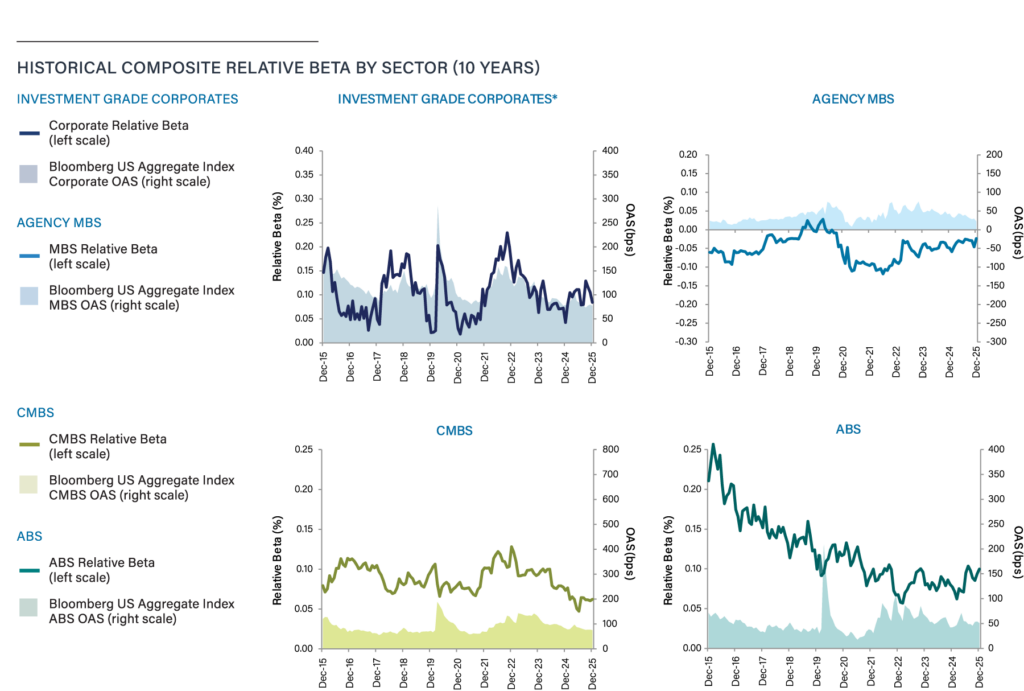
*The corporate beta represents the investment grade corporate portion of the composite as determined by Bloomberg Industry level one.
Source: Loomis Sayles and Bloomberg, from December 31, 2015-December 31, 2025. Beta characteristics are shown as supplemental information for the most actively
managed sectors typically utilized in this strategy. Beta measures the risk of each sector in the portfolio relative to the risk of that sector (Investment Grade Corporate, MBS,
CMBS, ABS) in the Bloomberg US Aggregate Index (recognized as an industry-wide representative index). A beta above zero means that the portfolio has greater risk in
that sector than in the Bloomberg US Aggregate Index. Indices are unmanaged and do not incur fees. It is not possible to invest directly in an index.
Past performance is no guarantee of future results.
High-Conviction Security Selection
After determining sector allocation, we populate portfolios with our best ideas sourced from deep fundamental research. In partnership with Loomis Sayles’ credit and securitized research analysts, we identify what we think are attractive securities and determine appropriate position sizes based on issuer contribution to beta, relative valuation and liquidity. Importantly, fixed income markets have become less liquid but more transparent; an evolution that we believe validates our focus on strong credit research as a key driver of security selection.
As has been widely reported, Wall Street banks’ proprietary trading desk activity has declined due to new regulations while corporate issuance has continued at a robust clip. As a result, bond markets have become less liquid with higher levels of outstanding debt. For money managers like Loomis Sayles, this can create opportunities. We focus on leveraging our deep fundamental credit research to opportunistically identify and purchase fundamentally strong securities at what we consider better valuations, aiming to exploit dislocations from lower liquidity.
At the same time, market information has increased with FINRA’s Trade Reporting and Compliance Engine (TRACE). We are now able to analyze market data to assess what bonds are trading, how often and at what levels. Quantitative insight into market dynamics provides valuable information that informs portfolio construction and implementation.
Furthermore, we have continued to refine the quantitative tools that support our fundamental research. For example, our corporate relative value (CRV) model analyzes an issuer’s curve to help identify mispriced securities. When augmented by the depth of our credit research, we can initiate positions or swap into more favorably priced issues. Similarly, we track trends and nuances of prepayment patterns in securitized debt. We have built data warehouses to monitor prepayment speeds for different types of mortgage pools. Our securitized analysts also assess the fundamental asset and liability structures backing these bonds.
We believe the depth and breadth of our credit and securitized research, combined with the recent evolution of fixed income markets, makes security selection one of our strengths.
Our Approach to Agency MBS
Agency MBS is known for market depth and liquidity. Historically, the sector has also offered higher yields versus Treasurys without significantly increasing credit risk. We look for agency MBS sectors that have a prepayment risk premium but exhibit lower prepayment patterns. The commercial mortgage-backed segment, for example, typically has very stringent prepayment penalties that make it onerous and costly for the underlying loans to refinance. Agency CMBS often offers a higher yield than single-family MBS. Potentially higher return for less risk may seem contradictory, but we find it prevalent in many sub-sectors of the MBS market.
Potential Benefits of an Integrated Approach
Some investors fear a core fixed income allocation will relegate them to interest rate risk, macroeconomic headwinds and lackluster returns. This might be the case for passive investors who sit statically in an asset allocation. Active core fixed income investing requires more than assembling a portfolio from disaggregated pieces of the Bloomberg US Aggregate Index. We believe it requires an integrated approach driven by top-down sector insights and deep fundamental security research.
As evidenced by our strong long-term track record below, our dynamic investment process of tactical sector allocation and strong security selection has been successful when measured against the benchmark.
Historically, our investment process has resulted in consistent risk-adjusted excess returns over the Bloomberg US Aggregate Index. Looking at the past 10 years of trailing 12-month performance, the core strategy has consistently outperformed the benchmark or the median manager. As shown in the charts below, we have also maintained the strategy’s tracking error over time while still offering strong returns and information ratios.
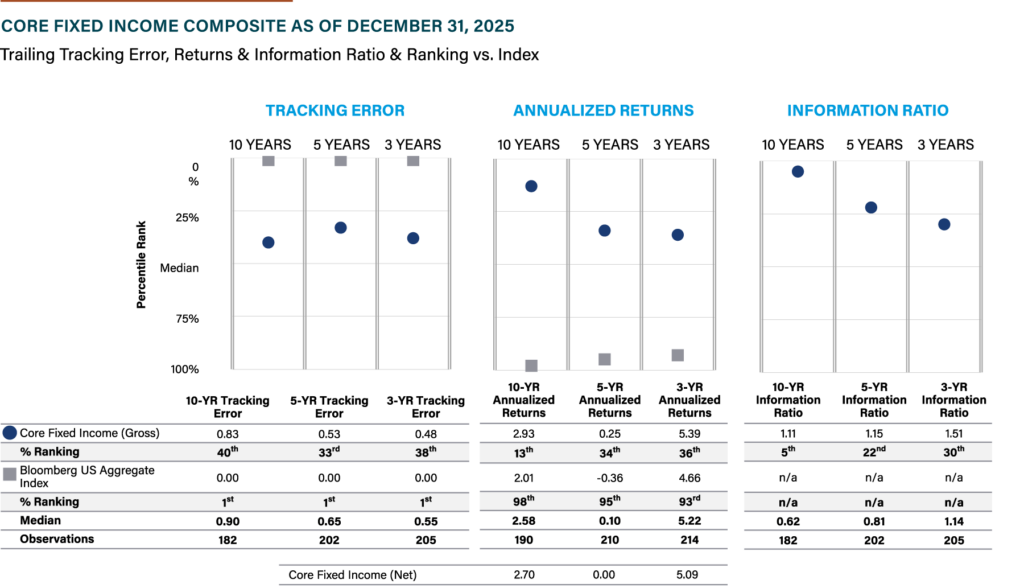
Source: eVestment; Nasdaq eVestment is the ranking agency. Universe: eVestment US Core Fixed Income. This data is provided as supplemental to a full product presentation book. Gross returns are net of trading costs. Net returns are gross returns less effective management fees. Annualized performance is calculated as the geometric mean of the product’s returns with respect to one year. Rankings are based on gross returns and do not take into account management fees or other fees and expenses. The highest (or most favorable) percentile rank is 1, and the lowest (or least favorable) percentile rank is 100. Rankings are subject to change. No compensation is received for ranking. Median is the value for the observations as of the end of each period shown. Although we believe it is reliable, we cannot guarantee the accuracy of data from a third-party source. This information cannot be copied, reproduced or redistributed without authorization in any form.
Please request the GIPS Composite Report for a complete description of the Loomis Sayles Core Fixed Income Composite.
Past performance is no guarantee of future results.
Endnotes
i eVestment Alliance, based on December 31, 2025 data.
About Risk
Investing involves risk, including risk of loss. Portfolios that invest in bonds can lose their value as interest rates rise, and an investor can lose principal. Investments in mortgage securities are subject to prepayment risk, which may limit the potential for gain during a declining interest rate environment and increase the potential for loss in a rising interest rate environment.
Disclosure
Past performance is no guarantee of future results.
Market conditions are extremely fluid and change frequently.
There is no guarantee that the investment objective will be realized or that the strategy will generate positive or excess return.
This marketing communication is provided for informational purposes only and should not be construed as investment advice. Investment decisions should consider the individual circumstances of the particular investor. Any opinions or forecasts contained herein, reflect the subjective judgments and assumptions of the authors only, and do not necessarily reflect the views of Loomis, Sayles & Company, L.P. Investment recommendations may be inconsistent with these opinions. There is no assurance that developments will transpire as forecasted and actual results will be different. Information, including that obtained from outside sources, is believed to be correct, but Loomis Sayles cannot guarantee its accuracy. This information is subject to change at any time without notice.
This material was prepared for an institutional audience, is it not intended for a retail investor.
For more information on the Loomis Sayles Core Fixed Income strategy, please request a current presentation book with GIPS Composite Report.
LS Loomis | Sayles is a trademark of Loomis, Sayles & Company, L.P. registered in the US Patent and Trademark Office.
8821116.1.1
Authors