
Authors


2026 Outlook for Private Credit: Q&A
1. Before we get started, how do you define “private credit?”
The large and diverse private credit market is comprised of non-bank lending, where institutional investors provide debt financing directly to companies, bypassing traditional public markets’ issuance mechanics. It encompasses several segments tailored to different borrower profiles and risk-return characteristics.
In the investment grade (IG) private credit space, there are three key categories: corporate debt, generally long-term, fixed-rate debt issued by highly rated companies, asset-based finance (ABF) debt, which are more collateral-driven loans secured by consumer, commercial or other more esoteric assets, and real assets lending, which includes real estate, infrastructure and project finance.
Away from the IG market, direct lending tends to be smaller, higher-credit-risk lending, focused on middle-market firms and often used for leveraged buyouts or growth financing. There are also other more specialized areas of the market like mezzanine or distressed lending. These segments are designed to provide flexible capital to borrowers and diversification opportunities for investors.
2. It seems that characteristics of the private market IG sector resemble those of the IG credit public market to a degree. Is that accurate?
There are often significant—and arguably increasing—similarities to IG public issues in terms of general characteristics. However, there are notable differences. For example, private credit enjoys a well-established liquidity premium, which compensates investors for holding less tradable assets, and a complexity premium, reflecting customized solutions for structurally intricate transactions.1 Unlike publicly traded issues, private transactions often include lender-friendly protections, such as covenants and customized terms, which are designed to help mitigate downside risk and preserve capital in adverse scenarios. And lastly, there are potential opportunities in private markets that are not available in public markets, offering investors a chance to diversify their portfolio risk exposures.
3. Increased issuance was a significant topic in the private credit market in 2025. What are you seeing in terms of issuance in the market?
Last year, the market saw a notable surge in issuance in the investment grade private credit market. By November 2025, total reported issuance was expected to reach about $175 billion, already $25 billion higher than 2024’s peak, and when all the data is finalized, 2025 is likely to finish above $200 billion.2 That’s a significant jump. It’s important to remember, though, that these numbers only reflect reported deals—some transactions aren’t disclosed, so we believe that the actual volume is even higher.
We have seen this growth attributed to the size of the deals coming to market. There have been 25 deals larger than $1 billion, and roughly 40% of all deals have exceeded $250 million.3 So, it’s not just more deals, it’s bigger deals.
But we think there is more to this story than just larger deals. There has been significant growth in demand from a broad range of investors. The IG market investors used to be dominated by insurance companies. Now, pension funds of all types, foreign investors, and even retail investors to some degree, are stepping in. Not surprisingly, increased demand is driving issuance. But also, as these new lender types enter the market, there is an evolution taking place with structures tailored to suit a broader range of participants.
4. What do you think the implications are for spreads compared to public corporates as we enter 2026?
With regard to spreads, the IG private credit market has consistently shown a premium over public corporates. If you look at the data, you’ll see that average new issue spreads in the IG private credit market are regularly higher than those in the public market. This premium has persisted—and even increased slightly—since the pandemic. We think this is because the market has shifted to meet demand that requires more structured corporates, private asset-backed securities and fund finance transactions, which we find tend to offer higher returns (or “alpha”) for investors due to the complexity premium associated with underwriting more of these deals.
That said, we saw premiums narrow slightly in 2025. Generally, that is because there has been strong demand in the market, particularly from insurance companies who have been increasing their allocations in the space along with new buyers in the market.
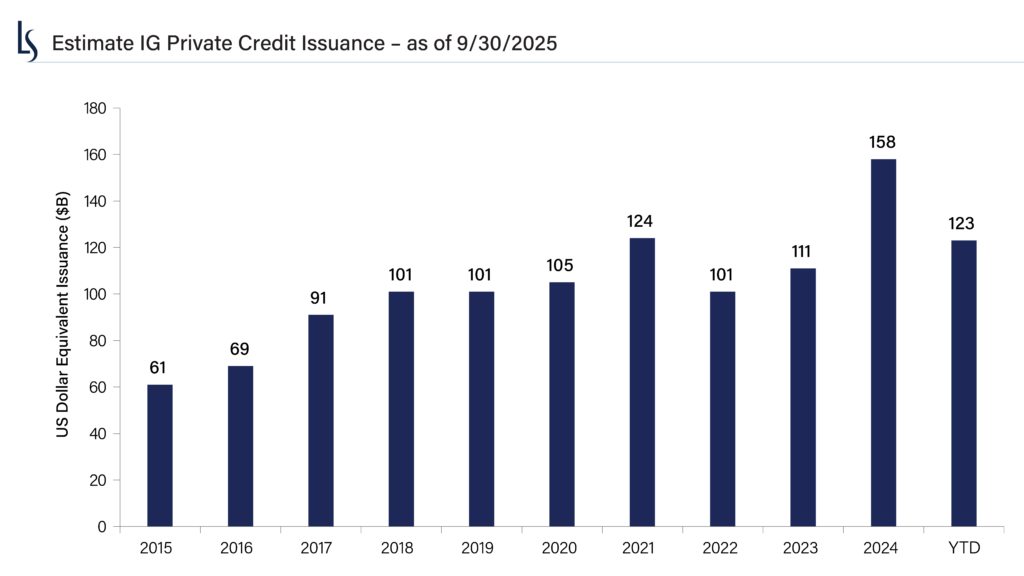
Source: Private Placement Monitor, as of September 30, 2025.
The chart presented above is shown for illustrative purposes only. Some or all of the information on this chart may be dated, and, therefore, should not be the basis to purchase or sell any securities. The information is not intended to represent any actual portfolio. Information obtained from outside sources is believed to be correct, but Loomis Sayles cannot guarantee its accuracy. This material cannot be copied, reproduced or redistributed without authorization.
5. Where do you see opportunities and risks within private credit for 2026 and beyond?
We believe AI- and technology-related capital spending will present the private credit market with interesting opportunities. An increase in mergers and acquisitions and strategic growth investing should also bolster a more diverse set of investment opportunities, in our view. Finally, we believe that delayed realizations in alternative assets (private equity and direct lending), as well as liquidity needs of illiquid and semiliquid fund structures, could present attractive opportunities for solutions-based capital. Strong investor demand should persist, bolstered by the increase in investors attracted to less mature areas of private credit (e.g. ABF), and new sources of non-institutional capital coming online, in our view.
While opportunities are significant, we note that risks remain. One key concern is rising competition among lenders, which could result in compressed yields and more aggressive deal structures. With more money chasing deals, we believe there is a risk of weaker underwriting standards. Additionally, macroeconomic uncertainty—such as interest rate volatility or slower economic growth—may expose weaker borrowers, potentially leading to higher default rates. Lastly, we believe that investors should also keep an eye on regulatory changes; as private credit grows, it will attract more scrutiny, which could impact how deals are structured and executed.
Endnotes
1 Source: Private Placement Monitor, September 9, 2025.
2 Source: Private Placement Monitor, January 13, 2026.
3 Private Placement Monitor as of December 2, 2025.
8726804.1.1
Market conditions are extremely fluid and change frequently.
Diversification does not ensure a profit or guarantee against a loss.
This blog post is provided for informational purposes only and should not be construed as investment advice. Any opinions or forecasts contained herein reflect the subjective judgments and assumptions of the authors only and do not necessarily reflect the views of Loomis, Sayles & Company, L.P. Information, including that obtained from outside sources, is believed to be correct, but Loomis Sayles cannot guarantee its accuracy. This material cannot be copied, reproduced or redistributed without authorization. This information is subject to change at any time without notice
Meet the Authors
