
Author

2026 Outlook for Municipal Credit: Q&A
1. What were the dynamics driving municipal market performance in 2025? Do you expect more of the same in 2026?
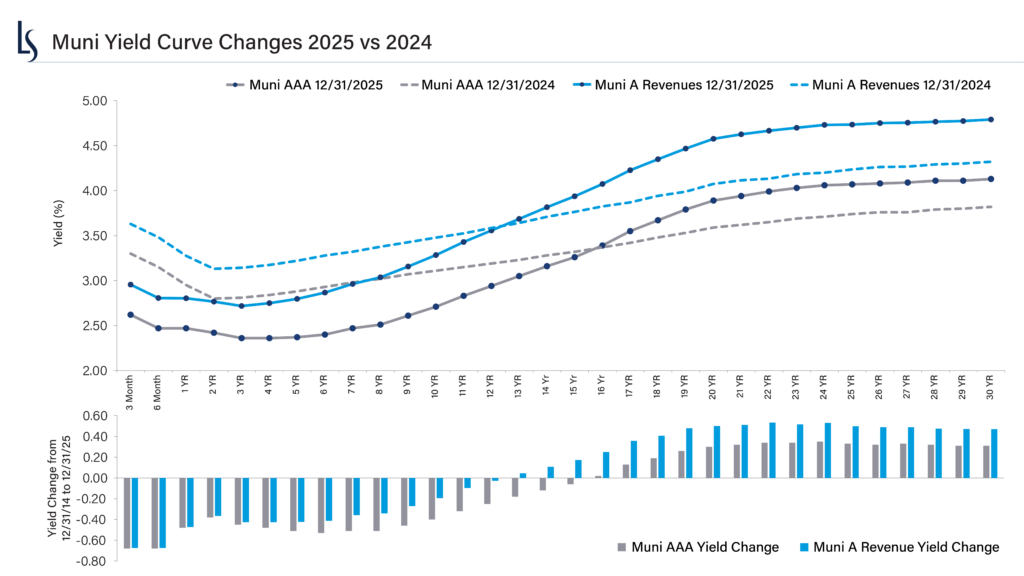
2025 was an eventful year for the municipal market. Falling yields drove strong annual returns (4.3%)1 despite significant swings in the shape of the yield curve, valuations and credit spreads from quarter to quarter. Market fluctuations accompanied a second consecutive year of record issuance, with 2025 supply up 17.1% over 2024 levels.2 The year was characterized by a tale of the two ends of the curve—the yield curve steepened aggressively with the long end moving higher and credit spreads widening for much of the year. That sharply reversed during the fourth quarter as the pace of supply slowed and attractive valuations drove investment further out on the curve, driving underperformance at the short end.
Source: Bloomberg, as of December 31, 2025.
Past market performance is no guarantee of future results.
As we look ahead into 2026, we believe higher nominal rates continue to offer an opportunity for individuals to lock in attractive taxable-equivalent yields. We expect healthy retail demand for the sector, with tax-adjusted yield-to-worst on the Bloomberg Municipal Bond Index at 5.9%.3 Additionally, we think potential for further Federal Reserve rate cuts, paired with wider credit spreads and a steeper yield curve, can support solid municipal market performance in 2026. Conversely, a higher rate environment would lead to more muted returns, but we believe the market’s strong carry component would partially mitigate downside risk.
2. What are the expectations for municipal market technicals in 2026? Can the market absorb another year of strong issuance?
We expect supply to remain elevated in 2026, but the pace may be slightly slower than in 2025. Issuers continue to face higher project costs from inflation, sunsetting pandemic relief funds and decreased federal support. This new reality is likely to drive borrowing needs in the near term. Heavy supply has the potential to oversaturate the market during periods when investors typically reinvest less. However, continued strong demand from retail investors, mutual fund inflows and a growing ETF segment of the market provide a technical anchor that remains supportive, in our view. We would see any further credit spread widening related to technical pressures as an opportunity for investors to selectively add exposure.
3. How do you expect shifting federal policy to impact municipal credit in 2026?
Current federal policy remains less supportive of the municipal market than prior administrations. However, we believe municipal issuers are currently well positioned to weather pressures given tax revenue growth, moderate consumer health and a resilient economy. We may see pockets of weakness in sectors directly impacted by federal spending reductions, such as higher education or hospitals.
Importantly, we are watching the potential impact of cuts to Medicaid from the One Big Beautiful Bill Act (OBBBA) on the state and hospital sectors. While these sectors are likely to remain stable in 2026, we anticipate weakness beginning in 2027 as OBBBA implementation leads to increasing rates of uninsured patients and loss of supplemental funding programs. Negative pressures such as these have the potential to widen the gap between stronger and weaker issuers in bifurcated sectors, underscoring the importance of credit selection in our view.
1 Source: Bloomberg, Bloomberg Municipal Bond Index (LMBITR) as of December 31, 2025.
2 Source: Bloomberg, as of December 31, 2025.
3 Source: Bloomberg, as of December 31, 2025. Calculated using 40.8% effective tax rate, which includes a 37.0% maximum federal income tax rate and a 3.8% net investment income tax to fund Medicare.
8711054.1.1
This material is not intended to provide tax advice. Please seek appropriate professional expertise for your needs. Indices are unmanaged and do not incur fees. It is not possible to invest directly in an index.
Municipal markets may be volatile and can be significantly affected by adverse tax, legislative or political changes and the financial condition of the issuers of municipal securities. Past market performance is no guarantee of future results.
Market conditions are extremely fluid and change frequently.
This blog post is provided for informational purposes only and should not be construed as investment advice. Any opinions or forecasts contained herein reflect the subjective judgments and assumptions of the authors only and do not necessarily reflect the views of Loomis, Sayles & Company, L.P. Information, including that obtained from outside sources, is believed to be correct, but Loomis Sayles cannot guarantee its accuracy. This material cannot be copied, reproduced or redistributed without authorization. This information is subject to change at any time without notice.
Meet the Author
