The Case for Systematic High Yield: Seeking to Enhance Multi-Manager Portfolios Through Complementary Alpha

Executive Summary
For decades, institutional investors have built multi-manager high yield fixed income portfolios by selecting among the industry’s most respected active managers—firms distinguished by deep credit research capabilities, seasoned portfolio management and established track records (traditional managers). This approach may have served investors well, but in our view, it has left meaningful investment opportunities on the table.
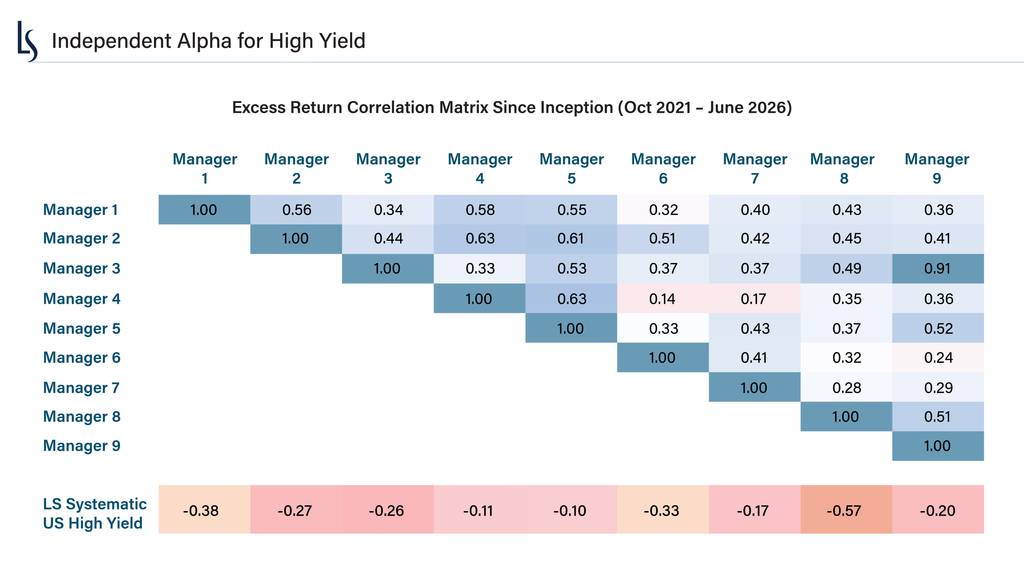
We acknowledge there is resource differentiation across firms. However, evidence exists showing investment focus, individual manager skill and underlying investment processes tend to behave similarly. The following page shows historically elevated correlations among top discretionary managers and the biases of human decision-making.
Key Takeaways
- Multi-manager high yield portfolios composed exclusively of traditional discretionary strategies may be suboptimal, missing out on meaningful diversification benefits that systematic approaches can provide.
- Systematic high yield strategies have delivered low-correlation alpha (approximately -0.27 correlation with top Nasdaq eVestment fundamental peers as of June 30, 2026) through a disciplined, rules-based process that deemphasizes the human element while maintaining the same fundamental investment principles.
- Combining systematic and discretionary approaches helps to create a more robust portfolio: systematic strategies tend to excel in high-dispersion environments and provide consistent coverage across the entire universe, while research-focused managers add value through deep analysis of complex idiosyncratic credit situations and unstructured qualitative data.
- Loomis Sayles’ systematic high yield strategy leverages the firm’s century-long heritage in credit analysis and trading, applying fundamental concepts through a quantitative framework backed by state-of-the-art infrastructure.
- Early adopters of systematic credit strategies can benefit from an emerging asset class that is gaining recognition among institutional investors seeking enhanced alpha and improved risk management.
Section Criteria
Swipe to view more columns
| Primary Investment Approach | Fundamental, with more than $100 million AUM |
| Benchmark | Full US High Yield only benchmarks offered by Bloomberg or ICE BofAML |
| Strategy Exclusions – Systematic | Excludes strategies whose process applies quantitative models, systematic screening or factor-based overlays |
| Strategy Exclusions – ESG / SRI | Excludes strategies that apply ESG screens, responsible investment mandates or sustainability-linked constraints |
| Strategy Exclusions – Distressed | Excludes strategies that explicitly target distressed credits and special situations |
| Strategy Exclusions – Alt Credit | Excludes strategies that allocate to non-core asset classes — loans, CLOs, private credit, convertibles, etc. |
Source: Loomis Sayles, eVestment data as of June 30, 2026.
Excess return correlation matrix is based on gross returns. Gross returns are net of trading costs but do not include the deduction of management or advisory fees, which would lower returns. Although we believe it is reliable, we cannot guarantee the accuracy of data from a third-party source. This information cannot be copied, reproduced or redistributed without authorization in any form. Past performance is no guarantee of future results.
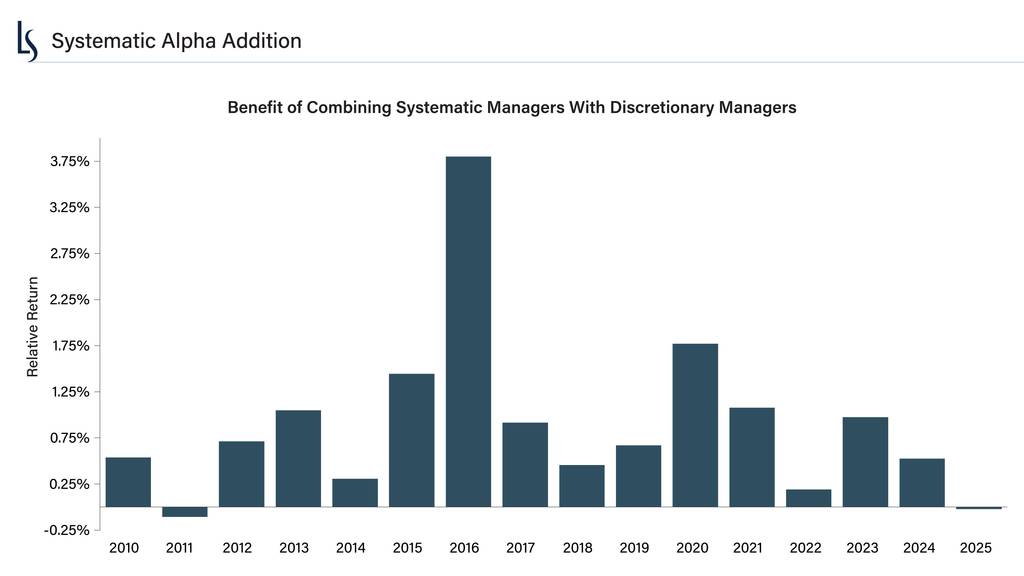
A systematic high yield strategy can address this correlation conundrum by seeking to generate alpha from largely uncorrelated sources, offering institutional investors an opportunity to enhance their multi-manager portfolios without increasing risk. The chart below demonstrates that adding a systematic high yield strategy to a portfolio of traditional managers can enhance overall returns, not because this approach abandons the fundamental principles that have guided investing for generations, but because it applies those principles through a meaningfully different process.
Manager Selection Criteria
Swipe to view more columns
| Reference Benchmark: Full US high yield index offered by ICE BofAML or Bloomberg |
| Primary Investment Approach: Fundamental |
| Performance Fee: Gross AUM: >$100 mil. Account Type: ETF |
| Theme 1 Exclusion: Systematic / model-driven process overlay |
| Theme 2 Exclusion: ESG-focused funds |
| Theme 3 Exclusion: Distressed / event-driven funds |
| Theme 4 Exclusion: Multi-asset / alternative credit |
Source: Loomis Sayles, eVestment data (gross of fees) as of June 30, 2026.
For consultants and institutional investors evaluating their high yield allocations, we believe the case for adding systematic credit exposure alongside human-derived strategies is compelling. This is not a one-or-the-other decision; both approaches offer distinct and valuable strengths. Rather, it is an opportunity to optimize existing portfolios by accessing a complementary potential source of alpha that can enhance diversification and improves overall portfolio efficiency.
This paper delves into how systematic high yield strategies can complement rather than compete with discretionary approaches and why Loomis Sayles can deliver this emerging capability as a stand-alone offering or alongside Loomis Sayles’ signature traditional high yield products.
The Evolution of Systematic Credit Investing
While systematic investing has been prevalent in equity markets for decades, its application to corporate credit is a relatively recent development. The historical barriers were significant: corporate bond markets lacked the transparency and liquidity of equity markets, data on individual bond transactions was scarce and the complexity of modeling finite-life securities with varying terms and seniority presented substantial challenges.
That has changed in recent years. The availability of granular, credit-specific data has expanded dramatically, providing the raw material necessary for firms seeking to build systematic strategies and test their intuition about factor behavior and efficacy. Advances in computational power now enable investment managers to analyze vast datasets with sophisticated models in real time. The explosion of fixed income ETFs has revolutionized trading dynamics, with share creation and redemption activity significantly enhancing market liquidity and enabling efficient portfolio-level transactions. These structural developments have reduced trading costs and improved execution quality, making systematic approaches economically viable.
INVESTORS NOTICING
Systematic high yield strategies are in the early stages of adoption among institutional investors. Forward-thinking allocators are beginning to recognize the potential of this approach. The opportunity for early movers is meaningful—systematic credit strategies represent one of the newest and most differentiated sources of alpha available in fixed income markets. As this capability matures and gains broader recognition, we believe early adopters can potentially secure benefits that strengthen their market position and unlock performance gains for all stakeholders. Crucially, while early adopters will likely benefit more, we view this opportunity as generally persistent for the foreseeable future.
Loomis Sayles: A Century of Credit Expertise Meets Quantitative Innovation
Loomis Sayles has been a trusted fiduciary partner since 1926, renowned for credit research, trading excellence and long-term investment discipline. Our systematic high yield strategy builds directly on this heritage. The systematic high yield team combines former fundamental credit analysts with quantitative researchers and data scientists, translating the firm’s foundational credit principles into a rules-based framework. Importantly, we do not rely on real-time recommendations from our fundamental research department; instead, we have codified the analytical concepts that have guided Loomis Sayles’ success into systematic factors and models.
This heritage of credit expertise reflects decades of demonstrated discipline in navigating complex credit markets through volatility and uncertainty. Loomis Sayles’ legendary investors have long relied on the conviction of their fundamental credit analysis to provide a bid to illiquid markets, purchasing what we believe to be fundamentally sound credits at a discount during periods of market stress. The systematic high yield approach seeks to capture this same disciplined, contrarian mindset by translating those enduring principles into rules and models that remain objective when markets become emotional.
Cognitive Bias Can Limit Portfolio Outcomes
Institutional investors have long constructed multi-manager high yield portfolios to achieve diversification across different firms, investment teams and approaches. The logic is sound; combining multiple skilled managers should reduce idiosyncratic risk and help to create more consistent performance. However, when all managers in a portfolio employ fundamentally similar processes—analysts assessing credit risk, portfolio managers making discretionary decisions about position sizing and traders executing based on judgment linked to market conditions—the diversification benefits may be limited.
Traditional judgment-led high yield management faces structural constraints that limit differentiation. Most importantly, the human element, while a source of strength in many ways, introduces common behavioral patterns across managers. Behavioral finance research has documented numerous cognitive biases that affect investment decisions: overconfidence, anchoring, loss aversion, herding and recency bias, among others.
We believe the strongest case for combining systematic and discretionary approaches is that they originate from fundamentally different processes, creating naturally lower overlap and more robust diversification.
Consider how these behavioral patterns manifest in high yield portfolios. During periods of market stress, humans often become more cautious, raising cash levels and avoiding securities that might present headline risk (such as bonds trading below par). When markets rally, humans may chase performance by adding risk at precisely the wrong time. Conviction in existing holdings can sometimes slow the incorporation of new information that contradicts the original thesis, particularly for positions that have been thoroughly researched and advocated for by credit analysts. Individual analysts often devote more attention to credits held in portfolios, possibly creating an uneven distribution of analytical coverage. Position sizes grow as analysis time and conviction builds, which can amplify the impact of decisions that may be influenced by emotion rather than objective assessment of value.
These shared behavioral patterns can contribute to higher-than-expected correlations among discretionary managers of so-called “differentiated” strategies. This is not an indictment of human-led portfolio management. The best high yield managers can deliver significant alpha and earn their fees through skillful navigation of credit markets. However, combining multiple discretionary managers, even the excellent ones, is likely to provide less diversification than combining discretionary and systematic approaches. The systematic component offers exposure to a genuinely differentiated process that is designed to generate returns from unemotional sources, potentially enhancing the risk-return profile of the overall portfolio.
The Complementary Strengths of Systematic & Discretionary Approaches
The case for adding systematic high yield exposure rests not on the superiority of one approach over another, but on their complementary natures. Both discretionary and systematic strategies draw from the same fundamental principles of credit analysis, seeking bonds that offer attractive compensation for risk, identifying issuers with sustainable business models and avoiding permanent capital losses. What differs is how these principles are applied and which market opportunities each approach is best positioned to capture.
WHERE HUMANS EXCEL
In our view, human analysts excel in ambiguous situations, such as restructurings, complex capital structures or idiosyncratic corporate events, where material qualitative inputs cannot be captured in structured data. Through direct engagement with management teams and deep credit work, discretionary investors can synthesize information that extends beyond observable metrics.
Perhaps most importantly, experienced discretionary managers, such as those at Loomis Sayles, can exercise patience on high-conviction investment theses, maintaining positions through short-term volatility when the long-term fundamental story remains intact. This patience, combined with deep knowledge of specific credits, allows them to potentially add significant value in complex situations where quick, rules-based decisions might miss important context.
WHERE SYSTEMATIC APPROACHES CAN EXCEL
Systematic strategies bring a different set of possible advantages that address the inherent limitations of human decision-making. Consistency is the defining characteristic of systematic investing—models apply the same analytical framework to every security in the universe, without regard to whether a bond is a large benchmark constituent or a small, overlooked issue. This uniform coverage broadens the investment universe and increases the chances that viable opportunities will not be missed.
Systematic strategies process new information nearly instantaneously. When earnings are released, when credit ratings change or when market prices move, systematic models can evaluate the portfolio implications of every affected security against risk budgets and trading costs, executing potentially alpha-positive trades immediately. This rapid response time is particularly valuable in markets where information diffusion varies across securities; less-followed issuers in fragmented markets may be systematically mispriced because analyst coverage is sparse and price discovery is slower.
Discipline is another critical advantage. Systematic strategies adhere to predefined rules in any market environment, including periods of market stress. During periods of stress when humans may show concern, systematic models continue to follow their rules, buying securities that have become dislocated from fundamental value without succumbing to fear. Conversely, when markets rally and valuations become stretched, systematic strategies systematically reduce exposure to overvalued securities, executing trades without hesitation or delay.
The rigorous tracking error control that systematic strategies employ can help neutralize unintended risk exposures. Portfolio construction is optimization-based, targeting the most efficient combination of securities while managing volatility relative to the benchmark. This process-driven approach to risk management is designed to create a more stable return stream, particularly when combined with the routine rebalancing that systematic strategies can execute.
Evidence of Portfolio Enhancement
The theoretical case for combining systematic and discretionary high yield strategies is compelling, but the empirical evidence is even more persuasive, in our opinion. Analysis of top-performing discretionary high yield managers reveals that adding a systematic allocation creates meaningful portfolio improvements across multiple dimensions.
The chart below illustrates an efficient frontier of different investment manager combinations. Specifically, different combinations of our Systematic US High Yield composite (in pale blue) when combined with different, conventional (discretionary) competitors. The efficient frontier was optimized for the highest information ratio for a given tracking error budget. So, for example, for a tracking error budget of 0.8%, the optimal mix of managers to obtain the greatest information ratio is a two-manager combination, with approximately 70% weighted to the systematic high yield strategy and 30% to the manager in yellow.
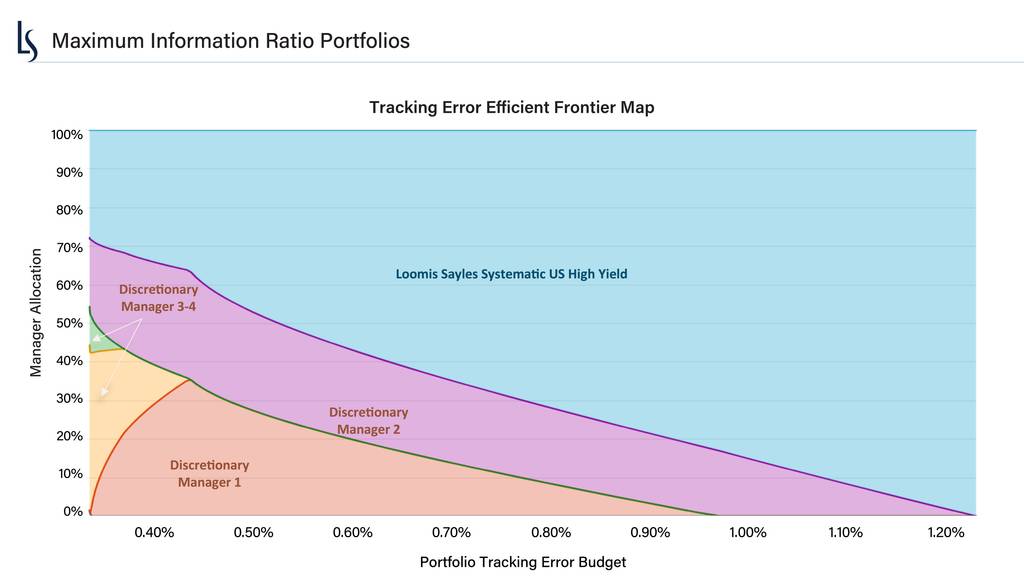
Source: Loomis Sayles, as of June 30, 2026.
Improved Risk-Adjusted Returns
Portfolio-level analysis demonstrates that a 50/50 blend of top discretionary managers with systematic exposure produces superior risk-adjusted returns compared to pure discretionary allocations. The blended portfolio captures the upside of both approaches while reducing drawdown risk. During periods of market stress, the disciplined, rules-based nature of systematic investing helps stabilize returns by maintaining exposure to dislocated securities that offer value. During calmer markets, discretionary managers contribute through their concentrated bets on high-conviction ideas
The issuer composition of systematic and discretionary portfolios differs substantially, with typical overlap of only 10%-20% at the name level. This low overlap exists even when both managers are investing in the same benchmark universe, reflecting the different processes that select and weight. Systematic portfolios tend to hold more diversified positions across a larger number of issuers, while discretionary portfolios usually concentrate in fewer, higher-conviction names. This structural difference enhances the diversification benefit of combining approaches.
The tracking error characteristics of the two approaches can also complement each other. Discretionary managers may take large active bets on duration, credit quality or sector positioning, creating concentrated sources of tracking error. Systematic strategies maintain tighter tracking error budgets with more diversified active risk. Combining them can produce a multi-manager portfolio with more efficient use of the overall risk budget, limiting the unintended concentration risks that can emerge from combining multiple discretionary managers with similar views.
Why Loomis Sayles for Systematic High Yield
We believe successful systematic credit investing requires more than quantitative sophistication. It needs to draw from a foundation of credit expertise, robust infrastructure, trading excellence and the institutional stability to support long-term investment in research, data and technology. Loomis Sayles brings these elements together in a way that few firms can.
Loomis Sayles Systematic High Yield: Strong Performance
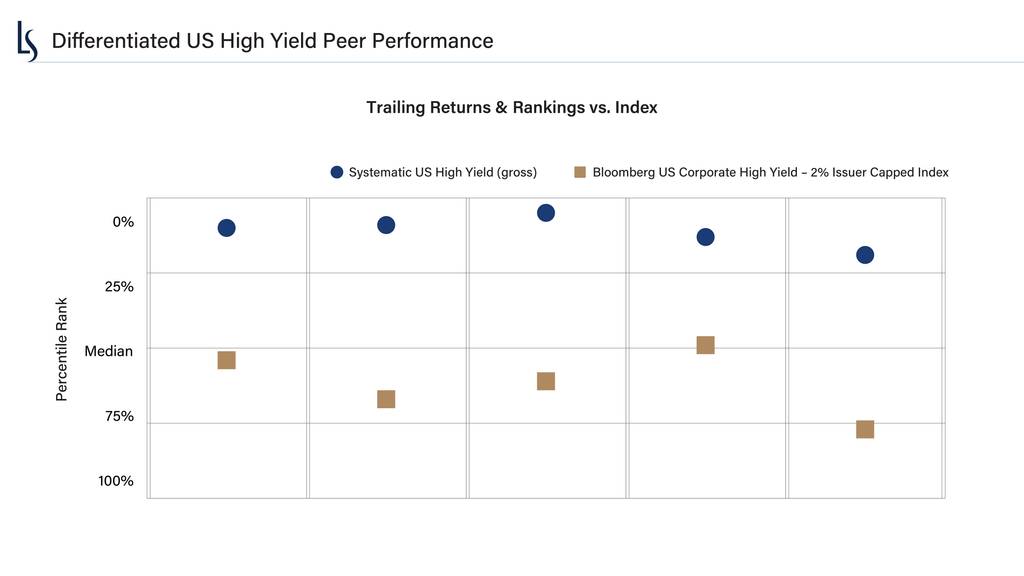
As shown below, our systematic US high yield strategy has demonstrated consistent outperformance across multiple time horizons when compared to Nasdaq eVestment high yield peer groups. The strategy’s performance ranks in the top quartile over 1-year, 3-year and 5-year periods, affirming the effectiveness of our systematic approach. This track record, combined with our institutional infrastructure and credit expertise, positions Loomis Sayles as a compelling choice for institutional investors seeking to add systematic high yield exposure.
The strategy’s excess returns exhibit low correlation to discretionary peers, validating that we have been capturing distinct sources of alpha. Perhaps more importantly, the strategy achieved these returns while maintaining disciplined volatility levels consistent with the strategy’s risk-managed design.
Swipe to view more columns
| Q2 2026 | YTD | 1 Year | 3 Years | Since Inception* | |
|---|---|---|---|---|---|
| Systematic US High Yield (gross) | 3.16 | 2.95 | 8.09 | 9.73 | 5.30 |
| % Ranking | 10th | 9th | 5th | 13th | 19th |
| Bloomberg US Corporate High Yield – 2% Issuer Capped Index | 2.46 | 1.96 | 5.91 | 8.86 | 4.20 |
| % Ranking | 54th | 67th | 61st | 49th | 77th |
| Median | 2.50 | 2.17 | 6.17 | 8.82 | 4.49 |
| Observations | 240 | 240 | 239 | 232 | 222 |
| Systematic US High Yield (net) | 3.05 | 2.72 | 7.61 | 9.24 | 4.83 |
*Inception Date: 10/1/2021.
Source: Loomis Sayles, eVestment data as of June 30, 2026; Nasdaq eVestment is the ranking agency. Universe: eVestment US High Yield Fixed Income. Gross returns are net of trading costs. Net returns are gross returns less effective management fees. Annualized performance is calculated as the geometric mean of the product’s returns with respect to one year. Rankings are based on gross returns and do not take into account management fees or other fees and expenses. The highest (or most favorable) percentile rank is 1, and the lowest (or least favorable) percentile rank is 100. Rankings are subject to change. Loomis Sayles has paid a standard fee to eVestment for access to rankings data. Median is the value for the observations as of the end of each period shown. Although we believe it is reliable, we cannot guarantee the accuracy of data from a third-party source. This information cannot be copied, reproduced or redistributed without authorization in any form.
Past performance is no guarantee of future results.
Our Systematic High Yield team combines former fundamental credit analysts with quantitative researchers and data scientists. This blend of expertise grounds our models in sound credit principles while leveraging cutting-edge quantitative techniques. The team has developed a proprietary library, built through rigorous research and testing. These factors embody the same fundamental concepts that have guided Loomis Sayles’ credit investing for a century, seeking bonds with attractive spreads relative to credit risk, identifying issuers with sustainable business models and investing with a margin of safety.
In our view, the firm’s infrastructure provides meaningful advantages for systematic investing, supporting high-quality data, efficient execution workflows and risk-controlled portfolio construction. At the same time, our traders apply judgment and market insight in situations where human discretion remains essential, ensuring that systematic signals are implemented effectively in real-world liquidity conditions. Traders leverage electronic platforms, dealer relationships, market knowledge and real-time assessment of liquidity conditions to achieve best execution across thousands of trades.
Risk management operates at multiple levels, including systematic constraints within portfolio construction, quantitative risk monitoring and experienced human oversight to address idiosyncratic situations that models may not fully capture.
Technology capabilities are equally important. The firm has invested significantly in data infrastructure, computational resources and trading systems that support all fixed income strategies. This investment reflects Loomis Sayles’ commitment to offering clients a complete suite of capabilities, discretionary and systematic, all supported by the same institutional foundation.
Perhaps most importantly, our systematic strategy benefits from the credibility and client relationships that Loomis Sayles has built over decades. We are not a start-up seeking to prove ourselves, but rather an established firm adding a complementary capability. For institutional investors and consultants, we believe this reduces implementation risk and provides confidence that the strategy will continue to be supported through different market environments and business cycles.
Conclusion:
A Compelling Allocation Decision
Systematic high yield strategies offer a powerful complement to traditional discretionary approaches by introducing a differentiated, low-correlation source of potential return designed to enhance portfolio efficiency without increasing risk. By combining the judgment and flexibility of discretionary managers with the consistency and discipline of systematic strategies, institutional investors can build more resilient, diversified high yield allocations.
FOR MORE INFORMATION
To learn more about Loomis Sayles’ Systematic High Yield strategies and how they can enhance your multi-manager portfolio, please contact your Loomis Sayles representative or visit www.loomissayles.com.
Important Information and Disclosures
Past performance is no guarantee of future results.
This material is provided for informational purposes only and should not be construed as investment advice. Investment decisions should consider the individual circumstances of the particular investor. Any opinions or forecasts contained herein reflect the subjective judgments and assumptions of the authors only, and do not necessarily reflect the views of Loomis, Sayles & Company, L.P. Investment recommendations may be inconsistent with these opinions. There is no assurance that developments will transpire as forecasted and actual results will be different. Data and analysis does not represent the actual or expected future performance of any investment product. Information, including that obtained from outside sources, is believed to be correct, but we cannot guarantee its accuracy. This information is subject to change at any time without notice.
There is no guarantee that the investment objective will be realized or that the strategy will generate positive or excess return.
Any investment that has the possibility for profits also has the possibility of losses, including the loss of principal.
Diversification does not ensure a profit or guarantee against a loss.
This information is intended for institutional investors only. Not for use with a retail audience.
LS Loomis | Sayles is a trademark of Loomis, Sayles & Company, L.P. registered in the US Patent and Trademark Office.
FOR INSTITUTIONAL USE ONLY. NOT FOR FURTHER DISTRIBUTION.
9111396.1.1
Meet the Team