
Corporate Health Outlook: Resilience Meets Late-Cycle Pressure
Key Takeaways
- Corporate fundamentals remain resilient. Our analysts’ improving profit margin expectations and credit outlooks suggest a strong fundamental backdrop for the next six months.
- Late-cycle pressures are building. Rising input costs, limited pricing power and higher leverage could test margins and balance sheets.
- We remain constructive, but increasingly selective. We believe healthy fundamentals continue to support corporate credit, but higher costs and less compelling valuations call for a discerning approach.
The common theme running through our latest survey of corporate health is that corporate fundamentals remain surprisingly resilient, even as late-cycle pressures continue to build.
Our September 2026 Credit Analyst Diffusion Indices (CANDIs) revealed improving profit margin expectations, a stronger credit outlook and little indication of widespread corporate distress. However, input and supply chain costs surged again, leverage continued to trend higher and views on consumer health remained subdued. To us, the results suggest the economy continues to expand, but it may be moving closer to the late-cycle phase of the credit cycle.
About the CANDIs
Once a quarter, we survey Loomis Sayles’ credit research analysts to assess their bottom-up views of approximately 30 different industries. We quantify their responses using a proprietary tool known as the CANDIs—an acronym for Credit Analyst Diffusion Indices (click here to learn more). The process culminates in a forum that brings together our credit analysts and top-down global macro strategists to discuss the CANDIs’ output through the lens of the credit cycle. The results can be an indicator of how key corporate health metrics may trend over the next six months.
Fundamentals Remain Supportive
Our optimism comes from strong results in areas that we see as critical for corporate health: profitability and credit outlooks. Our analysts’ credit outlooks improved and returned to a level that indicates an improving trend. Expectations for profit margins also climbed higher.
Taken together, we believe these readings suggest that companies continue to benefit from healthy demand and earnings trends. Even after several quarters of economic uncertainty, Loomis Sayles credit analysts generally expect corporate fundamentals to remain intact or improve over the next six months.
Cost Pressures Remain
The biggest change in the latest survey was a sharp acceleration in cost expectations. Anticipated input and supply chain costs jumped to one of the highest readings since the survey began in 2022, with costs expected to move higher in every manufacturing industry over the coming six months.
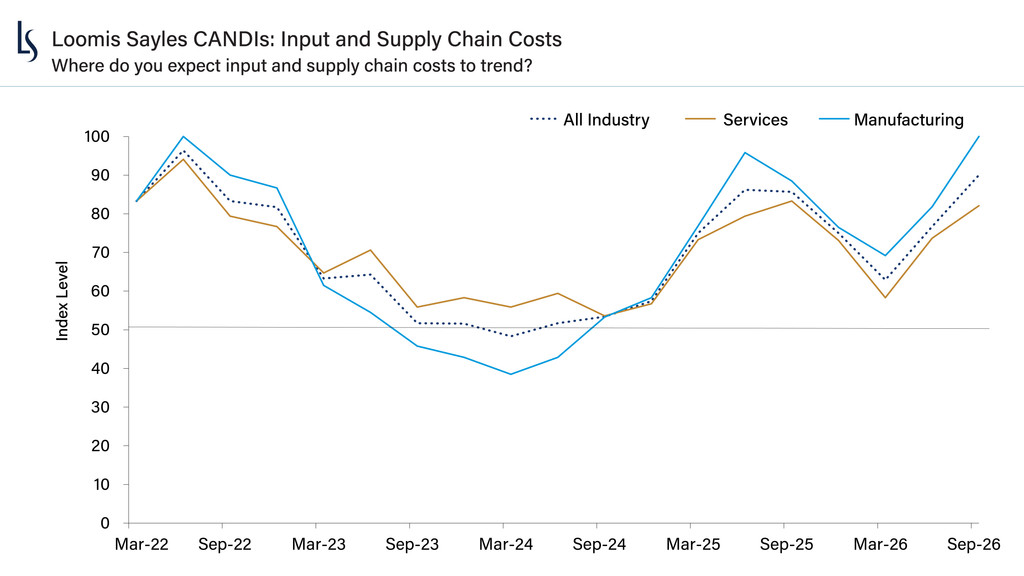
Source: Loomis Sayles Credit Analyst Diffusion Indices, as of October 5, 2026. For the input and supply chain costs component, readings above 50 indicate a rising trend. The chart presented above is shown for illustrative purposes only. The information is not intended to represent any actual portfolio.
On the other hand, pricing power remained flat, indicating that companies may not be able to pass the entirety of rising costs through to end users. Cost pressures are proving persistent, though the ultimate inflationary impact on consumers remains uncertain. We believe this is worth watching because companies are better able to manage rising costs if they can offset them with higher prices. If pricing power stalls, profit margins may come under pressure.
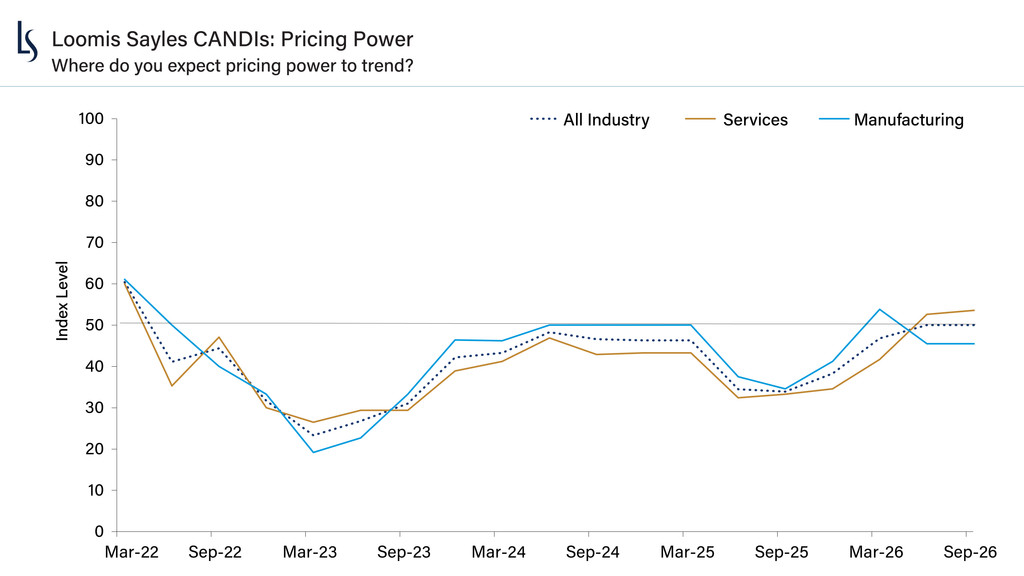
Source: Loomis Sayles Credit Analyst Diffusion Indices, as of October 5, 2026. For the pricing power component, readings above 50 indicate a rising trend. The chart presented above is shown for illustrative purposes only. The information is not intended to represent any actual portfolio.
Leverage Bears Watching, but Distress Remains Limited
Rising leverage is a hallmark of late-cycle environments. The survey’s leverage reading continued to increase, indicating that our analysts expect debt levels to move higher over the next six months. However, the increase has been gradual rather than alarming. Our crisis indicator suggests analysts see little evidence of broad-based or systemic financial stress. In our view, balance sheets deserve monitoring but do not yet represent a significant threat to corporate health.
A Revealing Contrast Between Services and Manufacturing
One of the most striking findings was a growing divergence between services and manufacturing. Services sector analysts’ profit margin expectations surged higher, while manufacturing expectations declined sharply from previously expansionary levels.
Yet manufacturing analysts remained relatively optimistic about future business conditions. Manufacturing outlook readings rose significantly, well above services, suggesting that demand is expected to remain healthy. We believe this points to concern about mounting cost pressures that could eat into profit margins.
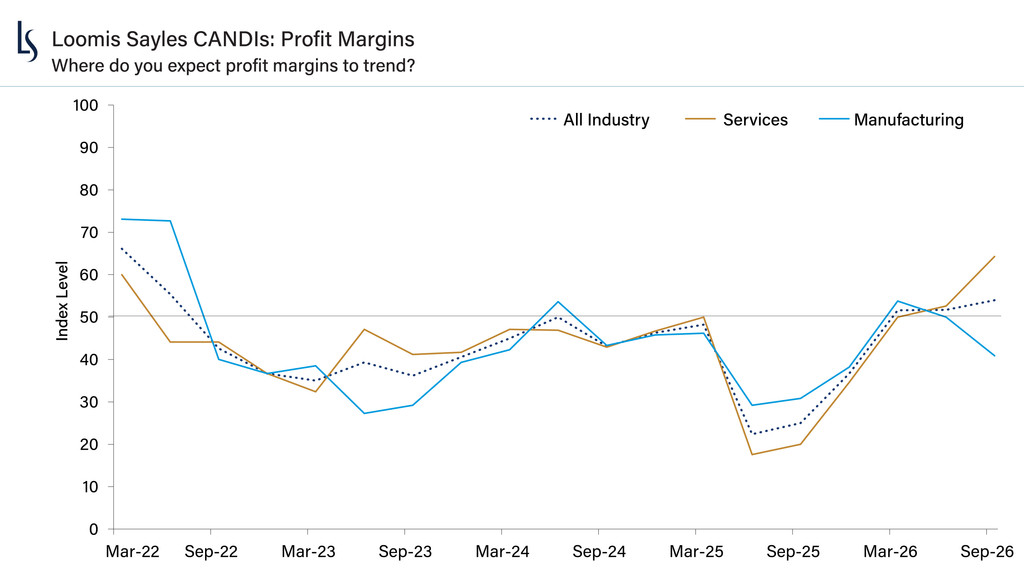
Source: Loomis Sayles Credit Analyst Diffusion Indices, as of October 5, 2026. For the profit margins component, readings above 50 indicate a rising trend. The chart presented above is shown for illustrative purposes only. The information is not intended to represent any actual portfolio.
Resilience Calls for Vigilance, Not Defensiveness
Our credit outlook remains constructive but less upbeat than earlier in 2026. With the Federal Reserve back in tightening mode and borrowing costs moving higher, valuations no longer look especially cheap. However, we believe the fundamental backdrop remains sufficiently strong.
The CANDIs suggest we are moving into a more mature phase of the credit cycle, where earnings and demand remain supportive, but inflationary pressures and higher borrowing costs create new challenges. For now, we think those pressures call for vigilance and selectivity rather than defensiveness. In our view, strong underlying fundamentals can allow credit investors to continue collecting carry while seeking to add exposure during periods of macro-driven volatility.
Disclosure
Market conditions are extremely fluid and change frequently.
This marketing communication is provided for informational purposes only and should not be construed as investment advice. Any opinions or forecasts contained herein reflect the subjective judgments and assumptions of the authors only, and do not necessarily reflect the views of Loomis, Sayles & Company, L.P. Investment recommendations may be inconsistent with these opinions. There is no assurance that developments will transpire as forecasted and actual results will be different. Diversification does not ensure a profit or guarantee against a loss. This material should not be considered a solicitation to buy or an offer to sell any product or service to any person in any jurisdiction where such activity would be unlawful. Data and analysis do not represent the actual or expected future performance of any investment product. Information, including that obtained from outside sources, is believed to be correct, but Loomis Sayles cannot guarantee its accuracy. This information is subject to change at any time without notice.
This material cannot be copied, reproduced or redistributed without authorization.
9180900.1.1
Author
