
Did the Public Debt Really Reach $40 Trillion? Should We Worry?
Market chatter is buzzing about the US national debt reaching $40 trillion. Do I think the federal fiscal situation is bad? Yes. Did the US public debt really reach $40 trillion? No. Let’s break it down.
Measuring the Debt
The Treasury term “Public Debt Outstanding” reached $40.047 trillion on August 18, according to US Treasury data released on the afternoon of August 19. The chart below gives daily data on Public Debt Outstanding:
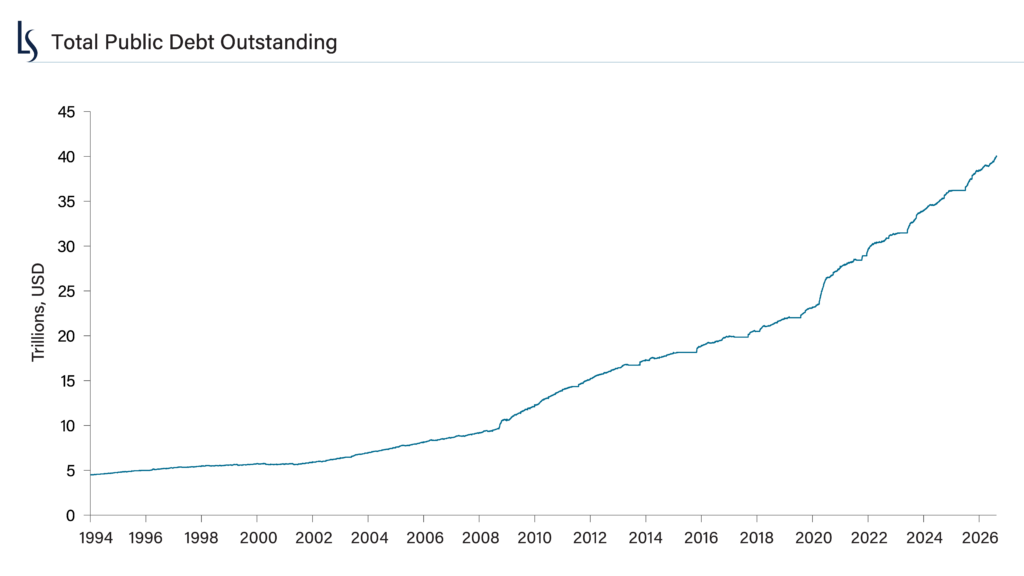
Source: US Treasury, Haver Analytics, as of August 20, 2026.
New record highs are attained on a daily basis, but it was newsworthy because it was a big round number. I think it’s the wrong number to look at.
Public Debt Outstanding is the sum of debt held by the public and intragovernmental holdings. Intragovernmental holdings are Treasury securities owned by other parts of the federal government. Examples include a federal pension plan or the Social Security Trust Fund. If I “borrow” money from one of my accounts and transfer it to another account I own, I cannot say my indebtedness rose; it is different from borrowing from a bank. An increase in intragovernmental holdings is just the government borrowing from itself.
Debt held by the public is a genuine liability. It has been rising rapidly (up more than 8% year over year so far in August), and on August 18, it stood at $32.266 trillion.i That is a lot of debt, but it is not $40 trillion.
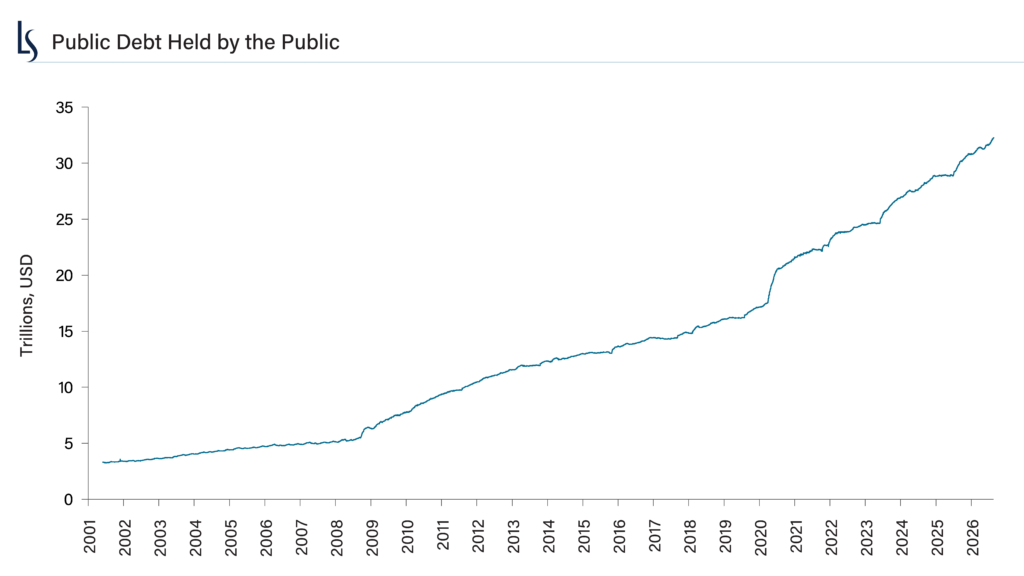
Source: US Treasury, Haver Analytics, as of August 20, 2026.
The Federal Reserve (Fed) is independent from the federal government for accounting purposes. Treasury debt held by the Fed is included in debt held by the public. On the other hand, the interest-paying bank reserves, which are a liability of the Fed, are not included in debt held by the public, nor is currency.
The Fiscal Challenge
The public debt may be lower than $40 trillion, but I expect it to continue to rise gradually relative to GDP and federal revenues because I expect chronically high federal budget deficits.
Rising debt boosts interest payments of the federal government. The problem worsens as Treasury yields rise and the government pays more interest on newly-issued debt. The US escaped this problem for a while because interest rates were exceptionally low for a long time after the Global Financial Crisis and again with the COVID-19 pandemic. Low interest rates allowed the federal government to run large deficits without paying a big price. Those days are over.
To help keep inflation at target with a rising debt burden, I believe the Fed will need to have higher policy rates on average. Larger and persistent deficits increase the supply of Treasury securities that must be absorbed by investors. Over time, that can place upward pressure on real interest rates and contribute to a higher estimate of “R-star,” the neutral real rate of interest.
Endnote
i Source: Daily Treasury Statement from the US Treasury, as of August 19, 2026.
Disclosure
Market conditions are extremely fluid and change frequently.
This blog post is provided for informational purposes only and should not be construed as investment advice. Any opinions or forecasts contained herein reflect the subjective judgments and assumptions of the authors only and do not necessarily reflect the views of Loomis, Sayles & Company, L.P. Information, including that obtained from outside sources, is believed to be correct, but Loomis Sayles cannot guarantee its accuracy. This material cannot be copied, reproduced or redistributed without authorization. This information is subject to change at any time without notice. Market conditions are extremely fluid and change frequently.
9087954.1.1
Author
