
Author

Emerging Markets Corporate Bonds: Yield and Diversification for Insurance Portfolios

In this Q&A, Dilawer Farazi, Co-Head of the Emerging Markets Debt Team, Portfolio Manager, discusses how the spectrum of emerging market (EM) countries continues to have the potential to provide diverse sources of growth in a world of accelerating change.
As EM and developed market (DM) growth differentials shift, Dilawer outlines how investors may benefit from exposure to the underappreciated potential within EM economies. He believes the evolving balance of risks and growth prospects outside the US presents compelling opportunities, particularly in EM corporate bonds, where strong fundamentals, supportive technicals and a varied opportunity set provide diversification opportunities for insurance companies.
Emerging markets have faced a challenging macro backdrop over the past few years. How do you assess the current state of EM debt and credit markets today, and what has changed meaningfully in the opportunity set?
I think it is fair to say the entire global economy has faced challenging events during the past few years and EM faced its share. However, let me make the point at the outset that it’s tricky to talk about EM fixed income as one asset class when you have over 55 disparate countries represented. It is a mistake to think of EM as a homogenous asset class.
Turning to the state of EM debt, the general trend that we have seen in most emerging markets emanates from improved economic structures. The structural reforms many countries have put in place include more disciplined monetary policy, fiscal rules and inflation targeting. Policymakers have created greater room and flexibility for managing shocks, and many have established solid foreign exchange reserves to deal with potential challenges. We have also seen changes in structural funding for many EM corporates and sovereigns. Increased local-currency funding helps to insulate borrowers from the Federal Reserve (Fed) and US dollar moves, which should result in countries improving their debt sustainability.
These structural reforms attract capital inflows that, in turn, foster improving confidence and more domestic investment contributing to better productivity and earnings. This positive feedback loop is a compelling story. Demographic advantages bolstering better relative economic growth in EM add another element of support. While the recently released International Monetary Fund April 2026 global growth report downgraded global growth owing to the energy shock, forecasts continued to show EM growth of 3.9% in 2026, well above the 1.8% aggregate growth forecast for DM.
Geopolitical risk remains elevated. How do you think about incorporating large, hard‑to‑forecast risks into EM portfolio construction, particularly for insurance clients with capital constraints?
From my perspective, gauging the state of EM in 2026 comes back to fundamentals and risk implications. It is the basis for our investment decision making. Forecasting disruptions or volatility in any segment of the world might make for interesting dinner conversations, but in reality, a resilient portfolio built on sound fundamentals weighed against risks is likely a better use of time and capital, in our view.
In EM we have seen these fundamentals largely remain robust through different geopolitical environments. In the EM corporate space, we are seeing the EM resilience of 2025 demonstrated again in 2026 thanks to a number of factors:
- supply chain flexibility
- trade route optimization
- cost pressure pass-through
- increasing diversification across sectors within the opportunity set
In our view, our disciplined approach to research and portfolio construction harvests this robust and evolving opportunity set in a way that is aligned with the yield and income objectives of insurers. We seek to understand each country and issuer, not only at the present, but as they evolve. We work with our analysts to identify resilient credits that have the potential to deliver the expected yield and income despite volatility with an eye toward minimizing ratings drift.
Where are you currently seeing the most compelling opportunities across EM? For insurance investors in particular, the ability to pick up incremental spread relative to DM credit is increasingly important.
In general, EM corporate spreads remain attractive relative to DM. Broadly, in the investment grade (IG) segment we see a spread premium for both A and BBB rated issuers in line with the three-year average and modestly tight to the five-year average, which is still reflecting post-COVID-19 dislocation.
This is particularly interesting as US technology investment grade issuers are ramping up heavy capex, which we believe could negatively affect leverage metrics for some US issuers. EM IG issuers are maintaining lower net leverage and higher interest coverage than that of DM issuers. We show a five-year history of fully adjusted-for-duration spread comparison in the BBB band for EM corporates, EM sovereigns and DM sovereigns. Interestingly, we are not seeing any spread premium in the EM sovereign space relative to DM, highlighting that the value in EM credit resides in the corporate segment.
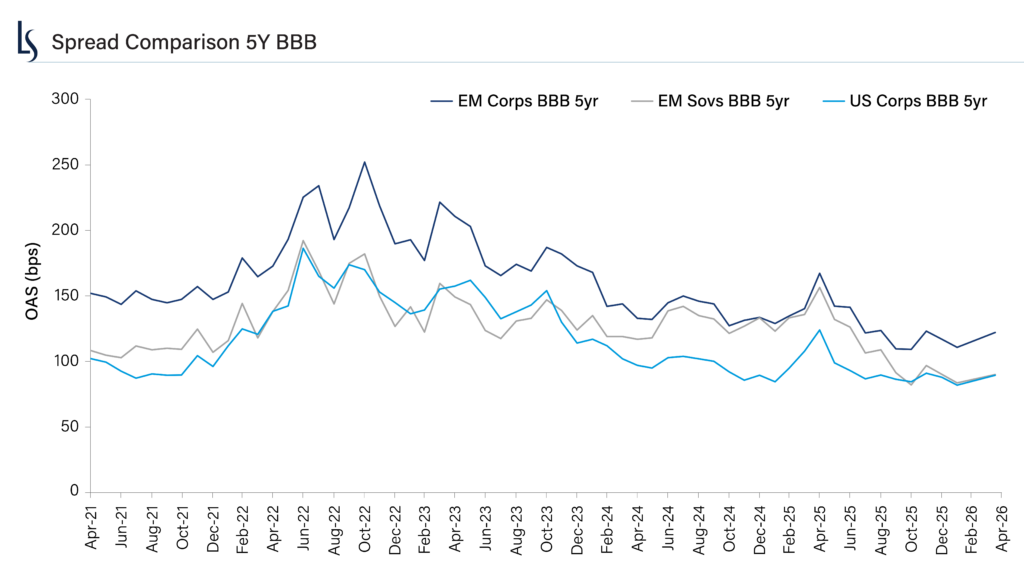
OAS is option adjusted spread. Source: Loomis Sayles, as of March 30, 2026. The chart presented above is shown for illustrative purposes only. Some or all of the information on this chart may be dated, and, therefore, should not be the basis to purchase or sell any securities. The information is not intended to represent any actual portfolio. Indices are unmanaged and do not incur fees. It is not possible to invest directly into an index. Past performance is no guarantee of future results.
In the EM corporate high yield (HY) segment, currently we are seeing spreads tighter than the three-year and five-year averages. Again, EM sovereigns offer very little pickup to DM credit. EM corporate HY issuers, in aggregate, continue to operate with leverage one multiple lower than US HY corporates and two multiples lower than European peers.
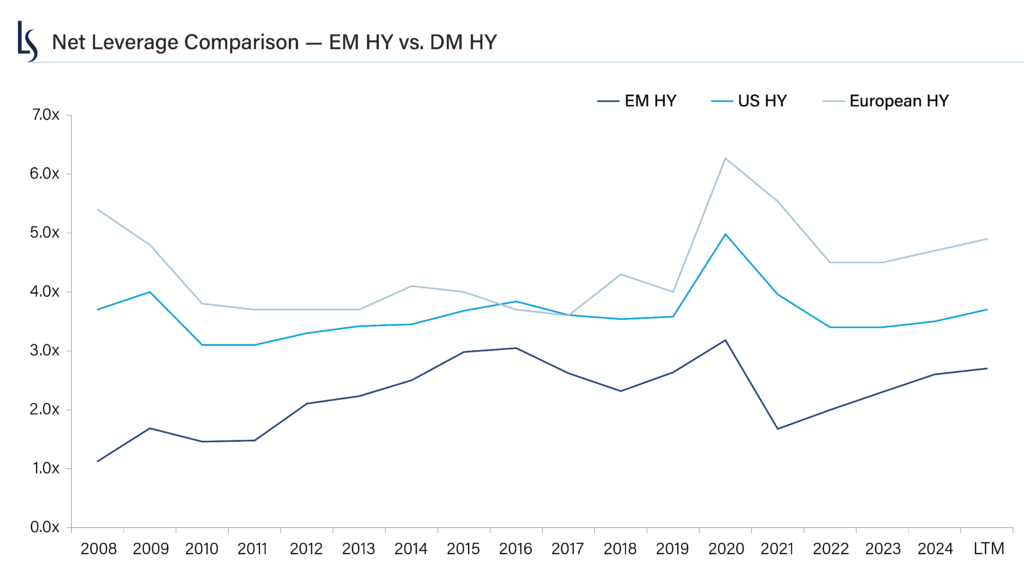
Loomis Sayles, as of March 31, 2026. The chart presented above is shown for illustrative purposes only. Some or all of the information on this chart may be dated, and, therefore, should not be the basis to purchase or sell any securities. The information is not intended to represent any actual portfolio. Indices are unmanaged and do not incur fees. It is not possible to invest directly into an index. Past performance is no guarantee of future results.
Looking at sectors broadly, we view energy names as more attractive with oil now expected to remain elevated through 2026. Of course, the fundamentally stronger, lower-cost producers tend to be the most resilient through cycles. We are positive about the mining industry given long-term structural support for various metals needed to support AI and associated infrastructure. Telecom continues to remain attractive to us due to its predictable cash flows stemming from the demographic advantages of EM, low data penetration, operational leverage and ability to deleverage after higher-capex periods historically. Utilities with strong levels of off-takers (entities contracted to purchase energy), often with government ownership, we also find are attractive, predictable issuers. The higher-growth dynamics of EM will also benefit many of the non-cyclical consumer issuers, in our view.
Our fundamental approach identifies specific opportunities across these sectors and regionally across Asia, Emerging Europe, the Middle East, Africa and Latin America. On average, Latin American spreads offer the highest spreads in both IG and HY issuers, yet we are watching some idiosyncratic situations and a heavy electoral calendar.
Looking ahead, are you expecting the favorable dynamics in EM corporate credit to persist? How should long‑term institutional investors such as insurers think about positioning?
- Strong credit metrics – Fundamentals in EM have remained robust even as DM metrics have started to deteriorate. EM, in general, has lower net leverage and higher interest coverage in both IG and HY relative to similarly rated DM corporates. Many issuers in EM are global in nature with strong balance sheets and diversified revenues, which contributes to their resilient credit metrics. These strong credit metrics have contributed to the low default rates we see in the asset class.
- Technical strengths – The structural reforms we discussed earlier that support continued strong growth in EM, as well as resilient fundamentals, have contributed to EM issuers not needing to issue as much debt. When they do issue, as discussed, they have access to more local-currency funding as these markets deepen. Many issuers have also locked in funding for the next few years as they manage reducing exposure to volatility in the markets. As a result, we expect flat-to-slightly negative net issuance in 2026. This lower issuance is a technical support for asset class valuation as bond redemptions, tenders and coupon cash flows need to be reinvested. We see evidence of this in strong primary market demand for new issues.
While EM have exhibited strong characteristics, we are seeing uncertainty in DM with lower growth rates, rising debt levels and uncertainty around the Fed’s monetary policy trajectory. We believe all of this contributes to the compelling case for EM investing, with EM corporates in particular standing out from a relative value perspective. In addition, we believe an exposure to EM corporates offers insurers the opportunity to pick up incremental yield with defensive underlying fundamentals diversified across regions, country and sector.
Disclosure
This marketing communication is provided for informational purposes only and should not be construed as investment advice. Any opinions or forecasts contained herein reflect the subjective judgments and assumptions of the authors only and do not necessarily reflect the views of Loomis, Sayles & Company, L.P. Investment recommendations may be inconsistent with these opinions. There is no assurance that developments will transpire as forecasted and actual results will be different. Data and analysis do not represent the actual or expected future performance of any investment product. Information, including that obtained from outside sources, is believed to be correct, but Loomis Sayles cannot guarantee its accuracy. This information is subject to change at any time without notice.
Diversification does not ensure a profit or guarantee against a loss.
Commodities, interest and derivative trading involves substantial risk of loss.
Market conditions are extremely fluid and change frequently.
Indices are unmanaged and do not incur fees. It is not possible to invest directly in an index.
Any investment that has the possibility for profits also has the possibility of losses, including the loss of principal.
Past performance is no guarantee of future results.
LS Loomis | Sayles is a trademark of Loomis, Sayles & Company, L.P. registered in the US Patent and Trademark Office.
8895560.1.1
Author
