
Author
April 2026 Investment Outlook

We believe the expansion phase of the credit cycle will continue through 2026, but acknowledge that markets will likely experience a number of challenges along the way.
On the micro level, corporate fundamentals have been solid and consensus 2026 earnings growth expectations are at healthy levels for most regions.i Earnings growth is the linchpin supporting investor demand, in our view. Fortunately, we continue to have confidence in bottom-up fundamentals, which should result in positive total returns across equities and corporate credits this year.
The macro picture appears less clear and fraught with risk on a number of fronts. The outbreak of war in the Middle East has sent energy markets soaring, and we expect prices to stay elevated. Liquidity and valuation concerns surrounding private credit investments are percolating. Most central banks appear to be finished cutting interest rates, which limits monetary policy support.
Investment Themes
Our take on macro drivers and major asset classes at a glance.

Macroeconomic Drivers
A prompt resolution in the Middle East seems unlikely to us. In the meantime, we think investors will look for strong fundamentals to buoy valuations.

Corporate Credit
Valuations across corporate credit markets have offered little risk premium since 2022, but we believe a broader opportunity set is emerging.

Government Debt & Policy
Just as US 10-year Treasury bond yields softened to near 4.0%, the war in the Middle East sparked concerns regarding inflation and US fiscal sustainability.iv Now it appears that rates may stay higher for longer.

Currencies
The US dollar tends to trade firmly when international developments pose risks to overall financial market stability.

Global Equities
We think risk-off sentiment tied to the war will be a temporary headwind for equity markets that were trading near all-time highs in February.vi

Potential Risks
The bright spot in our outlook is very robust earnings growth expectations, which are broadening across most of the world.x However, we are monitoring a number of geopolitical and economic risks.
Macroeconomic Drivers
A prompt resolution in the Middle East seems unlikely to us. In the meantime, we think investors will look for strong fundamentals to buoy valuations.
- Assistance from lower interest rates at the front or long end of the yield curve does not look likely across the majority of developed and emerging markets.
- Since the outbreak of the war in the Middle East, long-end interest rates have risen while market expectations for monetary policy have tightened.ii
- We think the Federal Reserve (Fed) will resume cutting interest rates, but the timing is uncertain. We had anticipated a couple of “fine-tuning” rate cuts by the summer of 2026, but now we think those cuts may be pushed out to late 2026. A lot hinges on the soft US labor market balanced with the potential for energy prices to pass through to goods inflation.
- We believe the Senate will confirm Kevin Warsh as the new Federal Open Market Committee Chairman, but the timing is questionable.
- For the European Central Bank and Bank of England, market expectations suggest interest rate hikes are more likely than cuts over the next 12 months. The Bank of Japan seems likely to hike by 25 basis points by September 2026.
- The supply-driven oil price shock has weighed on economic growth prospects, but our probability of recession has only shifted a touch higher.
- We believe increased economic activity fueled by artificial intelligence (AI) investment is still positioned to boost US and global GDP growth throughout 2026.
Spiking oil prices can disrupt consumer spending patterns, especially after trending lower for years.
The negative impact on consumer budgets could prove short-lived if traffic in the Strait of Hormuz can normalize in April or early May.
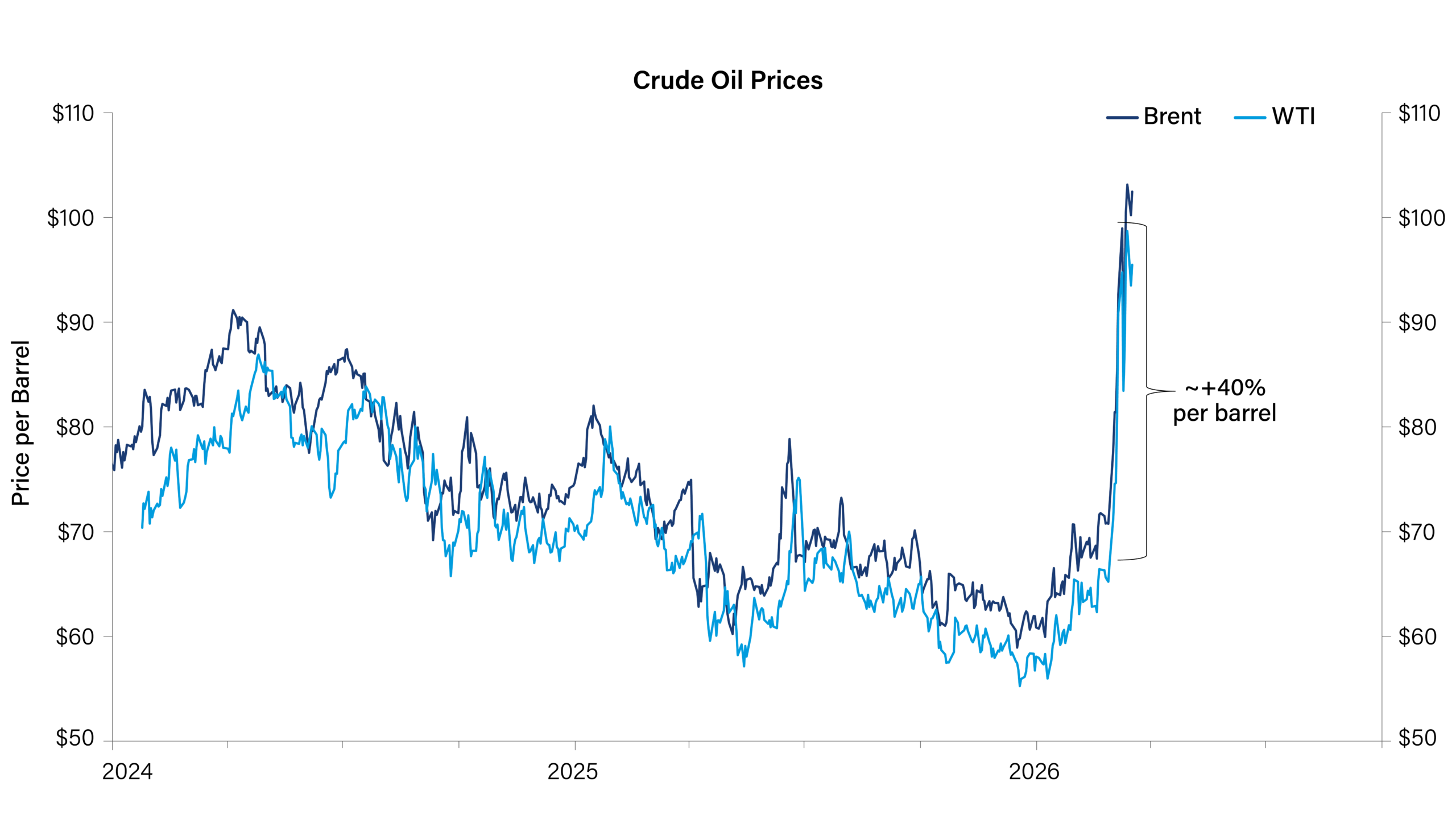
Source: Bloomberg, as of March 17, 2026.
The chart presented above is shown for illustrative purposes only. Used with permission from Bloomberg.
Corporate Credit
Valuations across corporate credit markets have offered little risk premium since 2022, but we believe a broader opportunity set is emerging.
- According to Bloomberg consensus estimates, US large-cap company earnings growth is expected to continue in 2026, with a high likelihood of year-over-year growth across all sectors of the market.iii
- After several quarters of lagging its peers, we believe the energy sector could contribute to domestic large-cap earnings growth this year.
- We also expect cyclical sectors like financials and industrials to contribute to earnings growth, increasing our confidence that the expansion continues.
- Based on our Credit Research Diffusion Indices, or CANDIs, our Credit Research Team anticipates profit margin expansion within industries like banking and technology.
- The CANDIs also show the team’s credit outlooks should remain stable or improve while leverage metrics, like debt-to-EBITDA, may actually decline a bit near term.
- Outside the US, we think an earnings rebound in Europe seems likely, which would support credit market valuations through 2026.
- We expect low-to-mid single-digit total returns for publicly traded corporate credit. Private credit liquidity concerns have been grabbing headlines, but we do not believe the asset class introduces systemic risks near term.
Corporate credit spreads have been tight worldwide for some time, but risk premiums are being restored and we are ready for potential opportunities.
Bouts of spread widening are not abnormal. We look to invest when valuations are dislocated from long-term fundamentals.
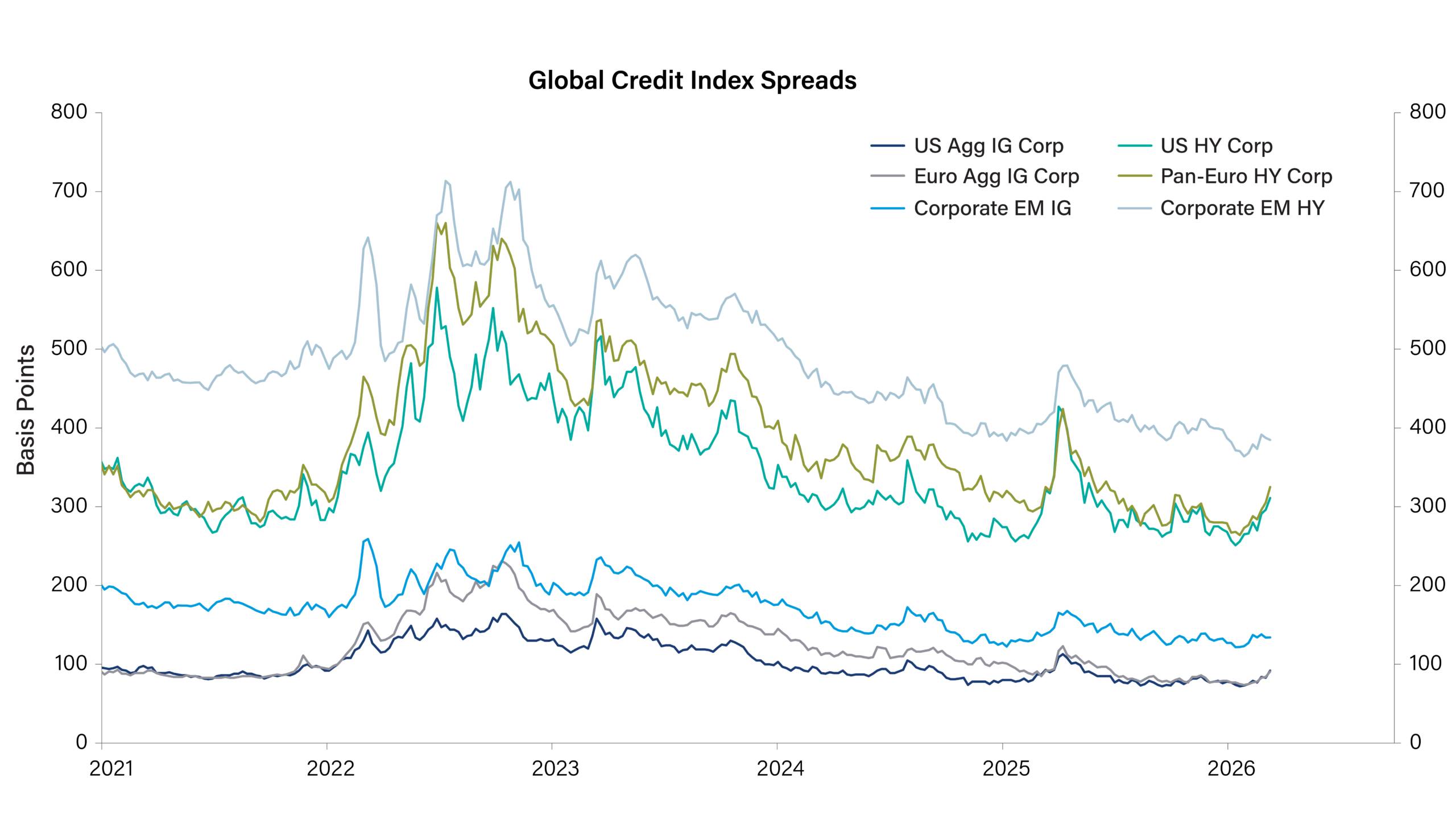
Source: Bloomberg, as of March 17, 2026. Used with permission from Bloomberg Finance L.P.
The chart presented above is shown for illustrative purposes only. Some or all of the information on this chart may be dated, and, therefore, should not be the basis to purchase or sell any securities. The information is not intended to represent any actual portfolio. Information obtained from outside sources is believed to be correct, but Loomis Sayles cannot guarantee its accuracy. This material cannot be copied, reproduced or redistributed without authorization.
Government Debt & Policy
Just as US 10-year Treasury bond yields softened to near 4.0%, the war in the Middle East sparked concerns regarding inflation and US fiscal sustainability.iv Now it appears that rates may stay higher for longer.
- We still believe US government debt burdens are large but manageable. Domestic fiscal policy risks are well known and should not drive long-term interest rates higher near term, in our view.
- However, the recent breakout of war and the associated costs adds risk to that view. The US has a recession-era budget deficit at a time when the economy is expanding.
- We think continued attacks on one of the world’s largest oil-producing regions will exacerbate inflation risks.
- Our current interest rate forecasts should be supportive for risk assets. However, if inflation risks continue to rise, we see potential for rates to rise to a level that would add pressure to risk assets.
- Countries in Europe and Asia are importers of Middle Eastern oil and could face significant challenges, such as lower economic growth and higher inflation, if oil supply tightens from here.
- We have a strong degree of confidence that the global economic expansion will continue despite present headwinds. Many economies started this war-related energy shock with economic growth levels near trend or better.v
Typically, risk-off events contribute to lower yields for high-grade global government bonds, but that has not been the case so far.
We believe the current risk-off tone could presage inflationary upside pressure and potentially larger government deficits, which have propped yields up.
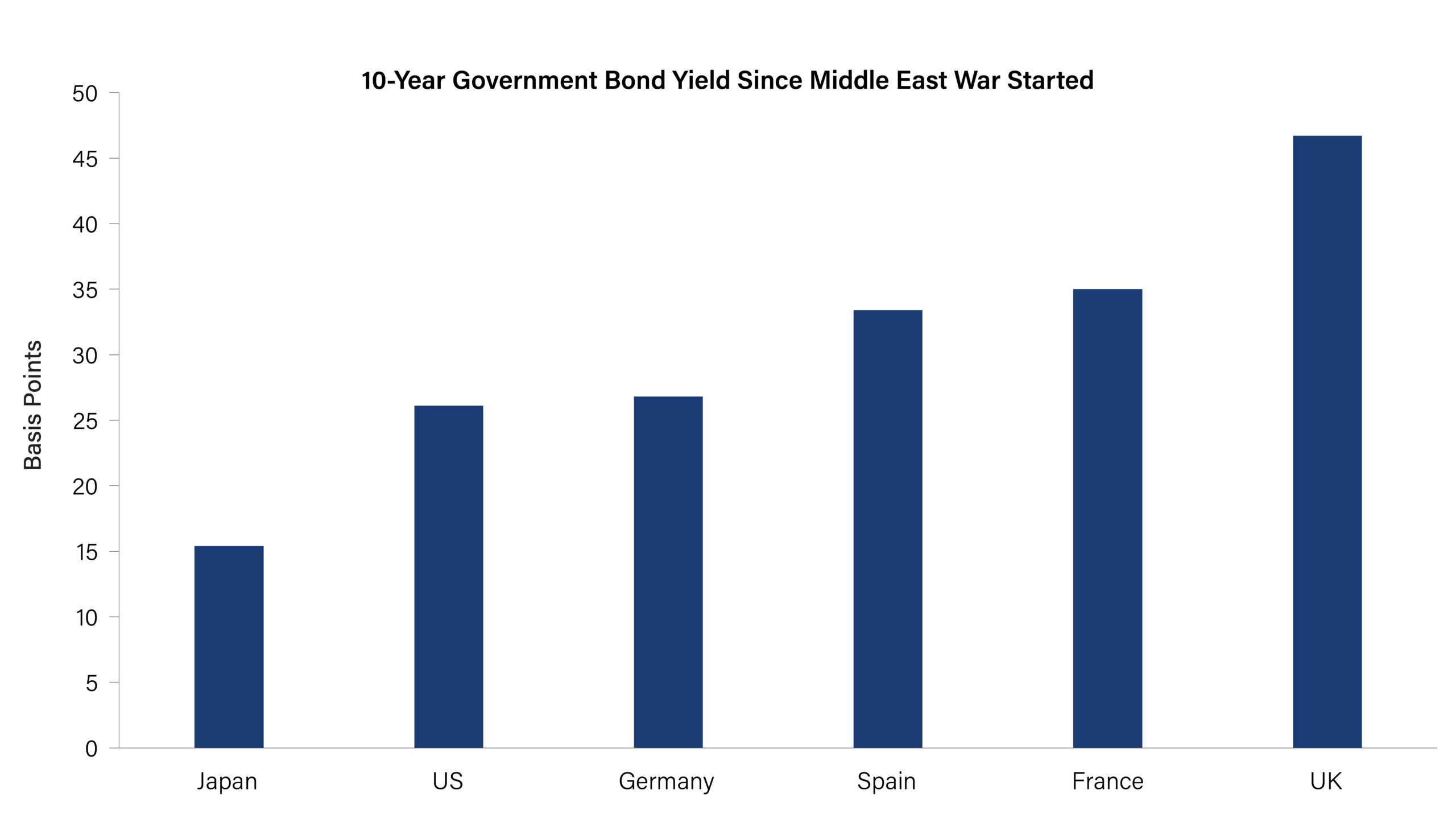
Source: Bloomberg, as of March 17, 2026. Used with permission from Bloomberg Finance L.P.
The chart presented above is shown for illustrative purposes only. Used with permission from Bloomberg. Some or all of the information on this chart may be dated, and, therefore, should not be the basis to purchase or sell any securities. The information is not intended to represent any actual portfolio. Information obtained from outside sources is believed to be correct, but Loomis Sayles cannot guarantee its accuracy. This material cannot be copied, reproduced or redistributed without authorization.
Past performance is no guarantee of future results.
Currencies
The US dollar tends to trade firmly when international developments pose risks to overall financial market stability.
- We believe that non-US-dollar assets can perform well as the expansion progresses, but ongoing conflict in the Middle East has lowered our optimism and expectations.
- The threshold for US investment grade and high yield corporate bonds to outperform non-dollar assets is now lower, in our view.
- The risk premium for owning non-US-dollar-denominated assets typically moves higher when global risks are rising. While the premium is rising, we are reluctant to turn pessimistic on non-US-dollar assets broadly.
- We still see attractive opportunities in Latin America, where we believe the potential to earn carry could exceed currency depreciation while investors wait for the war’s end.
- When global growth expectations begin to stabilize or even improve, we think a more bullish stance for owning non-US-dollar assets will return quickly.
US dollar indices traded higher as the Middle East war broke out, but we do not anticipate a full reversal of the dollar’s weaker trend.
The potential for a US dollar bull market remains low in our view, especially if the Fed cuts interest rates this year while other central banks hold or tighten monetary policy.
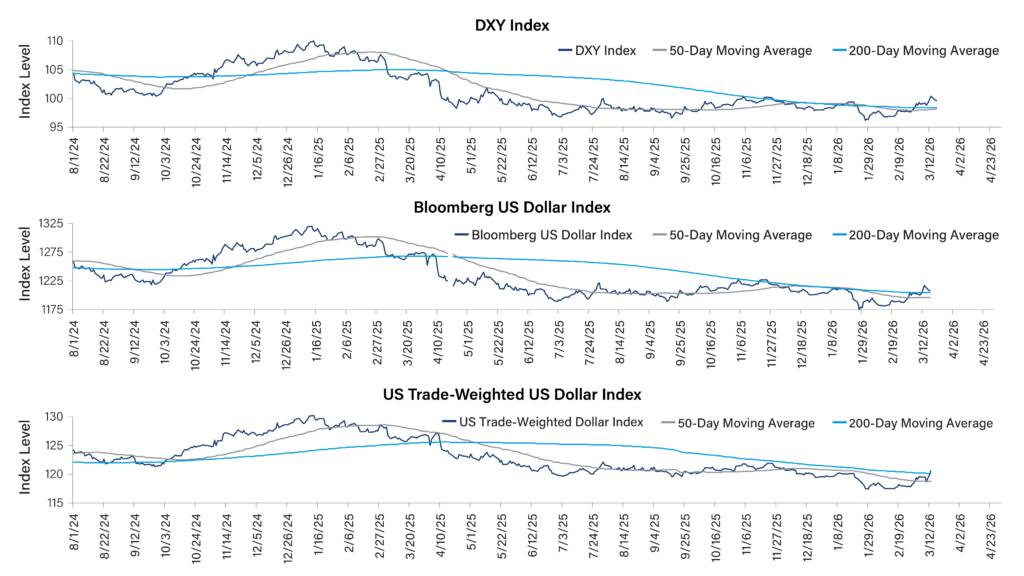
Source: Bloomberg, as of March 17, 2026. Used with permission from Bloomberg Finance L.P.
The chart presented above is shown for illustrative purposes only. Some or all of the information on this chart may be dated, and, therefore, should not be the basis to purchase or sell any securities. The information is not intended to represent any actual portfolio. Information obtained from outside sources is believed to be correct, but Loomis Sayles cannot guarantee its accuracy. This material cannot be copied, reproduced or redistributed without authorization.
Indices are unmanaged. It is not possible to invest directly in an index.
Past performance is no guarantee of future results.
Global Equities
We think risk-off sentiment tied to the war will be a temporary headwind for equity markets that were trading near all-time highs in February.vi
- Within the US, concerns over the demise of many software firms and fear of AI-related job losses will likely keep markets anxious. In our view, a software and services equity recovery may be slow to develop.
- We believe AI-related capital expenditure should help propel equity markets and domestic investment for years.
- We would not be surprised to see growth equities lead markets higher if tensions across the Middle East begin to ease and eventually simmer down. Large-cap growth companies still have better fundamental prospects than large-cap value peers. The Russell 1000® Growth Index has a forward price-to-earnings ratio of 25.2, which is lower than its five-year average near 30.vii
- Earnings growth is finally broadening beyond technology companies.viii We see potential for most S&P 500 Index large-cap companies to deliver double-digit growth rates in 2026.
- In our view, global equity earnings are poised to move higher. Consensus estimates suggest MSCI Emerging Market Index earnings growth could top 37%, MSCI Europe Index 9.4% and MSCI Japan Index 9%.ix
It’s been remarkable to see S&P 500 Index earnings estimates continue higher and consistently imply the potential for double-digit year-over-year growth.
One positive of higher oil prices is improved energy earnings, which are helping to lift aggregate S&P 500 expectations while other sectors remain stable.
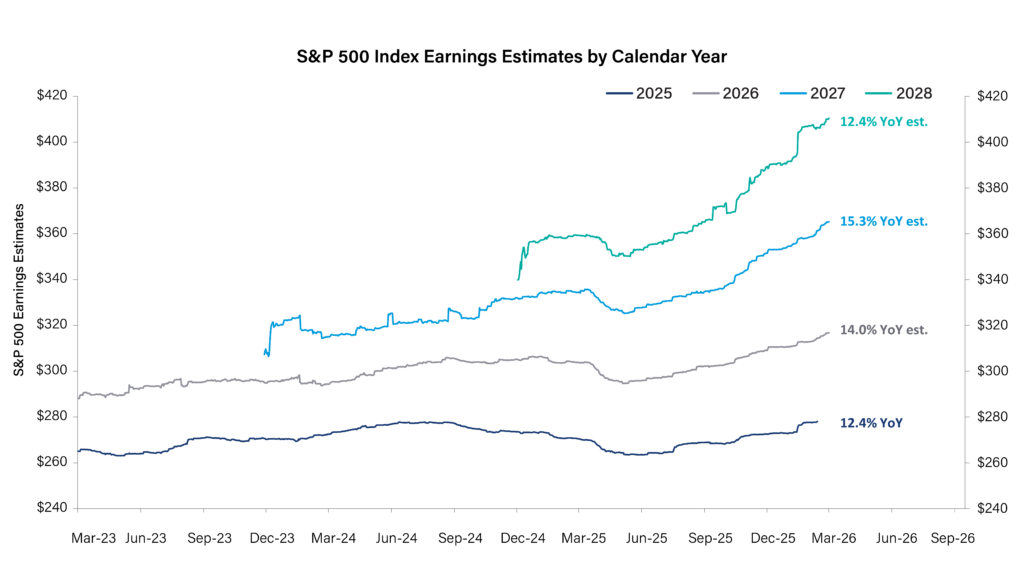
Source: Bloomberg, as of March 17, 2026. Used with permission from Bloomberg Finance L.P.
The chart presented above is shown for illustrative purposes only. Used with permission from Bloomberg. Some or all of the information on this chart may be dated, and, therefore, should not be the basis to purchase or sell any securities. The information is not intended to represent any actual portfolio. Information obtained from outside sources is believed to be correct, but Loomis Sayles cannot guarantee its accuracy. This material cannot be copied, reproduced or redistributed without authorization. Indices are unmanaged. It is not possible to invest directly in an index.
Past performance is no guarantee of future results.
Potential Risks
The bright spot in our outlook is very robust earnings growth expectations, which are broadening across most of the world.x The Fed may reduce interest rates later this year and a massive AI-driven capital expenditure cycle has been lifting economic growth. For the third year in a row, we believe double-digit S&P 500 Index earnings growth is likely in 2026. We expect global growth to remain resilient near long-run trend levels. However, we see more risks to consider.
- The Loomis Sayles Macro Strategies team is projecting a 15% probability of US recession. Oil prices spiked meaningfully, but perhaps not high enough to drive a material shock that saps consumption (excluding gasoline). That could change quickly in a military escalation though.
- High energy prices typically draw down sentiment globally, which could cause consumers to pull back on spending away from the gas pump.
- Global growth could take a larger hit than US growth. Many countries are net energy importers, while the US is a net exporter. Downward revisions to consensus global growth forecasts could lead non-US-dollar exposure to underperform, in our view.
- Labor markets are not robust, but keep in mind that substantial job creation is not typical late in the cycle.
- Private credit fears may prove to be just that. However, we are monitoring the sector closely for signs that true credit instability could be widespread.
- While more risks have emerged, we still believe solid bottom-up fundamentals will drive positive total returns across markets. We may just have to be patient near term.
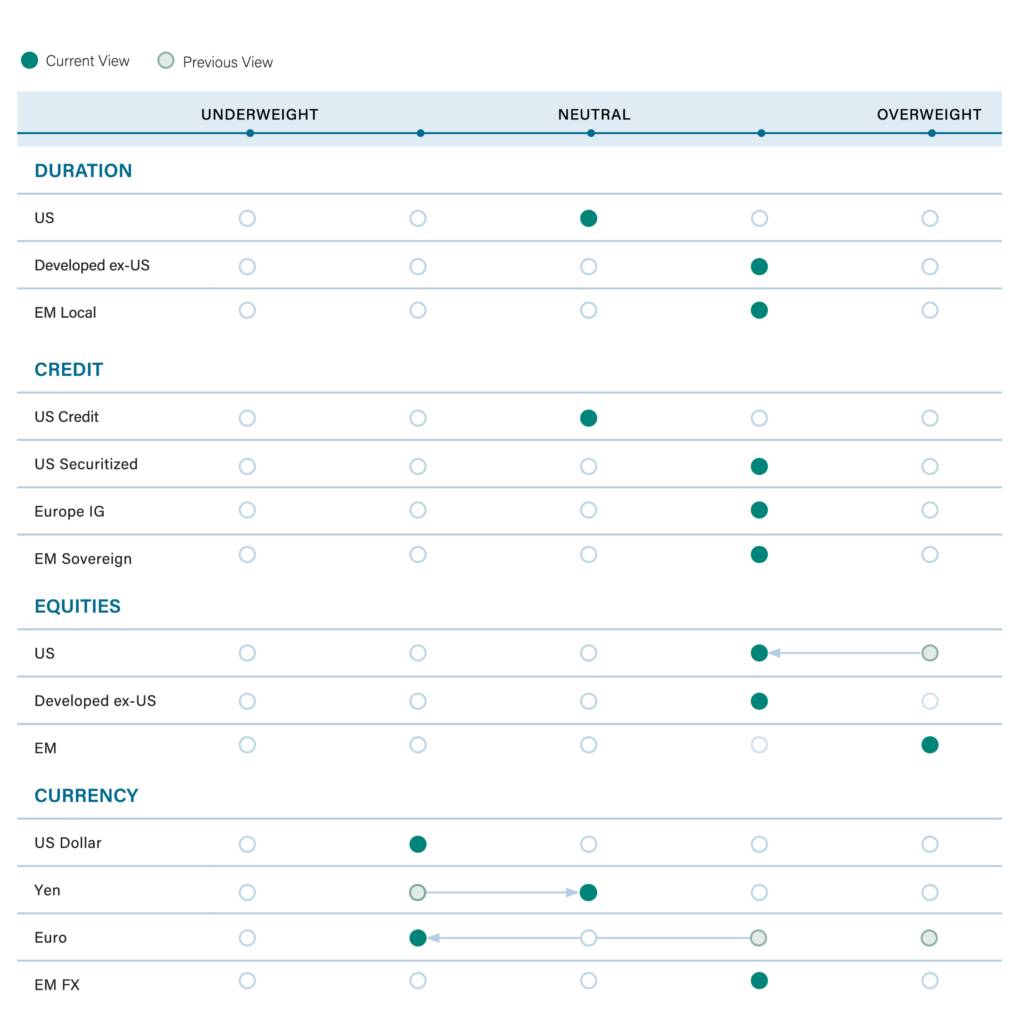
Asset Class Outlook
Risks could create potential dislocations in our preferred areas of the investment landscape. Investors should be
ready to seize on potential opportunities.
Endnotes
i Bloomberg, as of March 17, 2026.
ii Bloomberg, as of March 17, 2026.
iii Bloomberg, as of March 23, 2026.
iv Bloomberg, as of March 17, 2026.
v Government sources, as of December 2025.
vi Bloomberg, as of March 17, 2026.
vii Bloomberg, as of March 23, 2026.
viii Bloomberg, as of March 23, 2026.
ix Bloomberg, as of March 23, 2026.
x Bloomberg consensus estimates, as of March 23, 2026.
Disclosure
All data and views are as of April 1, 2026, unless otherwise noted.
This marketing communication is provided for informational purposes only and should not be construed as investment advice. Any opinions or forecasts contained herein reflect the subjective judgments and assumptions of the authors only and do not necessarily reflect the views of Loomis, Sayles & Company, L.P. Investment recommendations may be inconsistent with these opinions. There is no assurance that developments will transpire as forecasted and actual results will be different. Data and analysis do not represent the actual or expected future performance of any investment product. Information, including that obtained from outside sources, is believed to be correct, but Loomis Sayles cannot guarantee its accuracy. This information is subject to change at any time without notice.
Diversification does not ensure a profit or guarantee against a loss.
Market conditions are extremely fluid and change frequently.
Commodity, interest and derivative trading involves substantial risk of loss.
Indices are unmanaged and do not incur fees. It is not possible to invest directly in an index.
Any investment that has the possibility for profits also has the possibility of losses, including the loss of principal.
Past performance is no guarantee of future results.
LS Loomis | Sayles is a trademark of Loomis, Sayles & Company, L.P. registered in the US Patent and Trademark Office.
8840061.1.1
Author
