

2026 Outlook for Investment Grade Credit: Q&A
1. As we transition from 2025, how would you characterize industries in the investment grade (IG) credit sector?
As 2025 concluded, US IG industries largely exhibited stable to improving trends with tariffs not having had a significant negative impact on most companies or spreads. According to our Credit Research Group, a significant majority (85.4%) of Bloomberg US Aggregate Index industries remained in the expansion phase. A smaller segment, 9.5%, was in the downturn phase, including industries such as construction machinery, finance companies, oil field services, automotive, independent energy, integrated energy and health insurers. No industries fell in the credit repair category. This distribution underscores the resilience and general health of the IG sector, even as selected industries face challenges.
2. Based on this view, what are the implications for the IG credit sector in 2026?
From a forward-looking perspective, our credit research paints a somewhat mixed picture. The outlook for margins and free cash flow (FCF) has improved compared to mid-2025, which is a positive sign for credit quality and potential investment returns. However, the outlook for leverage and financial policy has become moderately worse, therefore, indicating some concerns about increased borrowing or less conservative financial management. Additionally, while the threat from tariffs appears “less negative” than before, it remains a wildcard for several industries, implying that external risks could still affect the overall credit landscape going forward.
3. Will 2026 resemble 2025 in terms of strong new issuance?
We anticipate the new issuance market will remain robust in 2026. JP Morgan projects a 17% increase in gross issuance, which would bring total supply to an impressive $1.8 trillion. While this headline figure is significant, it is important to look beyond the gross supply. A closer examination of the data is necessary to understand its composition and how industries are classified within these numbers. For instance, certain companies might be categorized as media or retail rather than technology, which could mean that some major technology-related issuers are not fully reflected in the technology sector’s supply statistics. This nuance is crucial, as it may lead to sector-level analysis that does not capture the full scope of issuance activity among key players.
Another important consideration is the extent to which 2026 new issuance estimates are being driven by potentially large-scale artificial intelligence (AI) financing initiatives. Wall Street is expecting roughly $250 billion of new gross issuance out of Technology sector this year, and the market’s reaction to sizable deals by the hyperscalers could result in actual supply exceeding current projections.
What is particularly notable for 2026 is the expected increase in net supply, which could have a more pronounced effect on the market than the gross supply numbers alone suggest. Historical correlations indicate that movements in net supply can affect market spreads, though the relationship also depends on the market environment and demand for IG credit. Current forecasts place net supply between $700 billion and $1 trillion, marking a substantial increase from previous years.1 This anticipated rise in net supply could influence various aspects of the market, including bond pricing and investor sentiment, as higher net supply tends to result in wider spreads and potentially greater volatility.
For investors and analysts to gain a clear understanding of market dynamics, it is essential to scrutinize what is included, and what is not, in these supply figures. Focusing on net supply and its underlying drivers will be especially important for assessing the potential risks and opportunities that may arise in the year ahead.
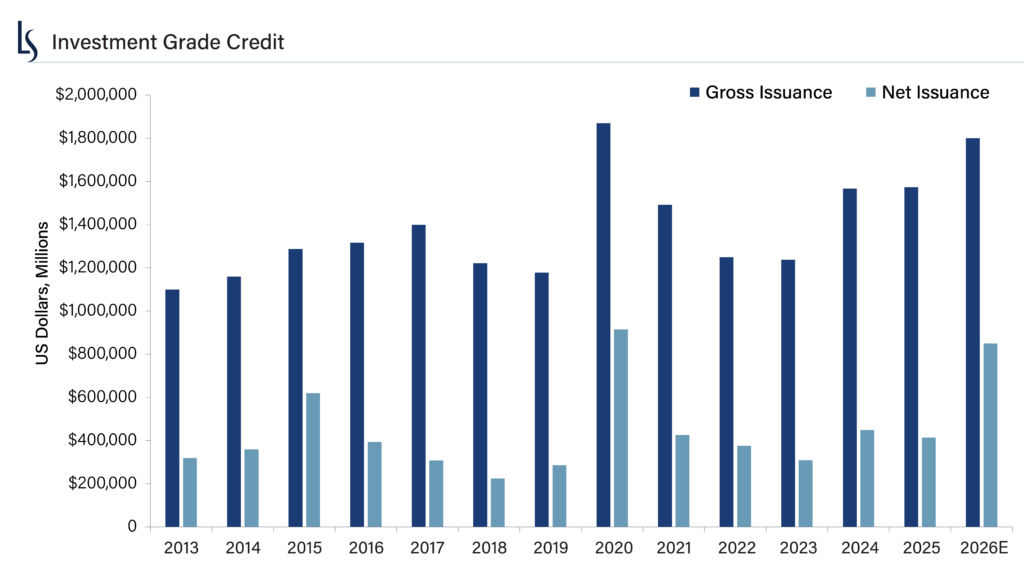
Source: Bloomberg as of January 9, 2026 estimate based on JP Morgan data as of November 13, 2025.
The chart presented above is shown for illustrative purposes only. Some or all of the information shown may be dated, and, therefore, should not be the basis to purchase or sell any securities. The information is not intended to represent any actual portfolio managed by Loomis Sayles. Information obtained from outside sources is believed to be correct, but Loomis Sayles cannot guarantee its accuracy. This material cannot be copied, reproduced or redistributed without authorization.
4. Speaking of risks and opportunities, what might they be for IG credit investors in 2026?
In our view, the key risks for IG credit investors in 2026 include potential economic stagnation, renewed inflation pressures and unexpected geopolitical developments. These factors could lead to spread widening or certain sectors being more impacted than others are.
On the opportunity side, the normalization of monetary policy and continued demand for high-quality assets could drive strong performance, especially as investors seek stability amidst uncertainty. There is also the potential for credit upgrades among companies that have improved their balance sheets since the pandemic. Active management and a selective approach—focusing on issuers with strong fundamentals—will be crucial for navigating the landscape and capitalizing on emerging trends.
1 JP Morgan, as of November 13, 2025.
8709443.1.1
Market conditions are extremely fluid and change frequently.
Diversification does not ensure a profit or guarantee against a loss.
This blog post is provided for informational purposes only and should not be construed as investment advice. Any opinions or forecasts contained herein reflect the subjective judgments and assumptions of the authors only and do not necessarily reflect the views of Loomis, Sayles & Company, L.P. Information, including that obtained from outside sources, is believed to be correct, but Loomis Sayles cannot guarantee its accuracy. This material cannot be copied, reproduced or redistributed without authorization. This information is subject to change at any time without notice.
Authors
