

2026 Outlook for High Yield Credit: Q&A
1. There has been a foundational shift in the high yield (HY) market and it’s evident in the quality and risk profile of the Bloomberg US Corporate HY Index. What does that mean going forward?
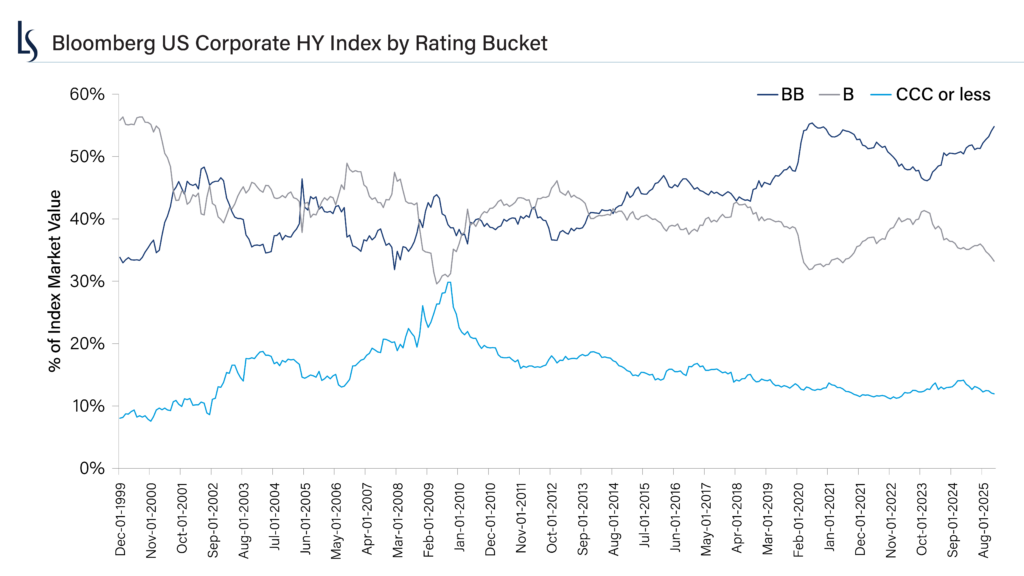
Since the global financial crisis (GFC), the HY index has shown a clear trend of improving quality. There has been a decreased presence of lower-rated credits—such as the CCC-rated segment—and a greater volume of issuance from higher-quality issuers.
Source: Bloomberg, as of December 31, 2025.
The chart presented above is shown for illustrative purposes only. Some or all of the information on this chart may be dated, and, therefore, should not be the basis to purchase or sell any securities. The information is not intended to represent any actual portfolio. Information obtained from outside sources is believed to be correct, but Loomis Sayles cannot guarantee its accuracy. This material cannot be copied, reproduced or redistributed without authorization.
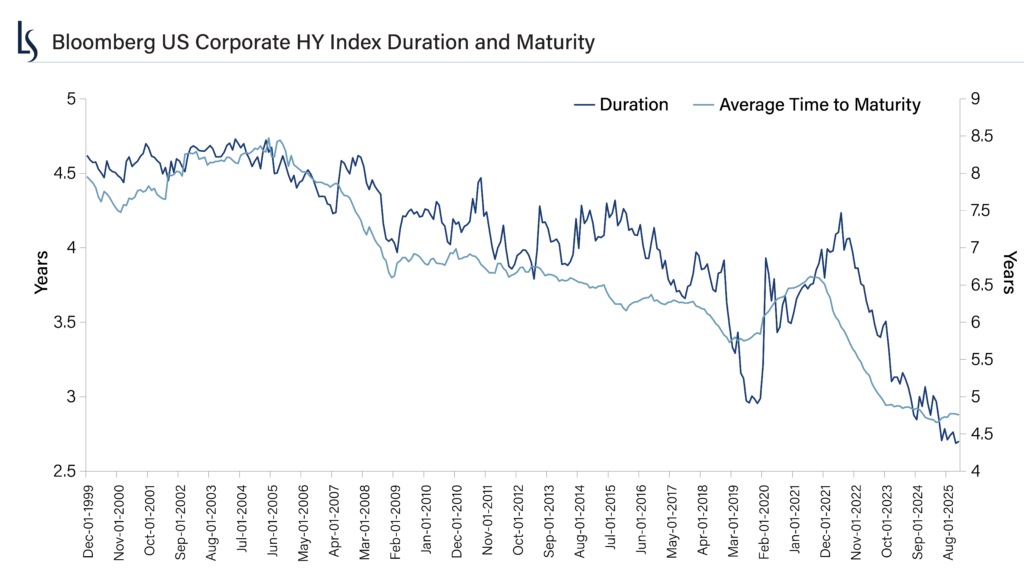
At the same time, the duration of the index has shortened, with the current spread duration now reportedly less than three years. These changes have resulted in lower overall volatility for the index, as both the spreads and duration have compressed. As a result, the beta of HY versus both riskier assets (like equities) and less-risky assets has declined over time, reflecting this shift in profile.
Today, the HY index behaves more like investment grade (IG) credit in terms of excess return volatility, further supported by the fact that its DTS (duration times spread) now more closely resembles those of higher-quality, lower-risk assets. Therefore, investors should not be surprised to see the beta and volatility figures trending lower with relatively tight spread levels given the index’s evolving composition and characteristics.
Source: Bloomberg, as of December 31, 2025.
The chart presented above is shown for illustrative purposes only. Some or all of the information on this chart may be dated, and, therefore, should not be the basis to purchase or sell any securities. The information is not intended to represent any actual portfolio. Information obtained from outside sources is believed to be correct, but Loomis Sayles cannot guarantee its accuracy. This material cannot be copied, reproduced or redistributed without authorization.
2. Which sectors within HY look especially attractive or pose greater risks as we head into 2026?
We think sector selection could play a pivotal role in returns throughout 2026. Sectors with cyclical exposure (such as energy, basic materials and industrials) may do well if economic momentum continues and commodities demand holds up. For example, energy companies have benefited from disciplined capital spending and higher commodity prices, leading to healthier cash flows and improved credit metrics.
Meanwhile, technology and telecommunications, which have become increasingly represented in the HY universe, might offer growth opportunities but could also exhibit higher volatility, especially in a rising rate environment or if technology valuations reset.
On the riskier side, sectors sensitive to consumer spending (such as retail, leisure and consumer discretionary) may face challenges if higher borrowing costs persist or wage growth slows, in our view. Real estate-linked credits could also see headwinds if property values remain under pressure and refinancing becomes more costly.
Conversely, we believe more defensive sectors, including healthcare, utilities and certain parts of the food and beverage industry, may offer resilience during periods of uncertainty. These industries tend to have cash flows that are more predictable and may be less sensitive to economic cycles, providing a degree of stability to HY portfolios. Ultimately, we believe maintaining diversification across multiple industries and performing granular credit analysis will be crucial to identifying both risks and opportunities.
3. What factors have contributed to the recent positive net supply and growth of the HY market?
The recent positive net supply and expansion of the HY market can be attributed to a shift in investor sentiment and market dynamics, where there is a collective expectation among market participants for continued growth in the asset class. While AI-related issuance will likely play a larger role in investment grade and private credit markets in the years ahead, we expect it to be a factor in HY markets as well.
Over the past few years, the HY universe has been increasing, and this upward trend is encouraging for investors and issuers alike. One of the main drivers behind this growth is the renewed confidence in the market following a period of contraction that started before and continued through the COVID-19 pandemic. The growth and mix of the high yield bond market, leveraged loan market and private credit market has contributed to an accommodative backdrop for lower-quality companies.
Post-pandemic, HY issuers have returned to the market, taking advantage of more favorable conditions, lower default rates and increased investor demand for income-generating assets in a low-interest-rate environment. This positive net supply means that more companies are issuing HY bonds than are being called or maturing, expanding the overall size of the market. In our view, it reflects a healthier, more robust market environment compared to the contraction during the pandemic and suggests that the asset class is regaining its attractiveness and resilience. Overall, we believe the growth of the HY market signals renewed optimism and opportunities for both issuers and investors.
8703172.1.1
Market conditions are extremely fluid and change frequently.
Diversification does not ensure a profit or guarantee against a loss.
This blog post is provided for informational purposes only and should not be construed as investment advice. Any opinions or forecasts contained herein reflect the subjective judgments and assumptions of the authors only and do not necessarily reflect the views of Loomis, Sayles & Company, L.P. Information, including that obtained from outside sources, is believed to be correct, but Loomis Sayles cannot guarantee its accuracy. This material cannot be copied, reproduced or redistributed without authorization. This information is subject to change at any time without notice.
Authors
