
Author

2026 Outlook for Structured Finance: Q&A
1. How will you navigate the landmines and diamonds you foresee in the outlook for commercial real estate (CRE) and commercial mortgage-backed securities (CMBS)?
Let’s begin with what could foster diamonds. Heading into 2026, several factors are creating a positive backdrop for structured finance. Anticipated Federal Reserve rate cuts are supporting CRE valuations and making financing more attractive, even though long-end rates could remain somewhat elevated. Lending activity is on the rise by various lender types and CMBS issuance is poised to set new records. Transaction volumes are slowly increasing, especially as investors reengage with office and retail sectors—primarily targeting high-quality assets. In our view, recent high-profile purchases signaled renewed confidence in these property types. Stabilized capitalization (cap) rates and ongoing rent growth are providing valuation support and improved occupancy and net absorption trends are helping to slow credit deterioration. The healing in the sector is gradual, and its pace is closely tied to job growth.
That being said, we are watchful for potential headwinds. Financing remains difficult for some non-stabilized assets (properties that have not yet achieved their expected operating performance) as borrowers may face cap rates approximately 300 to 400 basis points higher than those for stabilized properties. Although the CMBS market is seeing record issuance and strong investor demand, the overall pace of recovery is still slow. The healing of occupancy and credit trends is ongoing, but it is vulnerable to setbacks if job growth falters or if long-term rates don’t ease further. Investors will need to be selective, focusing on high-quality assets and monitoring the macroeconomic factors that could affect liquidity, valuations and overall market stability.
2. Turning to asset-backed securities (ABS), what are the main trends expected in 2026?
US consumer fundamentals remain broadly solid; however, labor market weakness among lower-income and younger demographic cohorts is expected to pressure certain segments of ABS. Recent rate cuts may offer modest support through lower loan pricing, but this benefit could be partially offset by originators seeking to maintain sufficiently high rates to mitigate potential concerns around collateral performance.
We are monitoring for signs of deterioration in macro-sensitive segments of the consumer loan market. Unemployment among younger cohorts (ages 16 to 24) who recently graduated from college has been trending higher. Wage growth among lower-income earners has slowed but remains positive.
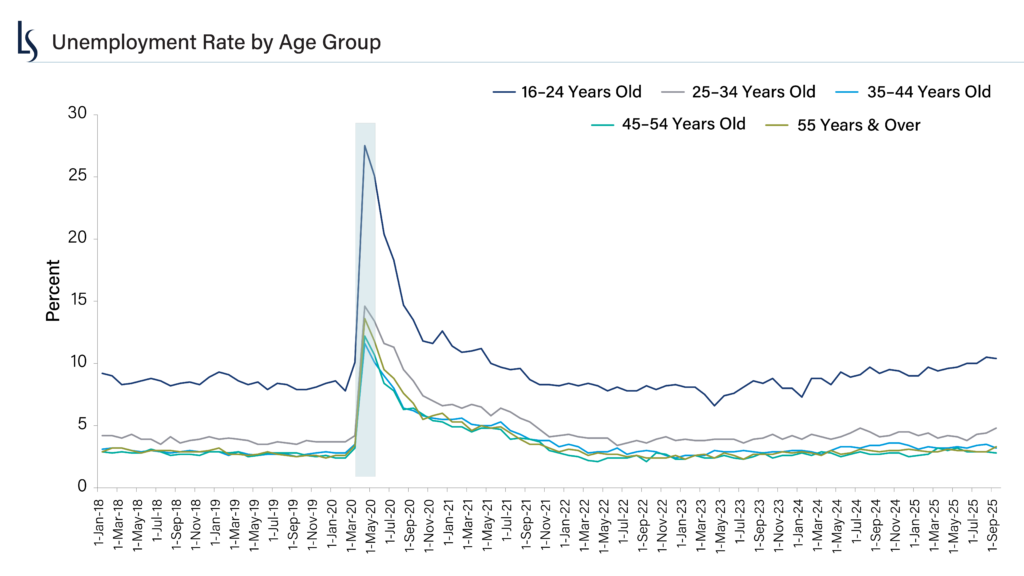
Source: St. Louis Federal Reserve, as of September 1, 2025. Shaded area indicates recession.
The chart presented above is shown for illustrative purposes only. Some or all of the information shown may be dated, and, therefore, should not be the basis to purchase or sell any securities. The information is not intended to represent any actual portfolio managed by Loomis Sayles.
Labor market confidence, as measured by quit rates (the percentage of workers voluntarily leaving jobs), remains below pre-COVID-19 levels. Historically, elevated quit rates signal optimism and wage mobility in the workforce; today’s lower levels suggest moderate confidence heading into 2026. Wage growth has also moderated, particularly among lower-income households and job switchers. While wage growth remains positive overall, the deceleration suggests discretionary spending among lower-income households will likely remain constrained in 2026.
In subprime auto ABS, collateral performance remains mixed. Loans originated in 2022 and 2023 have shown higher charge-off rates than anticipated, indicating underperformance in those vintages. In contrast, loans created more recently have performed more in line with expectations due to tighter underwriting. Overall, the ABS market appears to be moving sideways—showing neither significant deterioration nor meaningful improvement in underlying fundamentals.
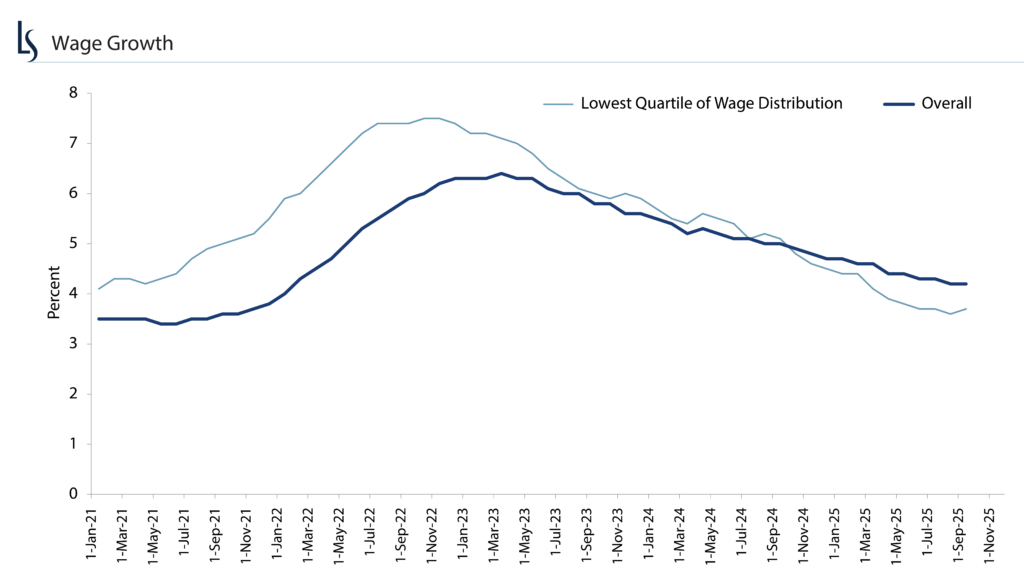
Sources: Current Population Survey, Bureau of Labor Statistics, and Federal Reserve Bank of Atlanta. As of September 1, 2025.
The chart presented above is shown for illustrative purposes only. Some or all of the information shown may be dated, and, therefore, should not be the basis to purchase or sell any securities. The information is not intended to represent any actual portfolio managed by Loomis Sayles.
3. How do you see the collateralized loan obligation (CLO) market evolving in 2026, and what volume can we anticipate?
In our view, the CLO market will maintain its strong momentum in 2026. As 2024 deals exit their contractual non-call periods, we expect primary activity to remain robust. This activity will continue the recycling dynamics that have characterized the maturing market. Paydowns are set to stay elevated, likely approaching $100 billion as deals outside the reinvestment period amortize. Outstanding CLO volume should edge higher, supported by healthy new issuance, especially in broadly syndicated loan (BSL) CLOs, which saw a $72 billion increase thanks to new deals offsetting paydowns. Wall Street forecasts suggest new issuance in the $150 to $190 billion range for 2026, including $35 to $45 billion in middle-market CLOs, mirroring levels seen over the previous two years.
4. What challenges and opportunities should investors watch for in ABS and CLO markets?
We believe investors should keep an eye on consumer income trends and ongoing employment issues, particularly those affecting younger segments of the population. For ABS, the mixed performance in subprime auto loans and less-favorable student loan repayment options signal that credit quality will remain a key concern. In the CLO space, the market’s resilience is encouraging, but elevated paydowns and marginal increases in outstanding volume suggest a competitive environment. We believe opportunities will likely arise from increased loan supply and steady new issuance, but prudent risk assessment will be essential as underlying fundamentals continue to evolve. Staying agile and monitoring sector-specific developments will be crucial for navigating the year ahead.
8695236.1.1
Market conditions are extremely fluid and change frequently.
This blog post is provided for informational purposes only and should not be construed as investment advice. Any opinions or forecasts contained herein reflect the subjective judgments and assumptions of the authors only and do not necessarily reflect the views of Loomis, Sayles & Company, L.P. Information, including that obtained from outside sources, is believed to be correct, but Loomis Sayles cannot guarantee its accuracy. This material cannot be copied, reproduced or redistributed without authorization. This information is subject to change at any time without notice.
Author
