

2026 Outlook for Emerging Market Debt: Q&A
1. Emerging market (EM) corporate debt posted strong performance in 2025 contributing to tighter valuations. What is your outlook for EM debt in 2026?
Valuations are at the tight end of historical ranges, but we believe EM corporate debt continues to offer value versus US corporate bonds. Looking at the JP Morgan CEMBI Broad Diversified Index, investment grade and high yield spreads have tightened less than those of their US and EM sovereign peers. In 2026, we expect support for EM corporate spreads to come from 1) steady fundamentals with resilient growth outlooks and benign macro conditions, 2) absolute attractive carry and 3) heightened interest in diversification from investors.
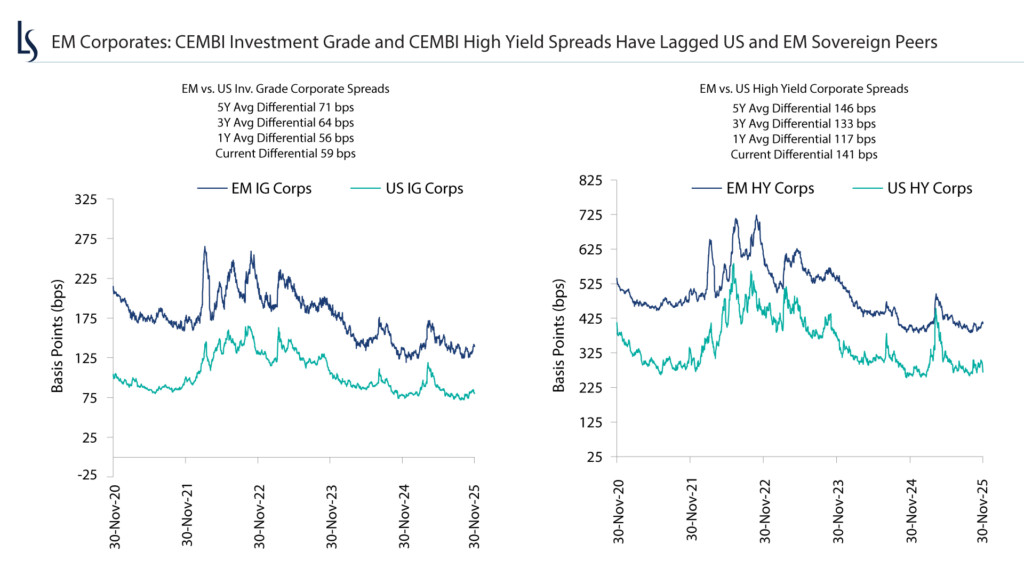
Source: JP Morgan, EM IG corporates = JP Morgan CEMBI Broad Diversified IG Index, EM HY corporates = JP Morgan CEMBI Broad Diversified HY Index, US IG Corps = Bloomberg US Corporate Index, US HY Corps = Bloomberg HY Corporate Index. Data as of 11/30/2025.
The chart presented above is shown for illustrative purposes only. Some or all of the information on this chart may be dated, and, therefore, should not be the basis to purchase or sell any securities. The information is not intended to represent any actual portfolio. Information obtained from outside sources is believed to be correct, but Loomis Sayles cannot guarantee its accuracy. This material cannot be copied, reproduced or redistributed without authorization.
Past market experience is no guarantee of future results.
Technicals could be constructive for the sector in 2026. Through November 2025, gross supply was $466 billion, while ex-China gross supply continued to set records at $398 billion. The 2026 full-year supply forecast stands at approximately $460 billion; a modest uptick from 2025. We expect issuance to hold up this year, pending rates rising meaningfully. Despite the strong supply, net supply contracted by roughly $30 billion in 2025 and 2026 net supply is forecasted to contract by approximately $20 billion, providing technical support to the asset class.1
2. What are the main factors that will likely influence emerging market debt performance in 2026?
From a macro perspective, we believe several drivers will likely shape the outlook for EMD in 2026. First and foremost, global interest rates remain a critical factor. If major central banks, especially the US Federal Reserve, continue to gradually ease rates, this could support capital flows into emerging markets as investors seek higher yields, in our view. Additionally, we think the pace of global economic growth will be important: sustained growth in core key EM economies can boost investor confidence and help to reduce default risks. Lastly, geopolitical developments—such as elections, regional conflicts or shifting trade policies—could create pockets of volatility, so investors should be prepared for potential swings in sentiment.
Using a micro lens on EM debt assets, EM corporate fundamentals have remained on firm footing and should remain steady into 2026, in our view. Net leverage for EM investment grade and EM high yield corporate debt remained flat year on year at 1.0 and 2.7 times respectively.2 With full-year 2025 data not quite finalized, EM corporate rating actions were net positive for the second year in a row, supporting broader uplift in the average credit rating of the overall EM corporate index.
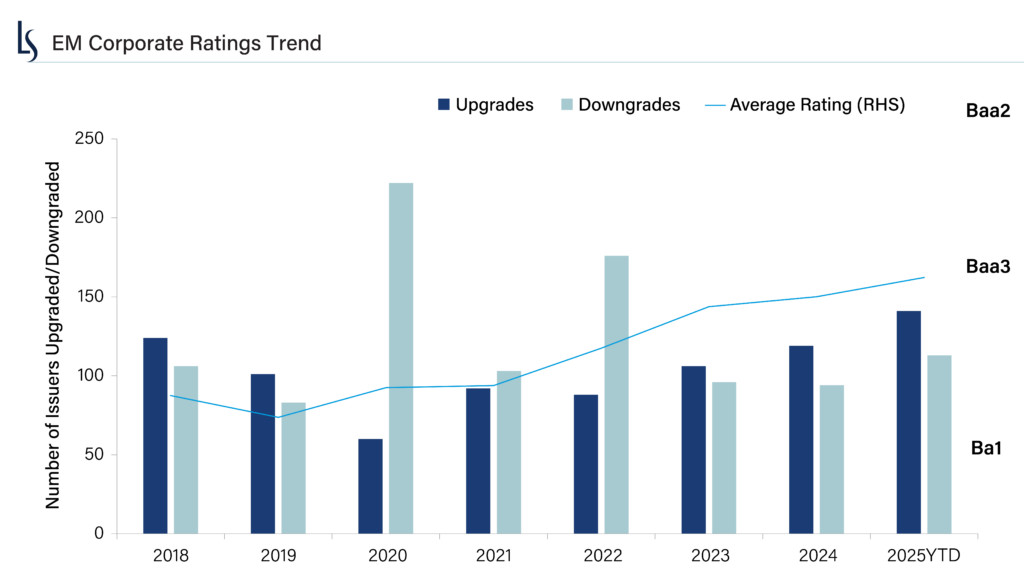
Source: JP Morgan, as of 11/30/2025. JP Morgan CEMBI Broad Diversified Index used as proxy for EM Corporate Hard-Currency Asset Class.
The chart presented above is shown for illustrative purposes only. Some or all of the information on this chart may be dated, and, therefore, should not be the basis to purchase or sell any securities. The information is not intended to represent any actual portfolio. Information obtained from outside sources is believed to be correct, but Loomis Sayles cannot guarantee its accuracy. This material cannot be copied, reproduced or redistributed without authorization.
Past market experience is no guarantee of future results.
As of the end of November 2025, the EM high yield corporate default rate stands at 2.9%, a far more normalized figure than experienced from 2021 to 2023 (exacerbated by the Russia-Ukraine war and China property woes). JP Morgan forecasts the 2026 EM high yield corporate default rate to be approximately 3.0%, in line with the projected 2026 forecast of about 2.75% for US high yield.
In terms of EM sovereigns, 2025 saw a wave of ratings upgrades on the back of reduced external vulnerabilities. Declining global interest rates, lower energy costs, resilient exports and effective policymaking drove improved sovereign fundamentals. The successful completion of sovereign debt restructurings also boosted sentiment. In 2025, the EM sovereign default rate was 0%, and we are anticipating 2026 will also be a benign year for sovereign defaults.
3. EM local markets had an outstanding 2025 with full-year returns in excess of 19%.3 Can the favorable conditions that underpinned these gains persist?
We believe favorable conditions will continue into 2026. JP Morgan expects returns in excess of 8% in the asset class. High nominal and real local interest rates in select markets provide carry and support to local currencies. Positive EM growth differentials and falling US interest rates also provide favorable conditions for sustained EM foreign exchange currency performance.
1 Issuance data: JP Morgan, November 28, 2025.
2 EM leverage numbers based on third-quarter 2025 earnings.
3 As of December 31, 2025.
8694553.1.1
Market conditions are extremely fluid and change frequently.
Diversification does not ensure a profit or guarantee against a loss.
Indices are unmanaged and do not incur fees. It is not possible to invest directly in an index.
This blog post is provided for informational purposes only and should not be construed as investment advice. Any opinions or forecasts contained herein reflect the subjective judgments and assumptions of the authors only and do not necessarily reflect the views of Loomis, Sayles & Company, L.P. Information, including that obtained from outside sources, is believed to be correct, but Loomis Sayles cannot guarantee its accuracy. This material cannot be copied, reproduced or redistributed without authorization. This information is subject to change at any time without notice.
Authors
