

January 2026 Investment Outlook

We believe the stage is set for robust earnings growth across developed and emerging markets. In 2026, healthy economic growth and moderating inflation should bolster most markets.
The expansion phase of the credit cycle is likely to persist. Corporate fundamentals have been solid and 2026 profit margins should remain near multi-year highs in most regions. Earnings growth is likely to accelerate in Europe but still lag MSCI Emerging Markets Index and S&P 500 Index growth rates.
Globally, risk premiums look slim across both credit and equity market valuations. But that does not imply potential for a market drawdown. In our view, it seems more likely that fixed income and equity assets can post modest total returns while the economic and earnings backdrop remains supportive.
Investment Themes
Our take on macro drivers and major asset classes at a glance.

Macroeconomic Drivers
Fiscal and monetary policy are far from restrictive, which supports investors’ risk appetite.

Corporate Credit
Strong bottom-up fundamentals should limit credit spread widening.

Government Debt & Policy
Projections for a record-breaking year of tax refunds should provide many US consumers with a financial boost in 2026.

Currencies
We expect foreign currencies to appreciate, but we do not anticipate 2025-level gains.

Global Equities
We see a global bull market led by impressive earnings rather than multiple expansion.

Potential Risks
We expect the US economy to remain resilient and grow at its
long-run-trend. But there are risks.
Macroeconomic Drivers
Fiscal and monetary policy are far from restrictive, which supports investors’ risk appetite.
- Central bank easing cycles are nearing an end. With the probability of recession not elevated, most economies should experience growth rates near their long-run trends.
- We expect the Fed to deliver at least one more rate cut in the first half of 2026. The composition of the Fed’s board is likely to become more dovish by midyear, when the Senate will likely confirm a new chair.
- The Bank of England is also likely to reduce rates at least once in 2026, while the European Central Bank remains on hold. The Bank of Japan looks poised to hike, but not until later in the year.
- Some indications of labor market weakness are evident within the United States, but not enough to derail the expansion, in our view.
- Increased economic activity fueled by artificial intelligence (AI) investment is set to boost global GDP growth throughout 2026.
- Productivity gains from AI implementation could lead to layoffs, but we do not see that as not a near-term risk.
Globally, corporations have done well maintaining or growing profit margins.
The global growth, inflation and interest rate backdrop should continue to support margins.
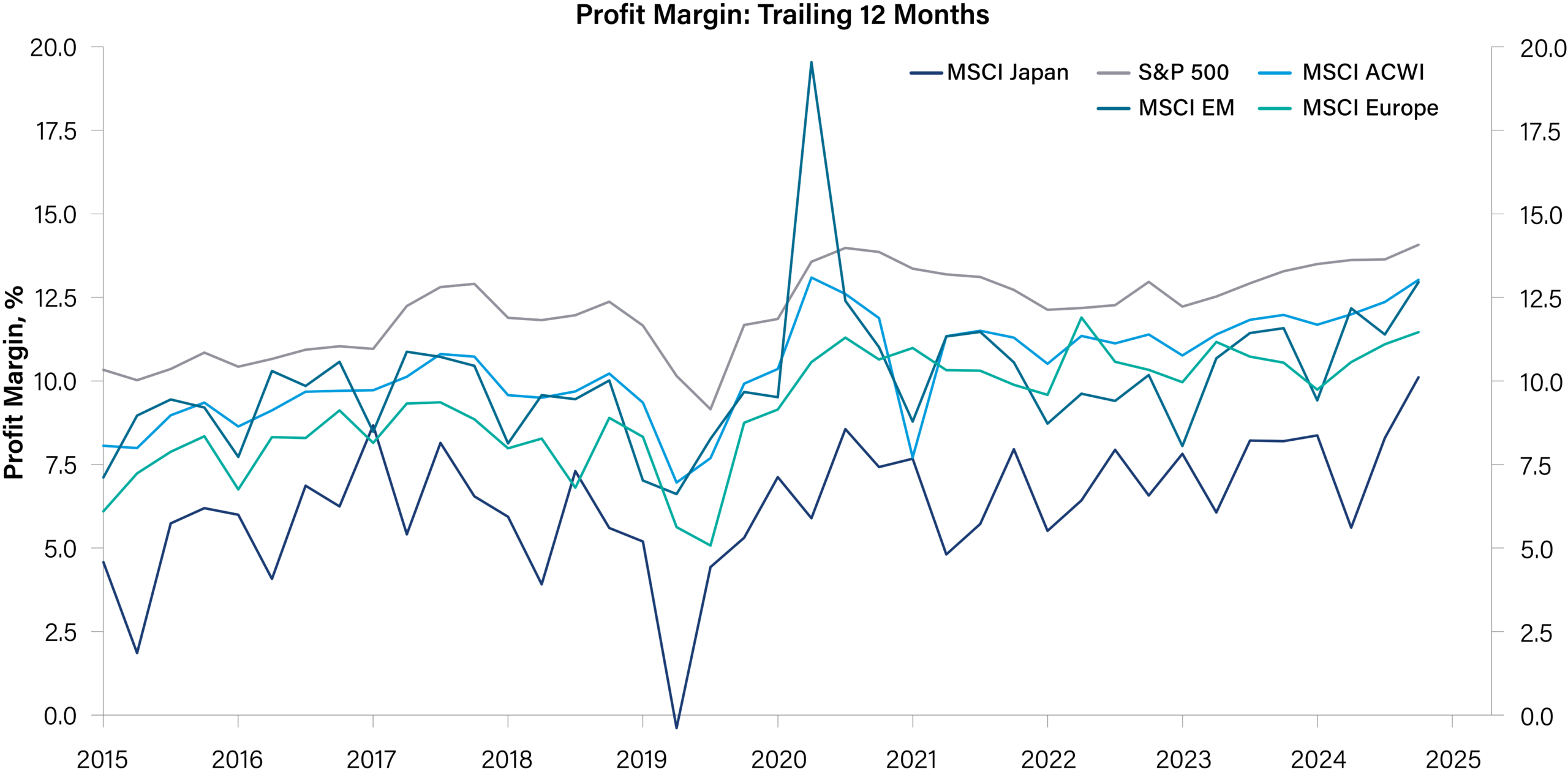
Source: MSCI, Bloomberg, as of 12 December 2025.
The chart presented above is shown for illustrative purposes only. Used with permission from Bloomberg. Some or all of the information on this chart may be dated, and, therefore, should not be the basis to purchase or sell any securities. The information is not intended to represent any actual portfolio. Information obtained from outside sources is believed to be correct, but Loomis Sayles cannot guarantee its accuracy. This material cannot be copied, reproduced or redistributed without authorization.
Past performance is no guarantee of future results.
Corporate Credit
Strong bottom-up fundamentals should limit credit spread widening.
- Based on bottom-up fundamental analysis, our Credit Research Team suggests 85% of Bloomberg US Aggregate Index industries are in the expansion phase of the credit cycle.
- Economically sensitive industries like banks, retailers and consumer products are within the expansion phase—a positive, forward-looking, cyclical indicator.
- During the past quarter, our Credit Research Team’s forward-looking view on profit margins and free cash flow improved. However, the outlooks for leverage and financial policy grew a bit more concerning.
- In the investment grade sector, we foresee technology—and AI-related companies contributing to nearly a 20% increase in issuance relative to 2025, which investor demand should be strong enough to digest.
- Downgrade and default risk is present but limited in our view. Our expected US high yield default rate, an output of Loomis Sayles’ risk premium framework, is 3.4%.
- We believe corporate credit will provide higher total returns than that of government bonds. However, our excess return expectations are modest for investment grade but stronger for high yield.
Investors can harvest attractive yields in corporate credit and total returns should be decent.
In our view, higher-yielding sectors are poised to deliver the best returns.
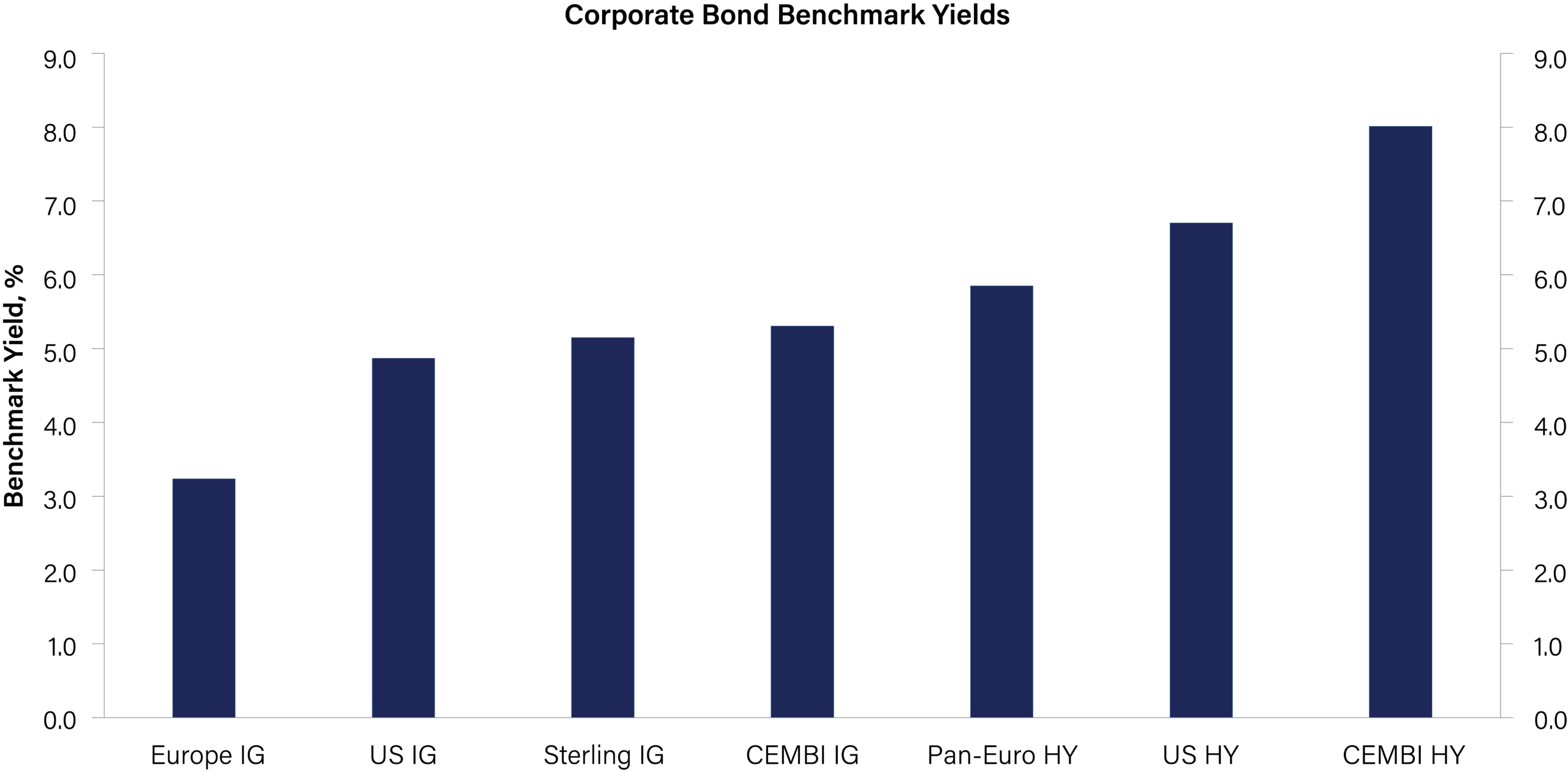
Source: Bloomberg, as of 15 December 2025.
The chart presented above is shown for illustrative purposes only. Some or all of the information on this chart may be dated, and, therefore, should not be the basis to purchase or sell any securities. The information is not intended to represent any actual portfolio. Information obtained from outside sources is believed to be correct, but Loomis Sayles cannot guarantee its accuracy. This material cannot be copied, reproduced or redistributed without authorization.
Government Debt & Policy
Projections for a record-breaking year of tax refunds should provide many US consumers with a financial boost in 2026.
- Government debt burdens are large but manageable. Risks related to domestic fiscal policy are well-known to markets and should not drive long-term interest rates higher in the short run.
- Central banks are nearing the end of their cutting cycles. But, global yield curves will likely retain steepness or steepen further given the expected economic expansion through 2026.
- Government borrowing costs across Europe could rise modestly now that Germany is loosening its fiscal purse strings—at least relative to history.
- The rise of long-term rates in Japan has been impressive, but we think it is nearing its end.
- We foresee the US 10-year Treasury yield being range-bound unless domestic growth accelerates meaningfully. In that case, a move toward 4.75% could develop—an upside risk.
- Relative to developed markets, emerging market (EM) local-currency bonds have more attractive yields, in our view. We believe Brazil, Mexico and South Africa have a significant yield advantage over US Treasurys.
Strong growth could challenge duration outperformance.
A strategic shift toward more investment could lead to increased euro zone government bond issuance and potentially higher yields.
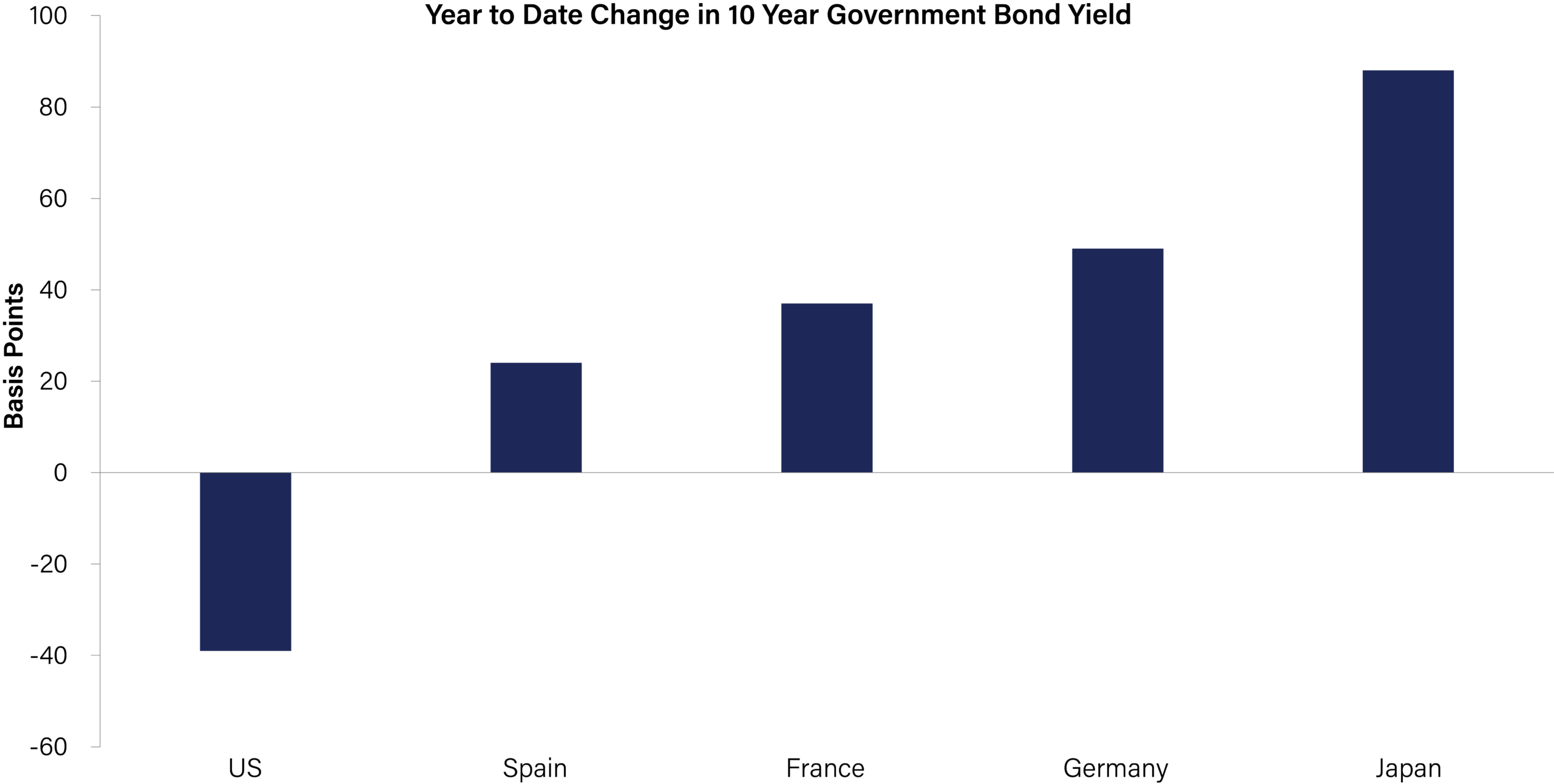
Source: Bloomberg, as of 15 December 2025.
The chart presented above is shown for illustrative purposes only. Used with permission from Bloomberg. Some or all of the information on this chart may be dated, and, therefore, should not be the basis to purchase or sell any securities. The information is not intended to represent any actual portfolio. Information obtained from outside sources is believed to be correct, but Loomis Sayles cannot guarantee its accuracy. This material cannot be copied, reproduced or redistributed without authorization.
Past performance is no guarantee of future results.
Currencies
We expect foreign currencies to appreciate, but we do not anticipate 2025-level gains.
- We believe diversifying portfolios and holding non-US-dollar exposure is a worthwhile strategy in the global risk-on regime that we expect.
- A flight-to-safety bid is unlikely to buoy the US dollar, in our view. Investors can seek higher yields and potential for currency appreciation outside the US.
- The US administration’s willingness to negotiate trade deals with its largest trading partners is a welcome development that reduces foreign currency downside risk.
- In Europe—particularly in Germany—the shift toward a more expansionary fiscal policy should raise long-term-trend growth rates for those economies. The euro likely has upside relative to the US dollar over the long run.
- A stable, if not improving, global growth backdrop is likely to attract US-dollar-based investors. This trend could last for several quarters or longer in developed and emerging markets.
- We recommend non-US-dollar local-currency fixed income—preferably in Latin America.
Local-currency fixed income markets overseas can deliver strong returns as the US dollar weakens.
We expect the US dollar to drift lower as the Fed cuts rates again in 2026.
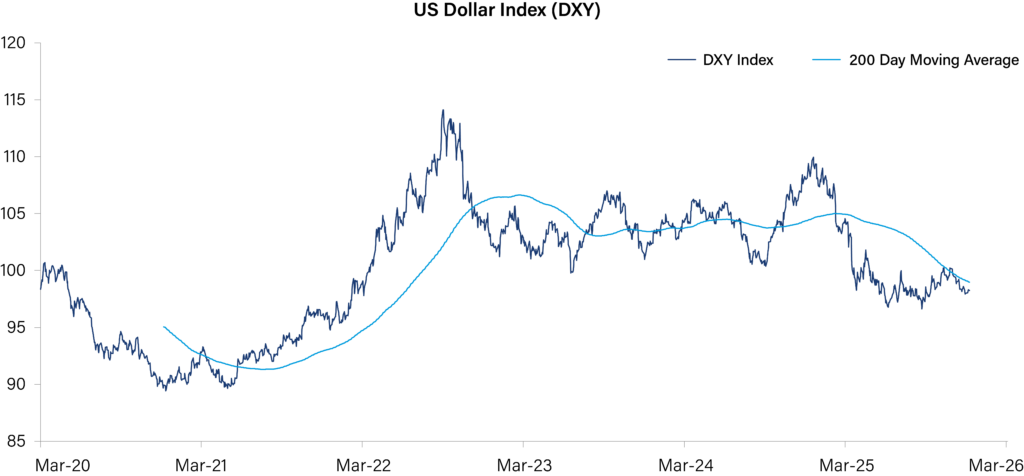
Source: LSEG Datastream, data as of 2 January 2026.
The chart presented above is shown for illustrative purposes only. Some or all of the information on this chart may be dated, and, therefore, should not be the basis to purchase or sell any securities. The information is not intended to represent any actual portfolio. Information obtained from outside sources is believed to be correct, but Loomis Sayles cannot guarantee its accuracy. This material cannot be copied, reproduced or redistributed without authorization.
Indices are unmanaged. It is not possible to invest directly in an index.
Past performance is no guarantee of future results.
Global Equities
We see a global bull market led by impressive earnings rather than multiple expansion.
- We believe AI-related capital expenditures should help propel equity markets and domestic investment for years, with highly profitable companies continuing to be the biggest spenders.
- Earnings growth is finally broadening beyond technology companies. We see potential for most S&P companies to deliver double-digit growth rates in 2026.
- Domestic small-cap earnings could also turn higher. Russell 2000 consensus estimates for 2026 imply a strong rebound of 20% growth.
- In our view, global equity earnings are poised to move higher. Consensus expectations suggest MSCI Emerging Markets Index earnings growth could top 16%, MSCI Europe Index 9% and MSCI Japan Index 7%.
- Asia ex-Japan earnings growth expectations have been increasing. South Korea and Taiwan are driving improvement given exposure to semiconductor manufacturing and AI investment.
- We are optimistic about global equity markets. We could see robust performance even if booming earnings estimates prove a little too optimistic.
The earnings story is not a US phenomenon. Fundamentals are also driving global indices to all-time highs,
in our view.
2026 will likely be a year where earnings growth, rather than multiple expansion, drives performance.
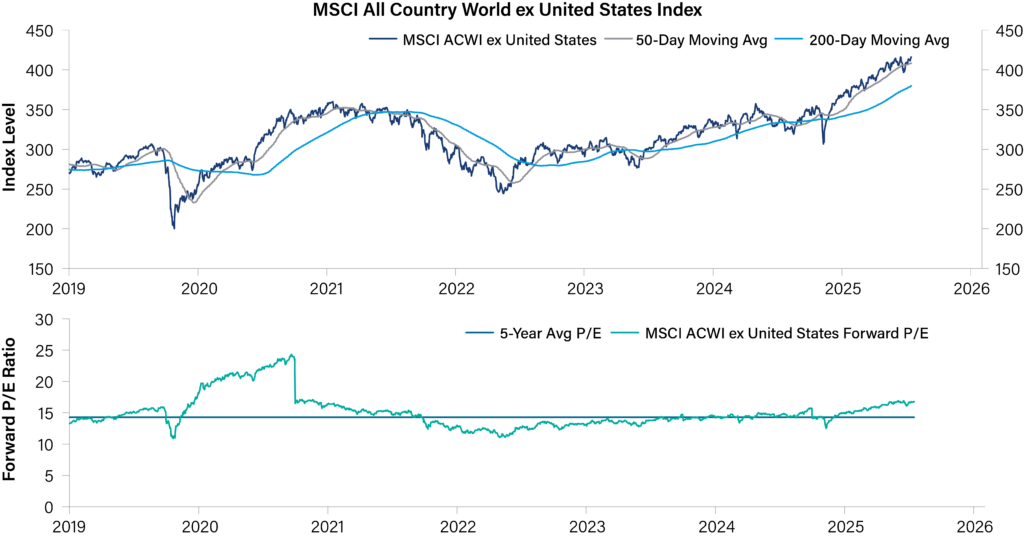
Source: Bloomberg, MSCI, as of 15 December 2025.
Neither MSCI nor any other party involved in or related to compiling, computing or creating the MSCI data makes any express or implied warranties or representations with respect to such data (or the results to be obtained by the use thereof ), and all such parties hereby expressly disclaim all warranties of originality, accuracy, completeness, merchantability or fitness for a particular purpose with respect to any of such data. Without limiting any of the foregoing, in no event shall MSCI, any of its affiliates or any third party involved in or related to compiling, computing or creating the data have any liability for any direct, indirect, special, punitive, consequential or any other damages (including lost profits) even if notified of the possibility of such damages. No further distribution or dissemination of the MSCI data is permitted without MSCI’s express written consent.
The chart presented above is shown for illustrative purposes only. Used with permission from Bloomberg. Some or all of the information on this chart may be dated, and, therefore, should not be the basis to purchase or sell any securities. The information is not intended to represent any actual portfolio. Information obtained from outside sources is believed to be correct, but Loomis Sayles cannot guarantee its accuracy. This material cannot be copied, reproduced or redistributed without authorization.
Indices are unmanaged. It is not possible to invest directly in an index.
Past performance is no guarantee of future results.
Potential Risks
We expect the US economy to remain resilient and grow at its long-run-trend. But there are risks.
- The Loomis Sayles Macro Strategies Team is currently projecting a 15% probability of a US recession. Severe job losses would drive that probability higher and risk asset valuations much lower.
- Negative nonfarm payroll numbers would undermine our bullish narrative.
- A better-than-expected macro backdrop could introduce risk. Inflation, which is still a bit above the Fed’s target, could start to move higher driven by robust demand and easy financial conditions. That would cause the Fed to hold steady or even hike rates, in our view.
- If expectations declined for AI productivity gains, there could be a market correction.
- If our base case unfolds, valuations could stay rich for a while. That is why we believe it is important to remain invested for the long term.
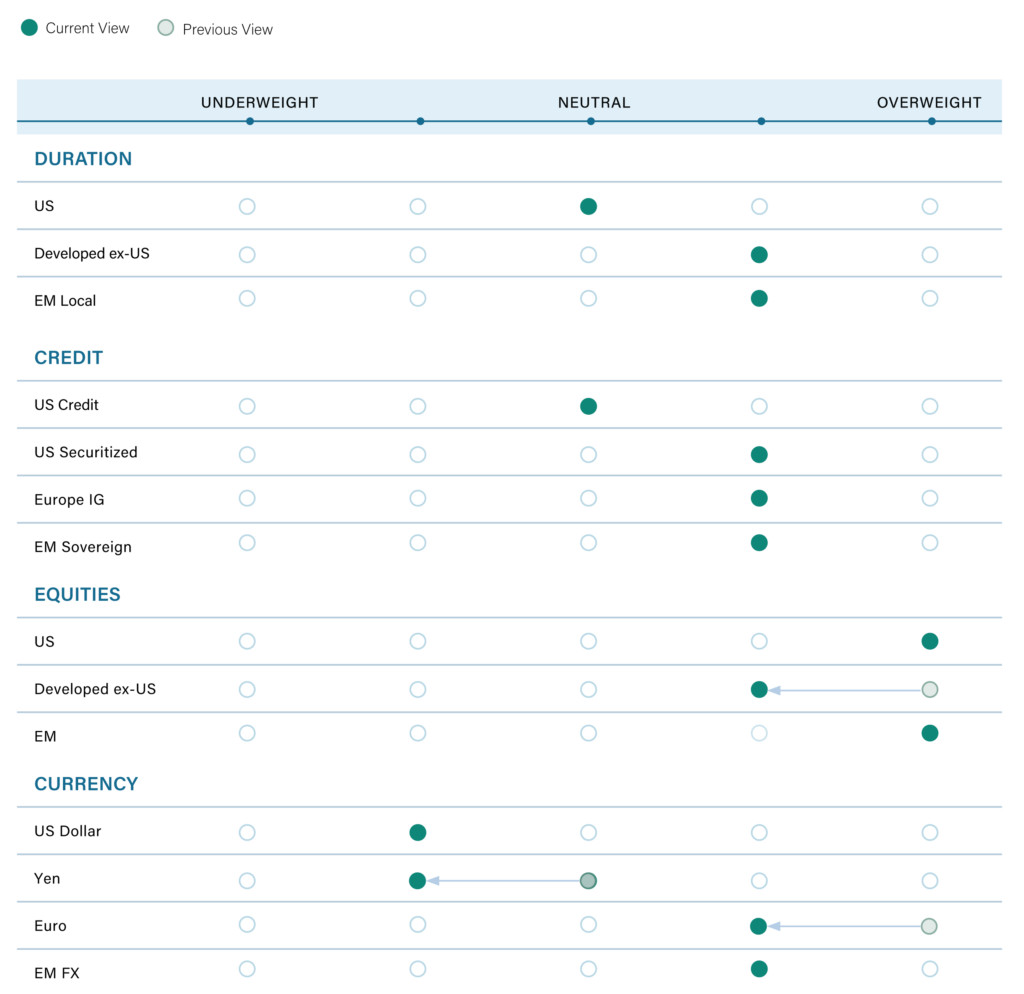
Asset Class Outlook
We believe the macro backdrop is creating opportunities across fixed income and equity markets.
Disclosure
This marketing communication is provided for informational purposes only and should not be construed as investment advice. Any opinions or forecasts contained herein reflect the subjective judgments and assumptions of the authors only and do not necessarily reflect the views of Loomis, Sayles & Company, L.P. Investment recommendations may be inconsistent with these opinions. There is no assurance that developments will transpire as forecasted and actual results will be different. Data and analysis do not represent the actual or expected future performance of any investment product. Information, including that obtained from outside sources, is believed to be correct, but Loomis Sayles cannot guarantee its accuracy. This information is subject to change at any time without notice. Intended for institutional investors and investment professional use only.
Neither MSCI nor any other party involved in or related to compiling, computing or creating the MSCI data makes any express or implied warranties or representations with respect to such data (or the results to be obtained by the use thereof ), and all such parties hereby expressly disclaim all warranties of originality, accuracy, completeness, merchantability or fitness for a particular purpose with respect to any of such data. Without limiting any of the foregoing, in no event shall MSCI, any of its affiliates or any third party involved in or related to compiling, computing or creating the data have any liability for any direct, indirect, special, punitive, consequential or any other damages (including lost profits) even if notified of the possibility of such damages. No further distribution or dissemination of the MSCI data is permitted without MSCI’s express written consent.
Diversification does not ensure a profit or guarantee against a loss.
Market conditions are extremely fluid and change frequently.
Commodity, interest and derivative trading involves substantial risk of loss.
Indices are unmanaged and do not incur fees. It is not possible to invest directly in an index.
Any investment that has the possibility for profits also has the possibility of losses, including the loss of principal.
Past performance is no guarantee of future results.
LS Loomis | Sayles is a trademark of Loomis, Sayles & Company, L.P. registered in the US Patent and Trademark Office.
8704154.1.1
Author
