
An LDI Playbook for 2025

As we head into 2025, corporate pensions continue to sit in a comfortable position relative to history.
Alongside strong equity market performance during 2024, discount rates also rose considerably—particularly in the month of December—a well-timed boost for plans that measure funded status on a calendar year basis.
Key Takeaways
- Corporate pensions enter 2025 well positioned overall, and improved funded status has opened new strategic options for many plans.
- Plans may consider tactical Treasury allocations and shoring up any remaining duration risk given long corporate credit and Treasury valuations.
- The PRT trend continues; effective liability- and custom-hedging strategies are key variables for plans offloading risk.
- Private credit options continue to proliferate; investment grade private credit may offer an attractive duration profile and source of diversification, yield and cash flow for plans to consider.
- Expanding into assets outside of long corporates when valuations become attractive can potentially support returns and help plans keep pace with liability.
Year-End High Watermark
As of the end of December 2024, average funding ratios reached 105.0%1—a year-end high water mark compared to the previous 17 years.2 Many plans now have strategic options that they may not have had access to in the past. In the following, we discuss how plan sponsors might consider assessing these options as they seek to harness hard-won gains to help meet plan sponsor objectives.
Assess the Interest Rate & Spread Backdrop
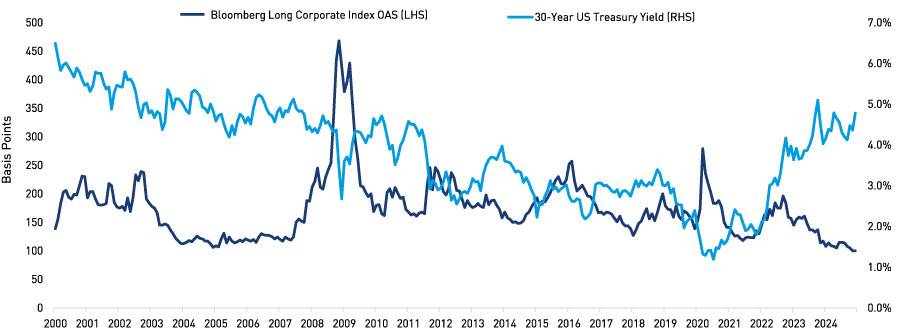
Following modest spread widening in early August 2024, long corporate spreads (as represented by the Bloomberg Long Corporate Index) narrowed significantly through the end of the year. Spreads broke the 100-basis-point floor on 6 November, entering their first double-digit level since July 1998—a period of more than 25 years. Despite a generally positive macroeconomic backdrop, further spread narrowing from current levels seems unlikely to drive outsized returns.
Conversely, while the 30-year Treasury yield was largely range-bound between 4% and 5% over the course of 2024, it has been trending toward the top of that range as we begin 2025. We do not pretend to have a high degree of confidence in the future direction of long Treasury yields, but current levels suggest something more akin to fair value—especially as compared to current spread levels. Figure 1 below shows a 25-year history of both long corporate spreads and the 30-year US Treasury yields.
Given these valuations, we suggest plans consider adding or boosting Treasury allocations and shoring up any remaining Treasury risk in the plan. This may be combined with a tactical tilt away from long corporate exposure or equities. For plans that still need growth to dig out of an underfunded status or to cover future accruals, this can be implemented through an overlay or completion structure that allows for modest leverage in seeking to achieve capital-efficient duration. For plans further along in their journey, leaning into Treasury allocations to fine-tune key rate hedging and reduce curve risk can help maintain funded status regardless of how the yield curve shifts in the future.
FIGURE 1 –
A 25-YEAR HISTORY OF LONG CORPORATE
SPREADS AND 30-YEAR US TREASURY YIELDS
Source: Bloomberg. As of 31 December 2024.
Indices are unmanaged and do not incur fees. It is not possible to invest directly in an index.
Past market performance is no guarantee of future results.
Prepare for Pension Risk Transfer (PRT) Strategy
The PRT market remains robust with nearly $40 billion of volume and a record number of contracts signed through the first three quarters of 2024.3 We have also experienced an uptick in plans seeking to execute a partial PRT or plan termination within the next two to three years. There are many factors that can impact the likelihood of achieving these objectives, but we believe one of the most critical is having an asset management partner with expertise in liabilities and custom hedging solutions.
PRTs are often pitched at the board or committee level as a reliable way to reduce risk and save dollars. The practical reality lies in how staff, advisors and asset managers manage and execute these transactions. Particularly for full-plan terminations, ensuring accurate liability hedging during the critical period between the initiation of the termination decision and the final execution is paramount to success in our view. We believe this requires a deep understanding of actuarial liability nuances, lump-sum take rate assumptions and optimal portfolio construction in relation to managing risk versus the liabilities. Asset managers need to coordinate closely with consultants and actuaries to thoroughly understand the various facets of a plan. While some uncertainty will always exist, a board or committee typically wants to avoid unforeseen costs or adverse outcomes due to mismanaged or misunderstood hedging needs.
Consider Investment Grade Private Credit
With an influx of private credit strategies, many plan sponsors have likely kicked the tires on whether these investment options may make sense for their plan. While there are many different flavors in this ever-expanding asset class, we believe plan sponsors could benefit from exposure to investment grade private credit – especially as compared to more traditional lower-quality direct lending strategies.
We believe there are many reasons to consider this as part of a pension allocation:
1. DIVERSIFICATION
Many corporate plans already have significant LDI allocations consisting of large public issuers and could benefit from diversifying their exposures and accessing a wider range of deal structures, covenants and collateral sources.
2. YIELD
As plans mature and seek out end-game strategies, it is critical to keep pace with liability growth. Investment grade private credit can offer a potential yield advantage over public credit at what we believe to be a reasonable cost of reduced liquidity. Figure 2 shows that the excess spread above comparable publics has averaged approximately 50 basis points since 2010 and approximately 80-100 basis points over the past five years based on available data through July 2024.
3. CASHFLOWS
As opposed to other private asset classes (e.g., private equity), investment grade private credit can generally provide reliable cashflows that plans can be used to help pay monthly benefit payments.
4. DURATION
While the interest rate duration of investment grade private credit may not have a directly observable link to a plan’s liability duration, the underlying exposure generally consists of fixed-rate bonds, which should ultimately reprice with market rates similarly to public fixed income. Many plans have also seen liability duration shortening as plans mature, which in our view makes an investment grade private credit allocation appropriate.
Ultimately, we believe investment grade private credit can be a natural fit for corporate pensions since it essentially mimics existing public bond allocations with the additions described above.
While plans need to consider the liquidity parameters in the context of their ultimate objectives, we believe many plans overestimate their liquidity needs and could potentially realize a net benefit from increased diversification, higher yields and cash flow generation.
FIGURE 2 –
ESTIMATED PRIVATE FIXED INCOME SPREADS
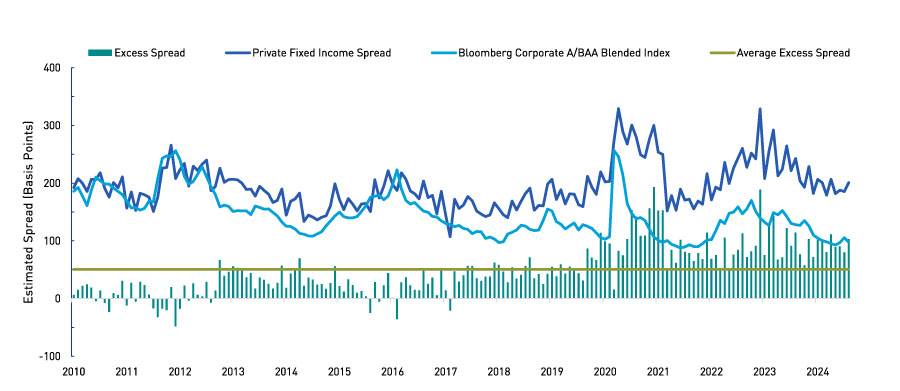
*The Bloomberg Corporate Index (A/BAA Blend) is a 40%/60% blend of the Bloomberg Corporate A-Rated Index and Bloomberg Corporate BAA-Rated Index. This blend largely reflects the weighting of private placement issuance
Source: Private Placement Monitor. As of 31 December 2024.
The chart presented above is shown for illustrative purposes only. Some or all of the information on this chart may be dated, and, therefore, should not be the basis to purchase or sell any securities. The information is not intended to represent any actual portfolio managed by Loomis Sayles. Indices are unmanaged and do not incur fees. It is not possible to invest directly in an index.
Views and opinions expressed reflect the current opinions of the Private Credit Group only, and views are subject to change at any time without notice.
Other industry analysts and investment personnel may have different views and opinions.
Past performance is no guarantee of future results.
Seek Diversified Credit Exposure
As noted previously, long corporate spreads are very tight relative to recent history. Many plans will continue to hold significant allocations to this sector because it provides the most reliable credit hedge versus plan liabilities. However, we believe it makes sense to incorporate strategies where the manager has flexibility to invest across other sectors such as high yield, bank loans, securitized credit and emerging market debt. Valuations remain tight across many fixed income sectors, but in our view, giving managers the latitude to pull additional levers when valuations become attractive can potentially support returns and help keep better pace with liability growth.
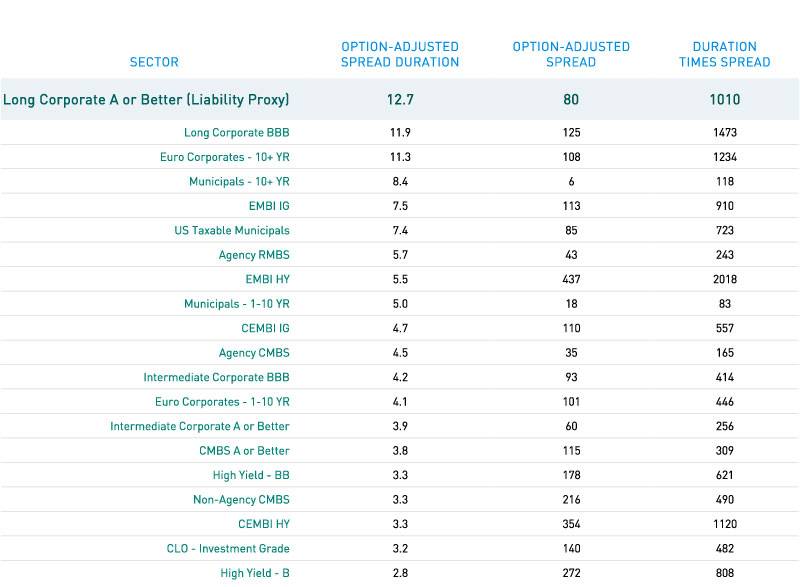
Figure 3 shows several asset classes that could be considered as part of a comprehensive liability hedging strategy. By using the Bloomberg Long Corporate A or Better Index as a proxy for the liability, we can assess the amount of credit risk that other sectors may provide using a duration times spread (DTS) metric. As compared to the liability proxy DTS of 1010 (shown in figure 3), we see several other sectors that may help provide a credit hedge versus the liability, including euro corporates, emerging markets debt, taxable municipals and high yield. While most of these sectors will bring down interest rate duration, they can be paired with an increase to the Treasury allocation (e.g., through Treasury STRIPS or an overlay) to help manage overall interest rate risk appropriately.
FIGURE 3 –
SECTOR OAS (OPTION-ADJUSTED SPREAD)
Source: Bloomberg and ICE BofA. As of 31 December 2024.
The corresponding index for each sector shown can be found at the end of this paper.
Indices are unmanaged and do not incur fees. It is not possible to invest directly in an index.
Past market performance is no guarantee of future results.
Conclusion
Currently, due to a favorable market environment, many plan sponsors now have optionality that may not have existed in prior years. In our view, the key to the next phase is to try to avoid losing those hard-fought gains and ensure that the plan is thoughtfully guided toward its distinctive objectives. We suggest plans take a multifaceted approach by making tactical tilts toward Treasury exposure, opportunistically offloading liabilities via PRTs and considering alternatives to traditional long corporate via investment grade private credit or other public fixed income sectors.
Endnotes
1 Milliman, Pension Funding Index January 2025 (7 January 2025) https://www.milliman.com/en/insight/pension-funding-index-january-2025
2 Milliman, 2024 Corporate Pension Funding Study (24 April 2024) https://www.milliman.com/en/insight/2024-corporate-pension-funding-study
3 LIMRA (10 December 2024) https://www.limra.com/en/newsroom/news-releases/2024/limra-u.s.-single-premium-pension-risk-transfer-sales-soar-36-to-$14.2-billion-in-the-third-quarter-2024/
Figure 3 Index List
Sector- Index
Long Corporate A or Better- ICE BofAML US Corporate Master
Long Corporate BBB- ICE BofAML US Corporate Master
Euro Corporates- 10+ YR- ICE BofA Euro Corporate
Municipals- 10+ YR- ICE BofAML Municipal Master
EMBI IG- JP Morgan EMBI Global Diversified Composite
US Taxable Municipals- ICE BofA Broad US Taxable Muni
Agency RMBS- ICE BofAML Mortgage Master Index
EMBI HY- JP Morgan EMBI Global Diversified Composite
Municipals- 1-10 YR- ICE BofAML Municipal Master
CEMBI IG- JP Morgan CEMBI Diversified Broad
Agency CMBS- ICE BofAML CMBS Fixed Rate
Intermediate Corporate BBB- ICE BofAML US Corporate Master
Euro Corporates- 1-10 YR- ICE BofA Euro Corporate
Intermediate Corporate A or Better- ICE BofAML US Corporate Master
CMBS A or Better- ICE BofAML CMBS Fixed Rate
High Yield-BB- ICE BofAML High Yield Master II
Non Agency CMBS- ICE BofAML CMBS Fixed Rate
CEMBI HY- JP Morgan CEMBI Diversified Broad
CLO- Investment Grade- JP Morgan CLOIE Index
High Yield-B- ICE BofAML High Yield Master II
Disclosure
Indices are unmanaged and do not incur fees. It is not possible to invest directly in an index.
Past market performance is no guarantee of future results.
Market conditions are extremely fluid and change frequently.
Diversification does not ensure a profit or guarantee against a loss.
Any investment that has the possibility for profits also has the possibility of losses, including the loss of principal.
This marketing communication is provided for informational purposes only and should not be construed as investment advice. Investment decisions should consider the individual circumstances of the particular investor. Any opinions or forecasts contained herein, reflect the subjective judgments and assumptions of the authors only, and do not necessarily reflect the views of Loomis, Sayles & Company, L.P. Investment recommendations may be inconsistent with these opinions. There is no assurance that developments will transpire as forecasted and actual results will be different. Information, including that obtained from outside sources, is believed to be correct, but we cannot guarantee its accuracy. This information is subject to change at any time without notice. This material was prepared for an institutional audience, is it not intended for a retail investor.
LS Loomis | Sayles is a trademark of Loomis, Sayles & Company, L.P. registered in the US Patent and Trademark Office.
8750269.1.1
Author