

The Anatomy of a Treasury Auction
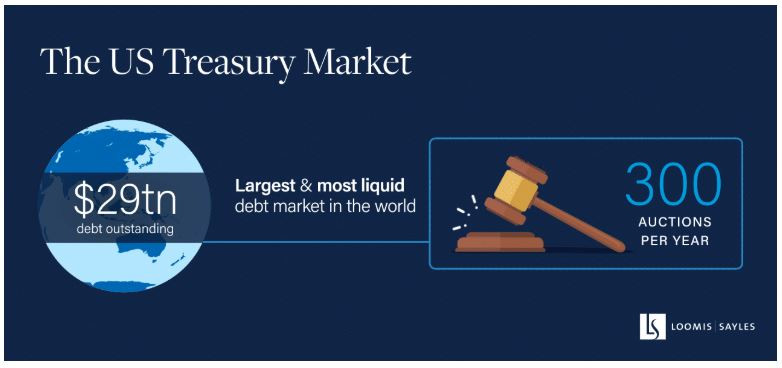
At roughly $29 trillion, the US Treasury market[1] is the largest, most liquid debt market in the world. Those qualities help make it a tame corner of the bond market most of the time. However, at times recently, it’s been anything but. Policy announcements, unwinding of leveraged positions and uncertainty have spurred bouts of volatility in 2025. Treasury auctions have also been under a microscope, with investors scrutinizing yields and demand—especially from foreign investors. Auctions are likely to remain under scrutiny in the coming years, particularly given the expected increase in Treasury issuance stemming from the One Big Beautiful Bill Act.
Demand for Treasurys is critical: the Treasury relies on approximately 300 auctions per year across bills, notes, floating-rate notes, bonds and Treasury Inflation-Protected Securities to fund the federal deficit. As Treasury actions increasingly attract attention and headlines, we think it’s helpful to understand how a typical Treasury auction works. In this post, we’ll break down the mechanics of Treasury auctions and the metrics that help investors assess an auction’s “success.”
How a Treasury auction works
The Treasury auctions securities through what is known as a Dutch auction process. The bidders fall into three distinct categories:
- Direct bidders: Primarily institutional investors. These bidders access the auction through the TAAPS—Treasury Automated Auction Processing System.
- Indirect bidders: All investor types. These bidders access the auction through an intermediary (or primary dealer) or through a TreasuryDirect account with the Treasury.
- Primary dealers: These bidders, designated by the Federal Reserve Bank of New York, are mandated to participate in all Treasury auctions at competitive prices. Primary dealers bid on a pro-rata basis (i.e., bid for a proportionate share of the total amount of securities being offered).
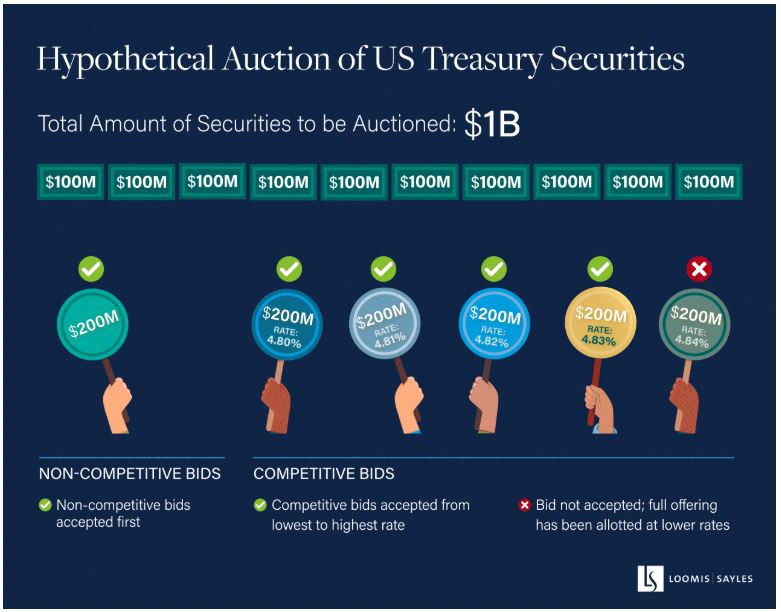
In a Dutch auction, the Treasury first accepts all the non-competitive bids (meaning bidders don’t specify an interest rate). Next, it accepts competitive bids (bidders specify a rate with their bid) moving from the lowest rate to the highest rate until the entire amount offered has been awarded. All auctions are open to the public, and all successful bidders receive the same rate—the highest accepted bid.
When the auction is complete, the securities allotted to direct and indirect bidders is known as the “End-User-Take,” since these market participants tend to buy and hold the Treasury securities they receive. The balance of the auction is awarded to the primary dealers, who are typically large financial institutions that will “make markets” by selling Treasury securities on the secondary market. Market makers provide liquidity and depth to markets and can profit from the difference in the bid-ask spread.
Assessing Success
Shortly after securities are auctioned, market participants can use several metrics to assess the auction’s success and health.
1. Through Price or Tail: The difference between where the “when-issued” (or the yet-to-be-auctioned security) is trading just prior to the auction versus the clearing level (or final interest rate) of the auction. If the auction clears at a lower rate than the when-issued security, the auction is considered to have “come through.” Generally, this indicates attractive pricing and potentially healthy demand. The opposite is true of a tail.
2. End-User Take: The percentage of an auction that end-users are awarded is one of the more scrutinized metrics as it exemplifies investor demand for securities. Typically, the end-user take ranges between 60% to 90%; anything below that could indicate a lack of demand.
3. Bid-to-Cover ratio: Measures the amount of bids received versus the amount of securities sold. A higher number is better since it indicates broad demand for a particular security. Since primary dealers are required to bid pro-rata for the entirety of an auction, participants look for a ratio greater than 2 to help gauge the success of an auction.
In our view, all of these metrics should be used in tandem and compared to prior auction statistics in order to gauge the relative success of any one auction. We think Treasury market scrutiny is likely to continue, and knowing the basics of the auction process can help investors independently assess Treasury market demand.
System Open Market Account (SOMA) Add-Ons
Maturing or rolled-down US Treasury debt in excess of the quantitative tightening cap established by the Federal Reserve must be reinvested at auctions. This excess debt is known as the SOMA add-on amount, and is determined by the size of the Treasury auction. This debt is not marketable, which means only the New York Federal Reserve places non-competitive bids to reinvest and hold these securities.
Endnote
[1] Source: treasurydirect.gov
8230388.2.1
Market conditions are extremely fluid and change frequently.
This blog post is provided for informational purposes only and should not be construed as investment advice. Any opinions or forecasts contained herein reflect the subjective judgments and assumptions of the authors only and do not necessarily reflect the views of Loomis, Sayles & Company, L.P. Information, including that obtained from outside sources, is believed to be correct, but Loomis Sayles cannot guarantee its accuracy. This material cannot be copied, reproduced or redistributed without authorization. This information is subject to change at any time without notice.
Authors
