
Three Questions on Political Risk in Emerging Markets
The line between economics and politics in emerging markets (EM) is becoming increasingly thin, particularly in countries with weaker institutional structures and stagnating growth. With several EM countries facing elections in the next 12 months, Eric Spencer, Senior Research Analyst on our Global Emerging Market Equities team, weighs in on potential risks and opportunities.
1. Which elections are you watching most closely, and what implications could they have for EM investors?
We track political risk to help us assess the potential impact on foreign exchange, local-currency asset prices and the risk of broader social destabilization in each country. Overall, we expect election outcomes to skew in the direction of more growth-oriented policies and economic orthodoxy, which we would view as more favorable for emerging market investors.
We think Argentina may be on course for regime change. Opposition candidates have been performing well in the polls, which could lead to a reversal of unconventional fiscal and monetary policies that have produced devastating inflation. While the challenges are immense in our view, an opposition win in Argentina would mark a break from the so-called “Pink Tide’’ of leftist victories in Latin America. We are optimistic on the prospects for real economic change in Argentina, where EM equity investors have been largely absent for the past decade. That said, the situation is, as usual for Argentina, very fluid and we are cautiously watching the recent rise of the right-wing populist candidate, Javier Milei, who has troublingly advocated for elimination of the central bank and broader adoption of bitcoin.
In Turkey, the prospects of real economic change are not quite so bright, in our view. President Tayyip Erdogan prevailed in the second round of the election in May, which means his preferred monetary policy—keeping central bank rates far below the level of inflation—is likely to continue as well.
In India and Indonesia, we believe elections are likely to maintain the status quo, which we would view as a good thing. We expect India’s Prime Minister Narendra Modi and the candidate endorsed by Indonesia’s President Joko Widodo (popularly known as President Jokowi) to be the front-runners in each country. In our view, these candidates are likely to continue established economic development programs with an emphasis on growing investments in infrastructure, expanding employment and sound fiscal policy. In India, we welcome the government’s efforts to make the country an attractive manufacturing alternative to China using production-linked incentives. And in Indonesia, we would expect Jokowi’s successor to continue his investment and employment efforts. Any shift towards more nationalist rhetoric and less economic development would be concerning to us.
2. Aside from election risk, are there other political risks you’re watching?
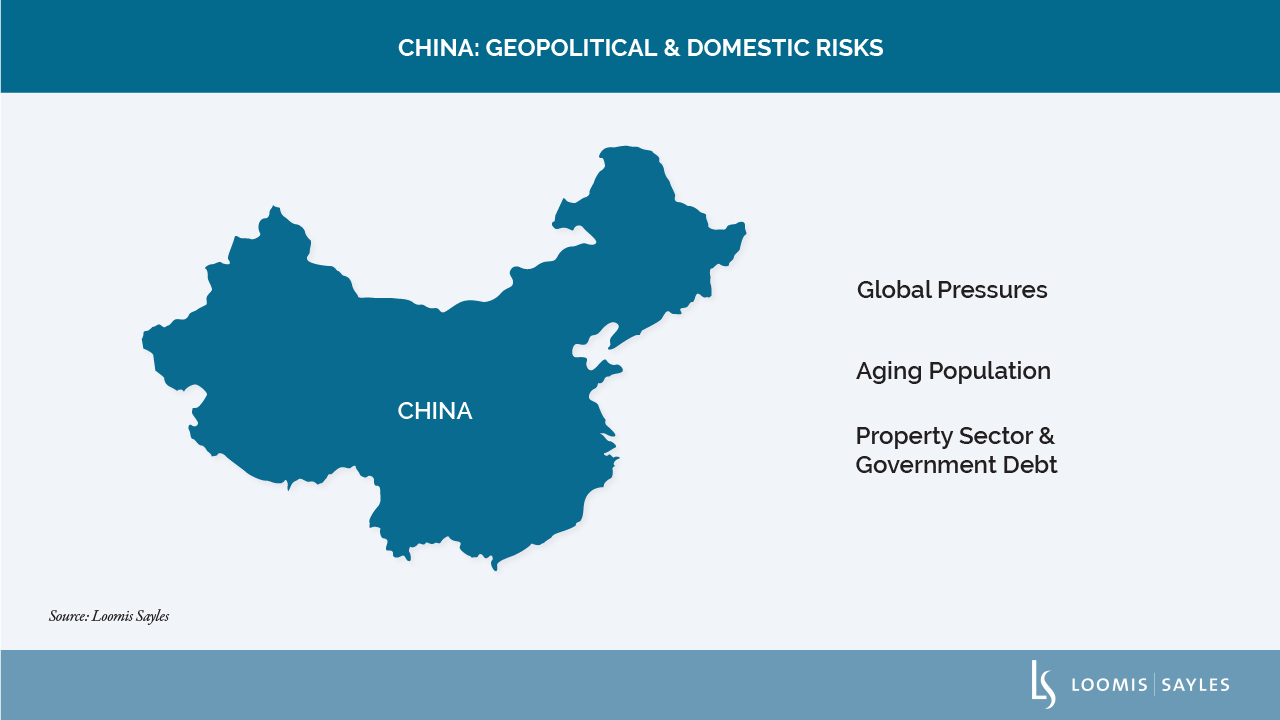
Absolutely. China is the largest market in the developing world, and it is dealing with a number of issues with domestic and global implications. On the global side, we are focused on the ongoing trade war with the United States and Europe, which could affect China’s long-term ability to develop leading-edge technology. We are also watching China’s militarization, the threat it poses to Taiwan and its relationship with rogue actors including Russia, Iran and North Korea. China’s domestic concerns include a rapidly aging population and excessive property sector and local government debt. We believe the latter is a major overhang on long-term growth and solvency. In our view, the challenges facing the Chinese economy are immense and taken together have serious implications for international capital flows as well as the domestic allocation of capital. After decades of breakneck growth, the country finds itself in a situation where it faces an increased risk of Japanese-style economic stagnation.
There’s also the issue of Russia, which remains a critical challenge for global policymakers and investors alike. In our view, an end to the Russia-Ukraine war needs to be negotiated as soon as possible, and in the meantime we will closely track the status of the conflict and risk of escalation. We are also cautious about the potential for further sanctions. In our view, you cannot ignore the breadth of US and European Union sanctions. As long as the war continues, we would expect further unconventional measures, with potentially negative impact on emerging market economies.
3. How are you thinking about positioning through this election cycle?
We expect some volatility through the election cycle, particularly in Turkey and Argentina, and tend to avoid participating in the “election trades” we often see in the market. We prefer to focus on generating returns over a long-term horizon and will look to position constructively in countries we believe are moving toward policies that will support stronger economic growth.

MALR031146